
You invested in a "world-class" sales training platform. The launch call went great. Your reps nodded along during onboarding. Then, three months later, you checked the usage stats — and 85% of your team had never logged back in.
Sound familiar? You're not alone. As one sales leader put it: "We spent $$$ rolling out one of the big names and it ended up being 15% of the people actually logging in." Another described their all-in-one platform as "just another tab my reps ignored."
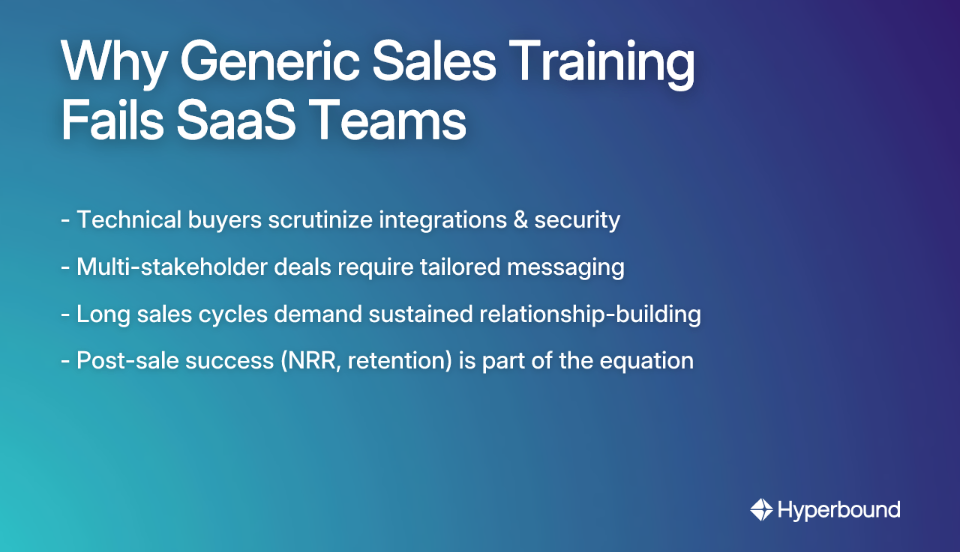
The hard truth is that most software sales training programs aren't built for SaaS teams. Generic training fails because SaaS selling is genuinely different:
What reps actually need is training that feels like practicing with a tough prospect — not 90-minute videos dumping frameworks they'll forget by lunch. The programs below cover the full spectrum: foundational methodologies, structured courses for individual reps, and modern AI-driven platforms that turn real call data into repeatable winning behavior.
If you've ever watched a new hire fumble through their third discovery call of the week making the same mistakes, you know what the real problem with software sales training is: reps don't get enough at-bats before they're live with real prospects.
Hyperbound Practice fixes this. It's the only platform that builds AI buyer personas from analysis of your team's actual call data — not generic scripts written by trainers who've never sold your product. The AI roleplays are trained on 2M+ hours of real B2B sales conversations, which means when a rep practices a cold call or a multi-stakeholder demo, they're up against something that behaves like a real buyer — including unexpected objections, topic changes, and the kind of skepticism your actual ICP throws at you.
What makes it different for SaaS teams:
Proof it works:
New hires at companies using Hyperbound can contribute by day 3 instead of sitting through weeks of scattered, forgettable training sessions. That's the difference between training and activation.
Best for: SaaS sales teams of any size that want to cut ramp time, standardize winning behaviors, and run realistic practice at scale.
The Challenger methodology flipped conventional wisdom on its head when it emerged from CEB research: the most effective B2B sellers aren't relationship builders — they're teachers who constructively challenge their customers' assumptions.
The framework — Teach, Tailor, Take Control — trains reps to lead conversations with unique commercial insights, tailor messaging to the specific concerns of each stakeholder, and assertively guide the deal rather than waiting for the buyer to make moves.
For SaaS teams selling in competitive markets where differentiation on features alone is impossible, Challenger gives reps the language and structure to shift conversations from price and product comparisons to business impact.
Best for: Mid-market and enterprise SaaS teams operating in competitive categories where reps need to differentiate through insight and take control of complex buying processes.
Richardson's Consultative Selling program is one of the most widely adopted frameworks for complex B2B sales — and for good reason. It trains reps to act as trusted advisors by asking insightful questions, deeply understanding the customer's business challenges, and co-creating solutions rather than pushing products.
Key training areas include insight-led discovery, virtual selling skills, and deal progression strategies — all of which are directly applicable to long-cycle SaaS deals where trust and business acumen matter more than product knowledge alone.
Best for: Teams selling high-value, complex SaaS solutions where understanding the customer's ecosystem and building genuine advisory relationships are prerequisites to winning.
For individuals looking to break into tech sales — or for managers hiring SDRs with no SaaS background — CourseCareers provides a structured, self-paced curriculum covering the fundamentals of software sales. Topics include the SaaS sales process, prospecting, customer engagement strategies, and product positioning basics.
It's affordable, accessible, and purpose-built for people stepping into their first SDR or BDR role. It won't replace ongoing coaching or practice-based training, but it gives new reps the vocabulary and mental model they need before entering a real sales environment.
Best for: Aspiring SDRs/BDRs, career switchers, or early-stage companies hiring reps without prior SaaS sales experience.
JB Sales is known for one thing: practical, no-fluff training that translates directly into results. Founded by John Barrows, who has trained sales teams at Salesforce, LinkedIn, and Box, the curriculum focuses on high-impact skills like prospecting, objection handling, and filling the funnel — with zero patience for vague theory.
If your team is struggling to generate pipeline or consistently getting stuck at the same objections, JB Sales delivers targeted, tactical training reps can apply the next day. It's the antidote to the "just prospect more" and "ask open-ended questions" generic advice that experienced reps rightfully dismiss.
Best for: SaaS teams that need to sharpen specific, tactical skills — particularly prospecting discipline and objection handling — without wading through high-level frameworks.
Winning by Design takes a scientific, data-driven approach to scaling revenue across the entire customer lifecycle. Their training is built around a common language for GTM teams — covering SDR, AE, CSM, and leadership tracks — which means everyone from your first cold call to your renewal conversation is operating from the same playbook.
Their approach focuses on diagnosing customer impact, aligning the sales process to the buyer's journey, and building a repeatable motion that scales. For SaaS companies that struggle with the handoff between new business and customer success, Winning by Design is one of the few programs that treats the full revenue lifecycle as a unified system.
Best for: Fast-growing SaaS companies that need to build a repeatable, cross-functional GTM motion — especially teams where SDRs, AEs, and CSMs need to operate from a shared framework.
The Sandler System is one of the most recognized names in professional sales training — and, as more than a few practitioners will note, one of the most expensive. ("Sandler expensive as hell, I got quoted £6k for 2 days.") But for teams willing to invest, it delivers a genuine shift in sales philosophy.
Sandler's core principle is equal business stature between the buyer and rep. Training focuses on upfront contracts, identifying real pain, and getting buyers to convince themselves — rather than reps over-pitching solutions to problems the buyer hasn't fully owned. It's particularly effective at reducing "unpaid consulting" and the chronic SaaS problem of deals that stay warm forever but never close.
The program is best approached as a longer-term coaching investment rather than a one-time workshop. Many practitioners recommend having their company cover the cost rather than paying individually.
Best for: Sales teams ready to fundamentally rethink their sales philosophy and commit to long-term coaching — particularly reps who tend to over-pitch or get stuck in endless discovery loops.
Other AI-driven practice platforms, such as Second Nature and PitchMonster, also let reps simulate sales conversations on demand. These tools often use conversational AI for role-play scenarios like cold calls and objection handling, with some adding features like speech coaching or leaderboards to drive engagement.
While these platforms are solid entry points for teams exploring AI-driven practice, a key distinction is how scenarios are created. Most rely on user-scripted scenarios, which means the quality of practice depends heavily on how well a manager builds out the simulations. In contrast, Hyperbound's approach — building buyer personas directly from your team's actual winning call data — removes that dependency and makes the practice environment as close to the real thing as possible.
Best for: Teams looking to introduce AI-driven practice without a heavy implementation lift, particularly for foundational skills like cold call openers and objection handling.
.png)
Before you sign anything, run every program on your shortlist through these five questions. The answers will tell you whether you're investing in real behavior change — or just buying another tab your reps will ignore.
☐ Methodology alignment: Does this fit how we actually sell? Don't get sold a generic framework dressed up in SaaS language. Ask whether the program aligns with your specific GTM motion, deal stages, and the actual language your buyers use. As one practitioner noted: "It's your business requirements that aren't suited to that program" — meaning the failure is often a fit problem, not a content problem.
☐ Real-world fidelity: Is the practice environment realistic or just scripted? Reps disengage from training that feels fake. Ask specifically: are AI buyer personas built from real call data, or are they scripted by trainers? A realistic practice environment is one where reps say it "feels like practicing with a tough prospect" — not reading from a flowchart. The gap between scripted and data-driven practice is significant.
☐ Adoption and workflow integration: Will my team actually use this after week two? This is the highest-stakes question. A platform nobody uses has zero ROI. Look for:
☐ Speed to ramp: How fast does this make new hires productive? Push for specific, verifiable metrics. Vague answers like "our customers see great results" aren't good enough. The right answer sounds like: "Vanta reduced ramp time by 60%, from 210 to 72 days." If a vendor can't point to customer proof on ramp time, that's a signal.
☐ Measurable behavior change: Can I prove it's working? Training that can't be measured can't be improved. Ask whether the platform provides analytics that connect training activity to real-world performance — not just completion rates, but changes in talk ratios, objection handling scores, and conversion metrics on live calls. The best platforms surface coaching opportunities automatically, rather than requiring managers to manually dig through call recordings.
The best software sales training programs don't just deliver content — they change how reps show up in real conversations. Traditional methodologies like Challenger and Consultative Selling give teams an essential foundation. Structured courses like CourseCareers and JB Sales sharpen specific skills. But knowing what to do and being able to do it under pressure are two different things.
That gap — between knowing and doing — is where modern SaaS teams lose deals. AI-driven practice platforms, and Hyperbound Practice in particular, close it by having reps practice the exact conversations they'll have with their actual buyers, built from the behaviors that make your top performers win.
The result isn't just better training — it's faster ramp, more consistent deal execution, and revenue outcomes you can measure. That's the difference between a training program and a revenue activation platform.
The best sales training program for a SaaS team is one that is tailored to the unique challenges of selling software, such as technical buyers, long sales cycles, and multi-stakeholder deals. While foundational methodologies like The Challenger Sale are valuable, modern teams see the most significant impact from AI-driven practice platforms like Hyperbound, which allow reps to practice realistic sales scenarios based on the company's actual customers and winning conversations.
SaaS sales training is different because the selling environment is fundamentally unique. Unlike transactional sales, SaaS deals often involve technical buyers who scrutinize integrations and security, complex multi-stakeholder buying committees, long sales cycles that require sustained relationship-building, and a focus on post-sale success metrics like Net Revenue Retention (NRR). Generic training programs often fail to address these specific complexities.
AI sales training platforms use artificial intelligence to create realistic, interactive practice environments for sales reps. For example, a rep can engage in a simulated cold call or demo with an AI buyer persona that responds dynamically, raises objections, and asks tough questions. The most advanced platforms, like Hyperbound, build these AI personas from analysis of a company's real call data, ensuring the practice is highly relevant to the reps' actual selling situations. After each session, the AI provides instant, objective feedback on performance.
When evaluating a software sales training platform, look for five key features: 1) alignment with your specific sales methodology, 2) realistic, data-driven practice environments (not just scripted scenarios), 3) features that drive high adoption, like bitesized content and workflow integrations, 4) proven ability to reduce new hire ramp time, and 5) analytics that provide measurable proof of behavior change and performance improvement.
To ensure your sales team uses a training platform, choose a solution designed for high adoption. This means the training should be delivered in short, accessible formats (e.g., 5-10 minute roleplays) rather than long videos. It must also integrate seamlessly into their daily workflow, plugging into tools like their calendar, CRM, and Slack. When training feels like a natural part of their day instead of a separate chore, adoption rates skyrocket.
The effectiveness of a sales training program should be measured by tangible business outcomes, not just completion rates. Look for metrics like a reduction in new hire ramp time, an increase in demo booking rates, and improvements in conversion rates at key deal stages. The best platforms provide analytics that connect training activities directly to on-the-job performance, allowing you to prove ROI and identify specific areas for coaching.










Use Cases
Legal