
You're at a social gathering. The room buzzes with conversation, but your mind races with thoughts: "What should I say next? Am I being awkward? Why can't I think of anything interesting?" Your heart pounds, palms sweat, and suddenly your mind goes completely blank mid-sentence. You've effectively killed the conversation—again.
If this scenario feels painfully familiar, you're not alone. For those with an anxiety disorder, social interactions can feel like navigating a minefield blindfolded. And the typical advice? "Just be confident!" or "Just relax!"—as if telling someone with depression to "just cheer up" would magically fix everything.
Social anxiety is not a character flaw or simple shyness—it's a real mental health challenge that affects millions. But here's the good news: there are practical, evidence-based strategies that can help you navigate conversations with more ease and less internal panic.
This article won't offer simplistic solutions. Instead, we'll explore three pillars for managing social anxiety in conversations: proactive preparation techniques, in-the-moment conversation tools, and the foundation of self-compassion that makes it all possible.
Social Anxiety Disorder (SAD) goes beyond ordinary nervousness. According to the Mayo Clinic, it involves intense fear, self-consciousness, and embarrassment in everyday social interactions due to the fear of being judged negatively.
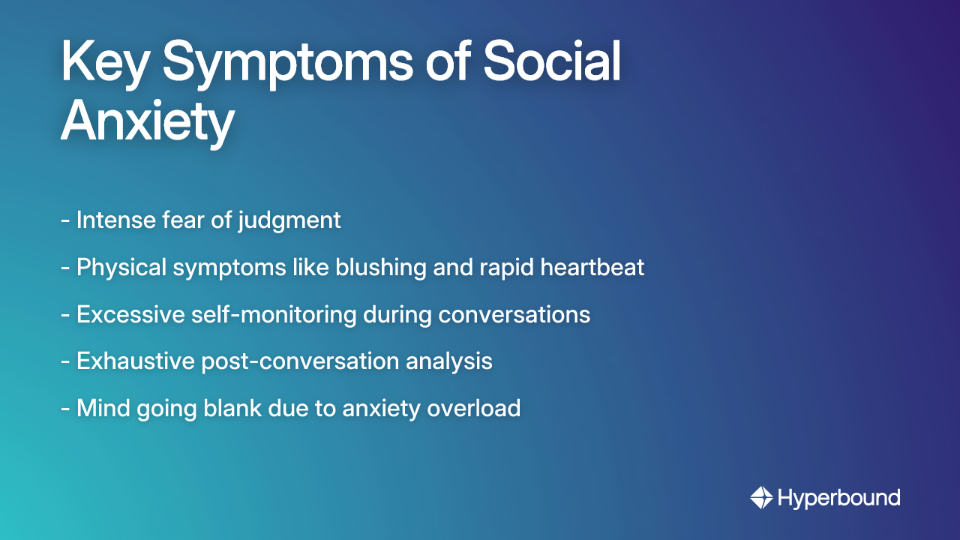
The symptoms can be overwhelming:
These symptoms create a vicious cycle: you worry about an upcoming interaction for days (anticipatory anxiety), then monitor yourself intensely during the conversation ("Am I making enough eye contact? Too much?"), and finally dissect your "performance" afterward, focusing on every perceived mistake.
This explains why your mind goes blank or you "forget what you're about to say" mid-conversation. Your brain is so occupied managing anxiety that there's little bandwidth left for actually engaging in the conversation itself.
Preparation isn't "cheating" at social skills—it's a smart strategy that reduces the pressure to perform and builds confidence. Here are evidence-based techniques to try:
Research shows that gradual exposure to anxiety-provoking situations can significantly reduce symptoms over time. Start with brief, simple interactions where the stakes feel low:
These small interactions are perfect practice grounds because they're brief and somewhat predictable. According to a study on Social Effectiveness Therapy, this kind of structured practice is powerful—research found that 67% of participants using similar techniques no longer met the criteria for Social Anxiety Disorder after treatment, compared to only 10% in the control group.
In professional settings, particularly in high-stakes roles like sales, this practice is crucial. Modern tools can create these low-stakes environments digitally. For example, platforms like Hyperbound's AI Sales Roleplays offer a safe space to practice challenging conversations, from cold calls to handling objections, allowing you to build confidence without risking a live deal.
Having ready-to-use phrases reduces the burden of spontaneity in conversation and gives your anxious mind something concrete to grasp:
This approach is not about being inauthentic—it's about giving yourself the scaffolding needed to build confidence, as suggested by experts in TIME.
Exposure therapy is one of the most effective treatments for anxiety disorders. You can apply its principles yourself:
For example, if your goal is to speak up in meetings, start by asking one prepared question in a small team meeting, then work up to contributing unprepared thoughts, and eventually presenting to larger groups.
.png)
When you're in the midst of a conversation and anxiety strikes, these evidence-based techniques can help you stay present and engaged:
Many people with social anxiety report difficulty formulating follow up questions during conversations. The solution? Become genuinely curious about the other person.
When you shift your focus to being genuinely interested in the other person, two things happen: your self-consciousness decreases, and you naturally think of questions to ask. This investment in others isn't just good social strategy—it's the foundation of meaningful connection.
Try these question formats:
This simple yet powerful technique from conversation experts is perfect when your mind goes blank:
When someone mentions something, especially with emotion, repeat the key word or phrase as a question. This shows you're listening and invites them to elaborate.
Example:
This small prompt encourages them to continue, giving you time to process and formulate a more substantive response. As TIME notes, this technique demonstrates active listening while relieving the pressure to immediately respond with something profound.
When anxiety spikes during conversation, use physical grounding to anchor yourself:
These grounding techniques help manage the physical symptoms of anxiety by redirecting your focus externally, making it easier to stay present and engage in the conversation.
Many people with anxiety feel they must fill every silence, leading to rambling or mind blanks. Remember that pauses are natural in conversation—they give both parties time to think.
Instead of viewing silence as failure, see it as a thoughtful moment. Take a breath. Gather your thoughts. Then continue or consciously choose to interject with a new question or observation.
While this isn't right for every situation, sometimes briefly acknowledging your anxiety can relieve the pressure of trying to hide it:
"I get a bit nervous in group settings, but I'm really enjoying this conversation."
This kind of honest self-expression can make you more relatable—many people will respond with empathy, perhaps sharing their own experiences with anxiety. As research in Psychology Today suggests, authentic vulnerability often increases likability rather than diminishing it.

The most powerful tool for managing social anxiety isn't a conversation technique—it's how you relate to them yourself. Self-compassion is treating yourself with the same kindness and understanding you would offer a good friend facing difficulties.
According to research reviewed by PsychCentral, self-compassion is strongly correlated with lower anxiety levels and greater emotional resilience—exactly what's needed to navigate social situations with an anxious mind.
Self-compassion has three core components according to researcher Dr. Kristin Neff:
Try these evidence-based practices to build self-compassion:
By practicing self-compassion, you release yourself from the crushing weight of perfectionism and self-criticism that often accompanies social anxiety. This doesn't just feel better—it actually improves your social performance by freeing up mental resources previously consumed by emotional burdens and self-judgment.
Managing social anxiety is not about eliminating all nervousness or becoming the life of the party. It's about developing skills that allow you to connect meaningfully with others despite the presence of anxiety.
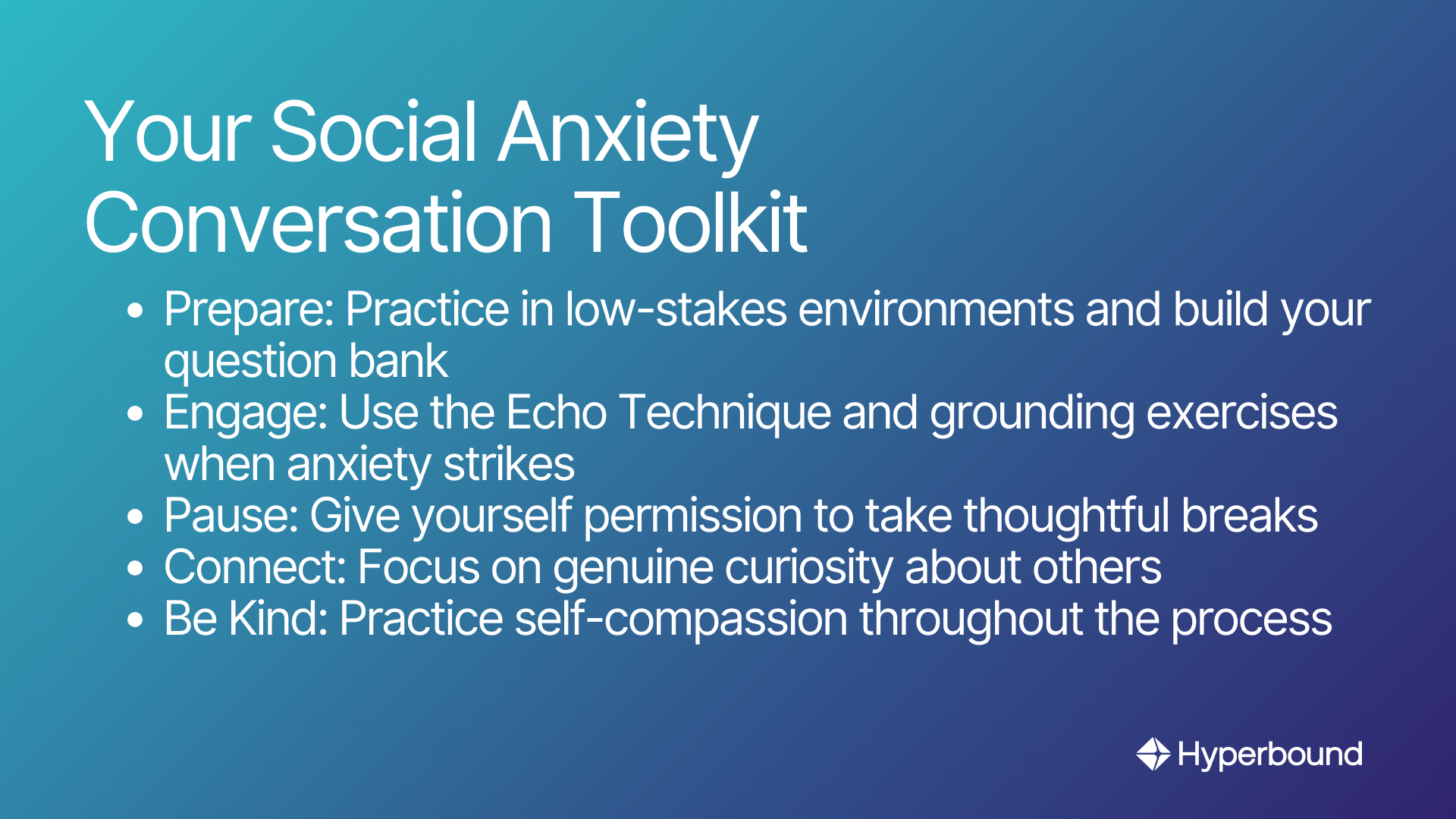
Remember these key strategies:
Social anxiety is a real mental illness that demands compassion, not criticism. Each conversation you attempt, regardless of how it feels in the moment, is a step toward growth. Celebrate your courage in facing social situations rather than judging your performance.
With consistent practice and self-kindness, you'll gradually find that conversations become less about survival and more about genuine human connection—which is, after all, what we're all seeking.
Remember: You don't need to overcome anxiety completely to have meaningful conversations. You just need to make room for both anxiety and connection to exist together, giving priority to what matters most: your authentic desire to connect with others.
Your mind goes blank during conversations because the anxiety response consumes most of your brain's cognitive resources. When you feel anxious, your brain focuses on perceived threats (like being judged), leaving little mental bandwidth for actively participating in the conversation. This cognitive overload is why you might suddenly forget what you were about to say.
You can start a conversation more easily by using a prepared, open-ended question. Having 3-5 simple questions ready, such as "What's been keeping you busy lately?" or "What's the best thing you've watched recently?", reduces the pressure of spontaneity. This strategy gives you a reliable starting point and helps shift the focus onto the other person, easing your self-consciousness.
A simple and effective trick is the "Echo Technique," where you repeat a key word the other person just said as a question. For example, if they say, "My trip was so relaxing," you can respond with, "Relaxing?" This shows you are listening, prompts them to elaborate, and gives you a moment to think without the pressure of formulating a complex response immediately.
You should consider seeking professional help when social anxiety significantly interferes with your daily life, including your work, school, or relationships. If you consistently avoid important social situations or experience intense distress that holds you back, a mental health professional can provide effective treatments like Cognitive-Behavioral Therapy (CBT).
If your social anxiety significantly impairs your daily functioning, consider seeking help from a mental health professional. Cognitive-behavioral therapy (CBT) and medication have been shown to be highly effective treatments for social anxiety disorder.
.png)









Use Cases
Legal