
You've heard it before: "Well, our org is small... I doubt we have enough money for this kind of program." or "I invest in books etc myself. We're too small for a program at the moment."
If you're leading a four-person sales team or flying solo as your company's lone sales representative, you might believe that structured sales training is a luxury reserved for enterprises with deep pockets. The reality? Small teams and solo salespeople who lack formal training are often "expected to find the best ways by themselves," which fundamentally leads to "disrespecting the profession as a whole."
But what if that investment, even a small one, could yield a 353% ROI? What if a structured approach could lead to a 19% improvement in sales performance?
The problem isn't your team's size; it's the approach. This article provides a blueprint for creating a powerful sales training engine tailored specifically for small teams and solo reps—without breaking the bank.
Before diving into implementation, let's address why structured sales training matters, especially for small teams:

In today's dynamic market, continuous training on modern strategies and tools is essential to stay ahead. Research shows that top-performing reps spend nearly 20% of their time on training and professional development activities.
For small teams, every hire is critical. Investing in development shows commitment and boosts retention. Employees are 94% more likely to stay with a company that invests in their development, according to research from LinkedIn.
Ensure that every customer interaction reflects your best messaging and process, creating a reliable and scalable sales motion that doesn't depend solely on individual talent.
Even with zero budget, you can establish a solid foundation for your sales training program using these strategies:
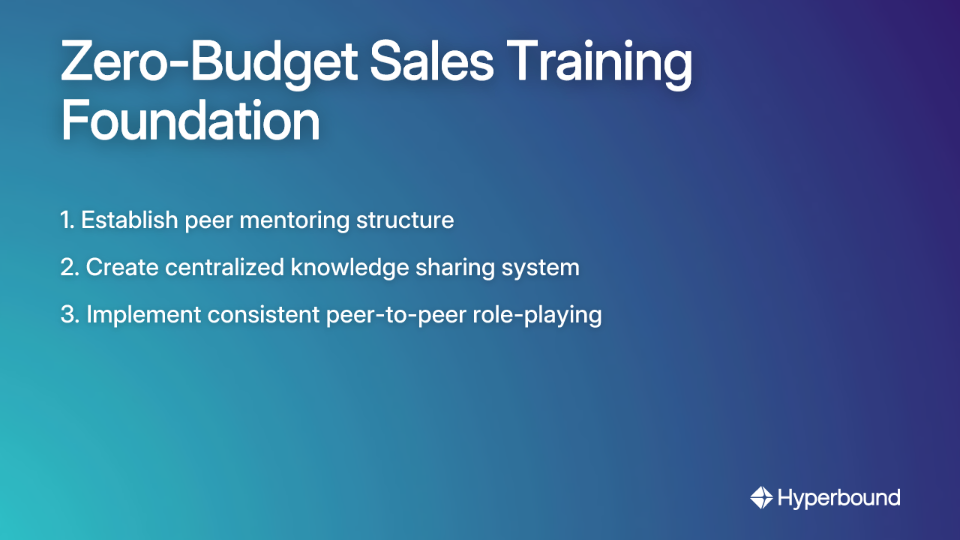
Mentoring is particularly powerful for small teams because it's cost-free, builds culture, and transfers tribal knowledge effectively.
How to implement it:
The impact is significant: mentoring can increase empowerment and confidence in participants by 87%.
Many small teams operate with valuable knowledge trapped in individual minds or scattered across various tools. A centralized system prevents "reinventing the wheel" and ensures best practices aren't lost when someone is out of office or leaves.
How to build it simply:
This becomes your single source of truth for all things sales, accessible on-demand for anyone in your small team.
For small teams, the ability to practice in a safe environment is crucial for building confidence before high-stakes client conversations.
How to structure it:
Even solo salespeople can benefit from role-playing by recruiting colleagues from other departments, or even friends and family for basic scenarios.
Once you've built your foundation, consider these affordable options to scale your training efforts:
Many sales professionals already invest in books for self-education. Take this a step further with a more structured approach:
Budget tip: Some providers, like ASLAN Training and Development, offer programs that can be customized for small teams, costing between $200-$2,500 per participant. Check your company policy manuals—many organizations offer reimbursement for professional development that employees aren't aware of.
The challenge with manual role-play is that it relies on manager/peer availability and can be inconsistent. What does a solo rep do when there's no one to practice with?
This is where technology can be a game-changer for small teams. Platforms like Hyperbound allow reps to practice critical conversations anytime, anywhere:
For small teams, it's like having an on-demand sales coach, ensuring reps get far more practice reps than would otherwise be possible. This solves the scalability problem for a team of one or a few without requiring the budget for full-time sales coaches.

Keep it simple: Track a few key metrics before and after implementing your training initiatives:
For teams ready to scale their measurement approach, tools can automate this process. For example, Hyperbound's AI Real Call Scoring can automatically analyze and score real customer conversations against your methodology, providing objective data on what's working and where skill gaps exist—saving hours of manual call review.
The impact of structured training programs on small teams can be substantial, as these case studies demonstrate:
FQE Chemicals, a global supplier with a dispersed team, needed to train their small sales force on a new sales strategy.
Logicalware, a SaaS business with a small team, was struggling with new client acquisition.
Both examples demonstrate that tailored, focused training—even when delivered online to small teams—yields massive results when properly implemented.
Building an effective sales training program for your small team doesn't require enterprise-level resources. Start with these steps:
For the solo salesperson or small team leader feeling overwhelmed by the prospects of implementing a training program, remember that you don't need to build Rome in a day. Start with one component—perhaps a weekly role-play session or a simple sales playbook—and build from there.
An effective sales training program isn't an event; it's a system and a culture of continuous learning and improvement. By implementing even a basic framework, the smallest teams can compete with and outperform their larger rivals through consistent, focused skill development.
After all, as the case studies show, it's not the size of your team that determines success—it's the quality of your training and the consistency of its application.
Ready to take your small team's sales performance to the next level? Begin by implementing one element of your training program today, and watch as your team's capabilities and results grow over time.
You can start sales training with no budget by leveraging internal resources. Focus on establishing a peer mentoring program, creating a centralized knowledge sharing system (using free tools like Google Drive), and implementing consistent peer-to-peer role-playing sessions. These foundational steps cost nothing but time and create a strong culture of continuous improvement.
The most important first step for a solo salesperson is to build a centralized knowledge base or a personal sales playbook. Document your ideal customer profile, value proposition, common objections, and best-practice email templates. This creates a single source of truth that ensures consistency and makes your process repeatable, which you can then use as a basis for practicing with colleagues or AI-powered tools.
A small sales team should aim to spend at least 1-2 hours on dedicated training activities each week. This can be broken down into smaller, manageable chunks, such as a 45-minute role-playing session, a 30-minute peer mentoring check-in, and 15-30 minutes reviewing calls or contributing to the knowledge base. Consistency is more important than the total duration.
You can measure the ROI of sales training by tracking a few key leading and lagging indicators before and after implementation. For leading indicators, monitor metrics like the number of meetings booked or the meeting-to-opportunity conversion rate. For lagging indicators, track your win rate, average deal size, and sales cycle length. A positive change in these metrics demonstrates a clear return on your training investment.
A small team should invest in sales training technology once they have established a foundational training process and need to scale practice and coaching efficiently. When peer role-play becomes a bottleneck or when you need a more consistent and objective way to practice and get feedback, it's time to consider tools. AI-powered platforms like Hyperbound provide on-demand practice and coaching, solving the scalability problem without requiring a full-time sales coach.
The best initial sales training topics for a small team are objection handling, discovery call execution, and mastering the value proposition. These three areas have the most immediate impact on performance. Mastering how to handle common objections builds confidence, improving discovery helps uncover customer needs more effectively, and a crisp value proposition ensures your messaging is consistent and impactful in every conversation.









Use Cases
Legal