
You're at a networking event, coffee in hand, bracing yourself for yet another discussion about the weather. Your internal dialogue kicks in: "Why am I even doing this? It seems pointless." As the awkward silence grows between you and the person you've just met, you scramble for something—anything—to say.
If this scenario makes you cringe, you're not alone. For many people, especially introverts and analytical thinkers, small talk feels like an excruciating social performance with little to no payoff. It seems shallow, forced, and ultimately futile.
But what if the problem isn't small talk itself, but our understanding of its purpose?
One of the biggest frustrations with small talk is hitting conversational "dead ends"—those painful moments when you ask "Do you have any pets?" and receive a simple "no," plunging you back into that dreaded awkward silence. The good news is that with the right techniques, you can transform these surface exchanges into meaningful interactions.
When you're not sure what to talk about, remember the acronym F.O.R.D.:
These topics are generally safe yet meaningful, allowing you to gather information about what matters to the other person.

The way you phrase questions dramatically affects the quality of responses you'll receive. Open-ended questions invite stories and elaboration, while closed questions often lead to dead-end responses.
Instead of: "Did you have a good weekend?"
Try: "What was the highlight of your weekend?"
Instead of: "Do you like your job?"
Try: "What's the most challenging part of your work?"
Notice how the second option in each pair requires more than a simple yes or no, creating natural pathways for the conversation to continue.
People generally enjoy feeling helpful and sharing their expertise. Asking for recommendations or advice not only flatters the other person but also creates a positive conversational dynamic.
Examples:
Remember that conversation is a two-way street. Both parties need to participate for it to flow naturally. If someone consistently gives minimal responses despite your well-framed questions, they might simply not be interested in engaging—and that's okay. Not every conversation needs to be a deep connection.
The true art of conversation lies not in mastering small talk itself, but in knowing how to transition from surface-level exchange to meaningful dialogue. This is where the concept of "Vertical Curiosity" becomes invaluable.
Most people practice what we might call "horizontal curiosity"—jumping from topic to topic (weather → weekend plans → work projects) without exploring any single subject in depth. This keeps conversations perpetually in small-talk territory.
The alternative is "vertical curiosity"—staying with one topic and asking follow-up questions that delve deeper. This approach transforms polite chit-chat into genuine connection.

This method works because it follows the natural flow of human interest. We all have subjects we care about deeply, and when someone shows genuine curiosity about those topics, we tend to open up and engage more authentically.
Vertical curiosity only works if you're genuinely listening. Pay attention not just to the content of what someone says, but to their tone, enthusiasm, and emotional cues. When you notice someone becoming more animated about a particular topic, that's your signal to dig deeper.
As one Reddit user wisely noted, following up on something previously mentioned ("How was that concert you mentioned last week?") demonstrates that you're paying attention, which builds trust and encourages further sharing.
For introverts and analytical thinkers, this structured approach to conversation can be particularly empowering. It provides a logical framework for navigating social interactions and allows you to bypass endless superficial topics to reach the substance you crave more efficiently.
Of course, knowing the framework is one thing—mastering it is another. Practice is essential for building the confidence to use these techniques in real-time. For sales professionals, this is where tools like Hyperbound's AI Sales Roleplays become invaluable, offering a safe space to rehearse transitioning from small talk to deep discovery with AI buyer personas.
As Susan Cain notes in her book Quiet, small talk isn't the enemy of meaningful connection for introverts—it's the essential "runway" that allows deeper conversations to take off.
Different social contexts call for different conversational strategies. Here's how to adapt your approach based on the situation:
In workplace or networking environments, small talk often serves as a professional compatibility check. Your goal is to establish rapport while finding relevant points of connection:
Remember that in professional settings, small talk builds the foundation for potential collaboration, mentorship, or business relationships.
When meeting someone specifically to get to know them better, you can accelerate through small talk more quickly:
In these contexts, small talk serves primarily as a brief warm-up before moving to more meaningful exchange.
The fundamental mindset shift needed to make small talk matter is recognizing that it's not an obstacle to meaningful connection—it's the necessary bridge that gets you there.
When we understand small talk as a tool for building comfort, gathering information, and identifying shared interests, it transforms from a pointless social obligation into a strategic skill that serves our deeper desire for connection.
For those who've always struggled with superficial conversation, this perspective can be liberating. You're not failing at small talk—you're simply trying to use the tool without understanding its purpose. Once you recognize its value as a starting point rather than an end goal, you can approach it with intention and patience.
The next time you find yourself dreading a social event filled with small talk, remember:
Small talk doesn't have to feel pointless. When approached with the right mindset and techniques, it becomes the gateway to the authentic connections we all crave. It's not about becoming someone you're not—it's about using a universal social tool more effectively to create the kinds of conversations that matter to you.

So the next time you find yourself sharing observations about the weather or asking about someone's weekend plans, remember that you're not just filling awkward silence—you're laying the groundwork for potentially meaningful connection. And that's anything but pointless.
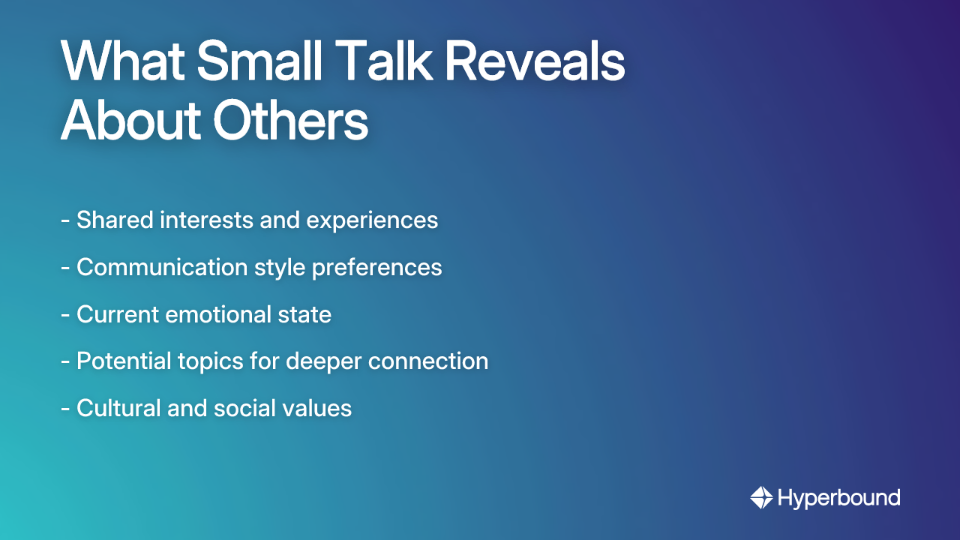
The main purpose of small talk is to act as a social lubricant and an information-gathering tool. It helps build initial rapport and comfort, allowing you to discover shared interests or potential topics for deeper conversation with another person.
You can make small talk less awkward by using proven techniques like the F.O.R.D. method (Family, Occupation, Recreation, Dreams) and asking open-ended questions. Instead of asking a yes/no question like "Did you have a good weekend?", try "What was the highlight of your weekend?" to encourage a more detailed response and keep the conversation flowing.
It's generally best to avoid highly sensitive or controversial topics like politics, religion, personal finances, or health problems during initial small talk. Stick to neutral, positive subjects like hobbies, travel, entertainment, or work-related topics that help you find common ground without creating tension.
The key to transitioning from small talk to a deeper conversation is to practice "vertical curiosity." Instead of jumping between different topics, pick one that seems to interest the other person and ask follow-up questions that delve deeper. For example, if they mention a recent trip, ask "What was the most memorable part of that experience?" or "What inspired you to go there?"
If you're an introvert, reframe small talk as a strategic tool rather than a social obligation. See it as a necessary "runway" that allows you to reach the meaningful conversations you prefer. Focus on quality over quantity; aim for one or two genuine connections using techniques like vertical curiosity, rather than trying to talk to everyone. This makes the process more intentional and less draining.
If someone consistently gives short, one-word answers, they may not be interested in talking, or they might be shy. After a few attempts with open-ended questions, it's perfectly okay to politely end the conversation. Not every interaction will lead to a deep connection; the purpose of small talk is also to identify who is open to engaging further.










Use Cases
Legal

Social Gatherings
At parties or casual social events, the pressure for "productive" conversation decreases, but the opportunity for meaningful connection increases:
The key is to find the balance between light-hearted fun and creating openings for more substantive discussion if both parties are interested.