You've been there. Sitting across from a colleague, awkwardly pretending they're a prospect while your manager watches from the corner, taking notes. Your palms sweat as you fumble through a pitch that would flow naturally on a real call but now feels forced and unnatural.
"Just me or is roleplaying 10x harder than actual calls?" as one sales rep put it on Reddit.
Traditional sales role-playing has long been a necessary evil in sales training – uncomfortable but supposedly essential. But with the rise of AI-powered simulations promising to revolutionize how we practice sales conversations, a crucial question emerges: Are these simulated sales calls actually worth your time, or are they just another tech gimmick?
Despite being a staple of sales training programs for decades, traditional role-playing comes with significant limitations:
Lack of Realism: When a peer or manager tries to act like a prospect, they often struggle to authentically replicate customer behaviors, objections, or specific industry knowledge. They know your product too well to ask the genuinely challenging questions prospects might ask.
Subjective Feedback: The quality of feedback entirely depends on who's evaluating your performance, leading to inconsistent coaching and potential bias.
Scheduling Nightmares: Coordinating time between reps, managers, and training staff creates bottlenecks, especially in large or remote teams. As one sales leader noted, "Finding time for quality role-play sessions is nearly impossible at scale."
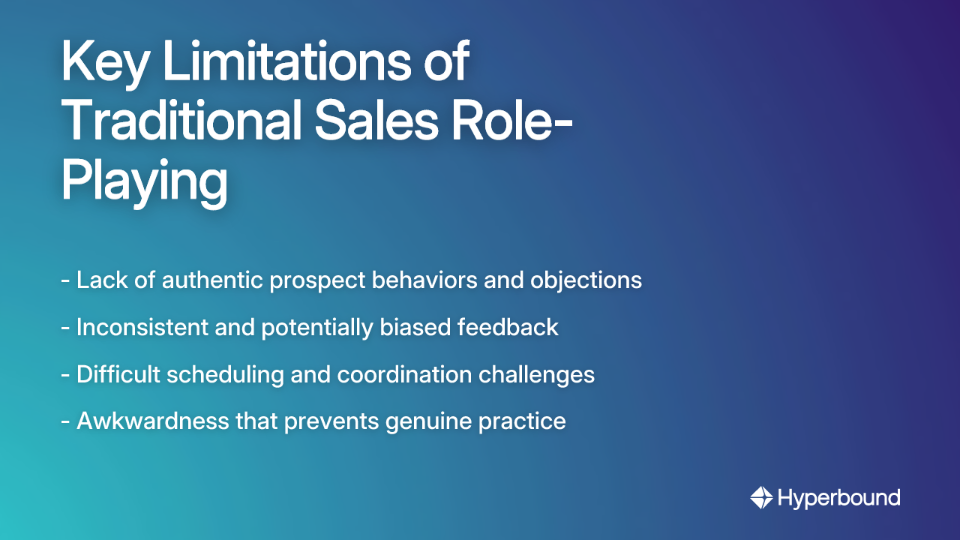
The Cringe Factor: Let's be honest – the awkwardness of pretending to sell to your colleague while others watch can prevent authentic practice. Many reps hold back or feel judged rather than truly practicing their skills.
AI-powered sales simulations create interactive, realistic sales conversations where reps practice with an AI "buyer" that responds in real-time to their approach. Unlike traditional role-playing, these platforms offer:
As one beta tester shared: "It's like having a prospect who's infinitely patient, never judges you for making mistakes, and is available whenever you need practice."
Let's compare these approaches across key dimensions:
AspectTraditional Role-PlayAI SimulationRealismVariable; depends on role-player's skillInitially robotic, but advanced AI trained on actual call data can now mimic specific buyer personas with impressive accuracyFeedbackSubjective; varies by observerObjective, consistent, and data-driven; ideal for tracking improvement over timeScalabilityPoor; requires 1:1 or small group timeExcellent; unlimited practice opportunities without scheduling constraintsEngagementOften low due to awkwardnessHigher due to gamification elements and judgment-free environmentCostHigh (manager time)Moderate (software subscription)Technical SetupMinimalMay require integration with CRM and call recording systems
The comparison reveals why many sales organizations are supplementing or replacing traditional role-playing with AI simulations – though skepticism remains about whether AI can truly replicate the unpredictability of human conversations.
Not all AI simulations are created equal. The difference between a valuable practice tool and a robotic waste of time comes down to these critical factors:
The most common complaint about AI simulations? "The responses just feel robotic and generic," as one sales rep shared on Reddit. Generic AI responses that don't reflect your specific market reality offer minimal value.
Effective simulations must be:
Platforms like Hyperbound address this by analyzing thousands of your actual sales calls to create AI buyer personas that sound and act like your real prospects. The AI can be trained on specific call IDs from your highest-performing reps, ensuring the simulation reflects your real-world selling environment.
"Management will not buy a tool like this on its own - they see feedback as being the most important element," noted one sales leader discussing AI role-playing tools.
For simulations to drive improvement, they need to provide:
This is where advanced AI coaching provides value beyond practice alone. The best platforms offer instant feedback on talk ratios, filler words, and missed opportunities to advance the sale or handle objections effectively.
Effective simulation tools should support practice across the entire customer journey:
With comprehensive practice options, reps can focus on their specific development needs rather than generic role-playing scenarios.
The value of simulated sales calls varies significantly depending on a rep's experience level:
AI simulations can dramatically reduce ramp time by providing:
One SDR manager reported: "Our new reps who used the simulation platform hit their call goals 23% faster than those who didn't, likely because they got over call anxiety through practice."
Experienced reps benefit differently:
"Even our top performers improved their objection handling on competitive deals after practicing specific scenarios," shared a sales director who implemented simulation training.
Whether you're using traditional role-play or AI simulation, the effectiveness ultimately depends on your practice approach. Follow this framework to maximize your return on time invested:
Before each practice session, define exactly what you're trying to improve:
Setting clear sales goals transforms aimless practice into deliberate skill development.
The most common mistake in both traditional and AI role-playing? Half-hearted participation. Treat each simulation like a real call:
"The more seriously you take the simulation, the more transferable the skills become," explains a sales trainer who incorporates AI practice into coaching sessions.
Don't just complete a simulated call and move on. Use a three-step debriefing process:
Organizations using structured debriefing report significantly higher skill retention and transfer to real calls.
Research shows that short, frequent practice sessions (15-20 minutes, 3-4 times weekly) build skills more effectively than occasional marathon sessions. This is where AI simulations shine – they enable consistent practice without scheduling headaches.

As one VP of Sales put it: "It's not about putting in hours of practice before a big call; it's about building muscle memory through consistent repetition."

The ultimate value of simulated sales calls lies in preventing expensive mistakes when dealing with actual prospects and customers. Consider these real-world scenarios:
A CSM is facing a renewal conversation with a key account that's pushing back on pricing. Without practice, they might panic and offer unnecessary discounts, costing thousands in ARR.
With simulation practice, they can:
One customer success team using Hyperbound's AI Post-Sales Roleplays reduced discretionary discounting by 17% after implementing simulation training for renewal conversations.
Your company is launching a major new offering, and consistent messaging is critical. Without proper practice, each rep might describe the value proposition differently, creating market confusion.
With simulation training:
"Our last product launch using simulated calls for practice had 89% message consistency across all reps, compared to 52% for our previous launch," reported one enablement leader.
The verdict: Yes, simulated sales calls are worth your time – with important caveats.
They're worth it when:
They're not worth it when:
As AI technology continues to evolve, platforms like Hyperbound are addressing the historical limitations of both traditional role-playing and early AI simulations. By analyzing your actual calls, creating custom simulated customers, and providing real-time coaching, these tools are finally making practice an effective use of your sales team's valuable time.
The most successful organizations are creating a culture where both managers and reps embrace simulation as part of their continuous improvement process – not because it's comfortable, but because it works.
When implemented correctly, simulated sales calls accomplish what traditional role-playing rarely could: making practice not just bearable, but genuinely valuable for driving sales performance.
So the next time you're tempted to skip practice because "roleplaying is 10x harder than actual calls," consider that with the right simulation tools, it doesn't have to be. In fact, it might be the most valuable 20 minutes of your day.
An AI sales simulation is a training tool where sales representatives practice conversations with an AI-powered "buyer" that realistically mimics a real prospect. It provides a safe, on-demand environment to practice skills like objection handling, discovery, and negotiation without the pressure of a live call or the awkwardness of role-playing with a colleague.
The most effective AI simulations create realistic conversations by training their AI models on a company's actual sales calls, including both successful and unsuccessful interactions. This process allows the AI to learn your specific industry language, common customer objections, and the unique behaviors of your target buyer personas, making the practice sessions feel much more authentic than generic role-plays.
Both new and experienced sales reps benefit from simulated sales calls, though in different ways. New reps can quickly build confidence and master core messaging, reducing their ramp time. Veteran reps can use simulations to refine advanced techniques, practice new product messaging, and eliminate ingrained bad habits.
No, AI simulations are designed to supplement, not replace, human coaching from sales managers. The AI provides objective, data-driven feedback on performance metrics like talk ratio and filler words, allowing reps to practice independently. This frees up managers to focus on higher-level strategic coaching, deal reviews, and personalized skill development during their one-on-one sessions.
The main advantages of AI simulation over traditional role-playing are scalability, objectivity, and realism. Unlike role-playing, AI simulations can be done anytime, anywhere, without scheduling conflicts. The feedback is based on objective data rather than a manager's subjective opinion, and advanced platforms can create more realistic scenarios than a colleague who already knows your product.
To get the most value, sales teams should use a structured and consistent approach to AI practice. This includes setting specific, measurable goals for each session, treating the simulation like a real call, using a debriefing process to review AI feedback, and engaging in short, frequent practice sessions rather than infrequent marathon ones.
Interested in seeing how AI-powered sales simulations could work for your team? Hyperbound offers a risk-free trial with custom simulations based on your actual sales conversations. Their platform handles everything from technical setup to integration with your CRM, with no twilio fees or compliance concerns to worry about.










Use Cases
Legal