
You've finally gotten the meeting with a promising prospect. You've polished your slides, memorized your product specs, and rehearsed your pitch until you could recite it in your sleep. But ten minutes in, you hear those dreaded words:
"Your product looks great, but honestly, it's the same as what your competitors are offering. What's your best price?"
And just like that, you feel like you've failed another Fallout speech check. The conversation shifts entirely to price, your margins evaporate, and you're left wondering if there's some magic dust you're missing that would make selling this commoditized product easier.
If this scenario feels painfully familiar, you're not alone. The struggle is real for sales professionals handling products with little differentiation – whether it's LED lights, office supplies, raw materials, or countless other offerings where the core specifications look virtually identical across competitors.
The first mindset shift required to escape the commodity trap is to recognize that when products are similar, the sales experience itself becomes your primary differentiator.
According to research from B2B International, buyers often claim products are identical to drive down prices, creating a "commodity trap." But the truth is, even with commoditized offerings, there are always differences – they're just not always in the product itself.
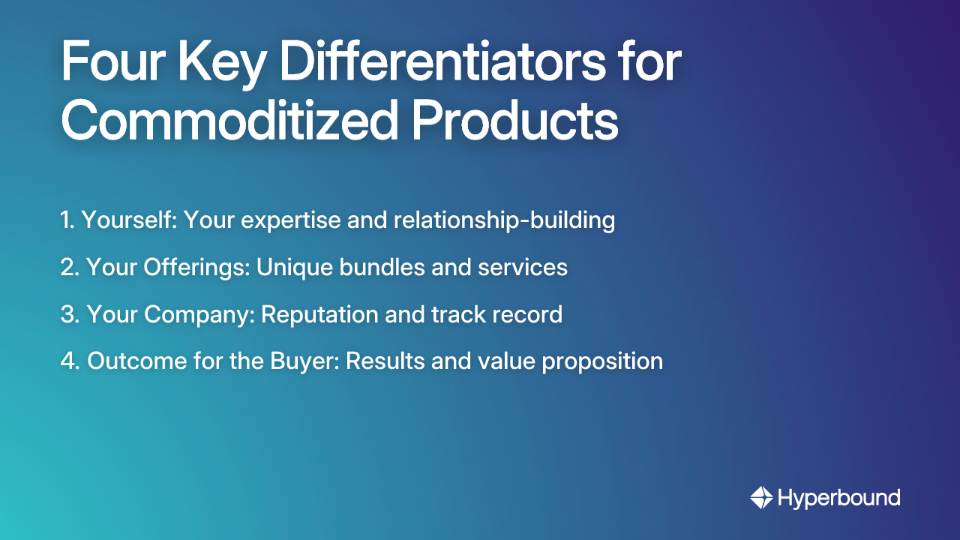
When your product's features can't be your hero, you need to focus on four alternative pillars of differentiation:
The overall Sales Experience (SX) you create can become your most powerful differentiator. Just as B2C giants like Apple win not just on product but on a distinct, seamless experience, B2B sales can adopt the same principles.
An effective SX requires mapping all customer touchpoints and ensuring cohesiveness across:
Remember: your behavior during the sales process is a direct reflection of what the customer can expect from your company. If you're responsive, professional, and thorough during the sale, it signals they'll receive the same treatment after becoming a customer.
When selling commoditized products, conversations inevitably gravitate toward price. Here are concrete strategies to shift the focus and create value beyond the product itself.
Rebates are often misunderstood and underutilized as a sales tool. Rather than positioning them as mere discounts, frame rebates as strategic incentives that create a competitive edge and build robust supplier relationships.
A well-managed rebate program provides several advantages:
The key is transparent communication about rebate structures and timelines. This builds trust and reduces misunderstandings while ensuring compliance with agreements maintains credibility and strengthens the partnership.
As one sales leader put it during our research: "Most reps I work with do not follow up quickly with good info and focus on the magic dust." Don't be that rep. Instead, use rebates as a structured reason to maintain consistent contact and demonstrate your reliability.
When selling a commoditized product like LED lights, the upfront cost can be a barrier. Offering flexible financing solutions makes the purchase easier and shifts the conversation from "how much does it cost?" to "how can we make this work for your budget?"
Additionally, creating a unique offering by bundling the product with value-added services can be a game-changer. Examples might include:
These approaches move the competition away from a direct price comparison and toward a comparison of the overall value and ease of doing business. They also create multiple points of contact with the customer, strengthening your relationship and making it harder for competitors to displace you.

The ultimate goal in selling commoditized products is to transform yourself from a replaceable vendor into an indispensable partner. This requires mastering two critical skills: follow-through and problem-solving.
One of the most consistent pain points expressed by buyers is the lack of effective follow-ups from sales representatives. As one frustrated prospect put it: "Most of the reps I work with do not follow up quickly with good info."
Mastering follow-through isn't about some mysterious magic dust – it's about disciplined, professional execution that combines timing, confidence, and information. When selling commoditized products, your responsiveness and reliability become powerful differentiators.
Consider implementing the "double tap" strategy for non-buyers and even existing customers. A prospect who told you to get lost last week might suddenly need your service today. Regular, value-focused check-ins keep you top-of-mind for when timing is right.
One sales professional shared: "That client who told you to get lost last week might now need your service/product, don't be afraid to 'double tap' non-buyers." This approach means being persistent without being pushy – a delicate balance that pays dividends.
You can't differentiate if you don't know your product and industry inside and out. One successful sales rep advised: "Become so knowledgeable on your product that your product team comes to you with questions."
This deep expertise allows you to shift from generic product pitches to consultative problem-solving. Instead of viewing objection handling as a battle to win, see it as an opportunity to understand and solve the customer's real problem. This requires moment-specific responses, not canned scripts.
When working with gatekeepers and decision-makers, your ability to quickly identify pain points and provide tailored solutions becomes invaluable. This consultative approach works especially well with warm leads who already recognize they have a problem to solve.
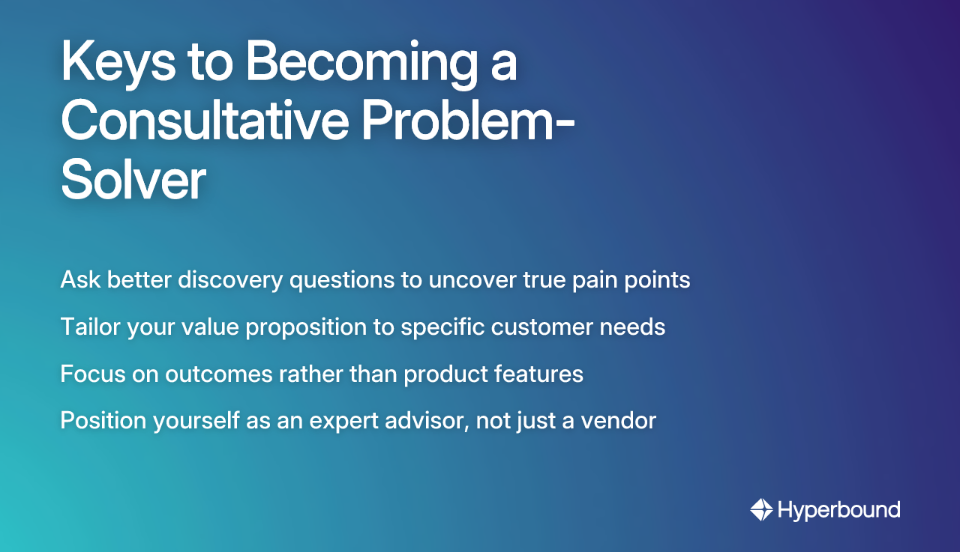
The key is asking better questions during discovery to gather insights that allow you to tailor your Customer Value Proposition. When you truly understand what keeps your prospects up at night, you can position even a commoditized product as the perfect solution to their unique situation.
In commoditized markets, victory comes through:
The product might be a commodity, but you are not. Your ability to build relationships, solve problems, and create a seamless buying experience is the one thing your competitors can never truly replicate.
The path to success isn't about finding that elusive magic dust – it's about continuous enablement and the conscious effort to "improve a small amount every day and after every sales call." This is why successful sales professionals use platforms like Hyperbound to leverage data-driven insights from each interaction, engage in real-world simulations through role-playing, and get the coaching and skills-based training needed to constantly refine their approach.
By mastering these strategies, you'll transform your sales approach from "Here's my commodity product at a competitive price" to "Here's how I can solve your unique problems and make your life easier." And that's a value proposition worth paying for – even when the product itself might seem like just another LED light.
The best way to sell a commoditized product is to stop focusing on the product itself and instead sell a superior experience and a valuable partnership. This involves differentiating through your personal reliability, your company's reputation, unique service bundles, and a clear focus on the buyer's desired outcomes. By creating an orchestrated Sales Experience (SX), you make the process of buying from you easier and more valuable than buying from competitors.
You can differentiate yourself through four key pillars: yourself (your expertise and reliability), your offerings (unique bundles and services), your company (reputation and track record), and the outcome for the buyer (your value proposition). While the core product may be identical, your personal follow-through and the unique solutions you create around the product are things competitors cannot easily copy.
The sales experience is a key differentiator because when products are similar, how you sell becomes more important than what you sell. A professional, responsive, and seamless sales process signals to the customer what it will be like to work with your company long-term. This experience builds trust and loyalty that price-cutting competitors can't match.
Effective alternatives to price discounts include offering value-added services, flexible financing options, and strategic rebate programs. Instead of simply lowering the price, you can add value through services like installation support or maintenance packages. Flexible financing makes the purchase more accessible, while well-managed rebate programs can incentivize loyalty and build long-term relationships.
To shift the conversation away from price, you must focus on solving the customer's core problems and demonstrating the long-term value of your solution. This requires deep product and industry knowledge, allowing you to act as a consultant rather than just a vendor. By uncovering a prospect's true pain points, you can tailor your value proposition to show how your complete offering solves their specific challenges, making the initial price less relevant.
Transitioning from a vendor to a partner means moving from a transactional relationship focused on selling a product to a consultative relationship focused on helping the customer achieve their goals. A vendor is replaceable and often chosen based on price. A partner is indispensable, chosen for their expertise, reliability, and proactive problem-solving, making them a vital part of the customer's success.










Use Cases
Legal