
Mock calls have always been one of the most effective ways to train SDRs. But as one sales manager put it in a Reddit thread on SDR training: "the challenge is finding enough people (or time) to actually run them consistently."
The result? Most SDR teams fall back on passive methods — shadowing recorded calls, sitting through enablement decks, or watching top reps dial on Zoom. These aren't bad, but they don't build muscle memory. Cold calling is a perishable skill. Without high-volume at-bats in a realistic setting, reps plateau fast.
AI sales roleplay tools promised to fix this. But here's the honest state of affairs: most AI simulators still feel like talking to a chatbot. As one rep put it, "AI call simulators are decent... but they can't replicate the chaos of real human conversations where prospects interrupt, go off-script, or have weird edge cases." And importantly, as another noted: "I think that can be fixed by training the model with call recording data" — a standard most tools haven't yet met.
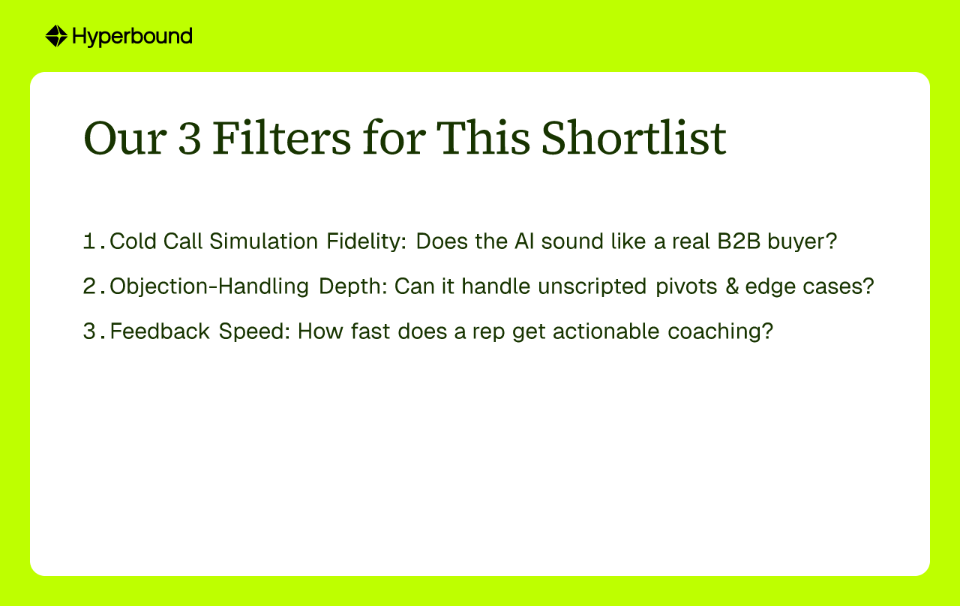
This article cuts through the noise. It's not a generic "top 10 sales tools" roundup. It's a curated shortlist evaluated specifically through the lens of SDR cold call coaching, filtered by three criteria that disqualify most legacy enablement platforms:
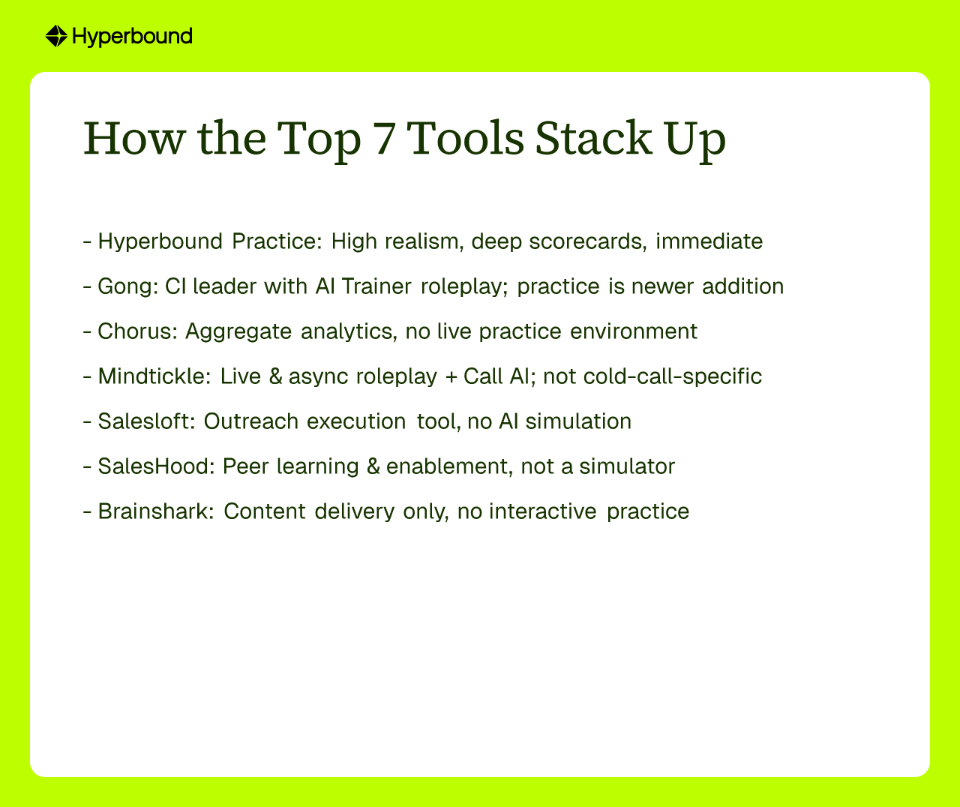
We've also included a comparison table at the end for a quick, scannable decision.
Best for: High-fidelity cold call simulation with instant, objective feedback
Hyperbound Practice is purpose-built for exactly this use case. Where most platforms treat roleplay as a secondary feature bolted onto a training LMS, Hyperbound built its entire product around the idea that reps need realistic, repeatable practice — not just content to consume.
The core differentiator: its AI buyer personas are trained on over 2 million hours of real B2B sales conversations. This directly addresses the complaint that generic AI doesn't handle unexpected prospect behavior. Hyperbound's personas interrupt. They push back. They give vague non-objections like "just send me an email" and "we're not looking at this right now." They behave like actual buyers — because they were built from real interactions with them.
Key features SDR managers care about:
The proof point that matters: Nivoda deployed Hyperbound and saw a 150% increase in their DM-to-demo conversion rate, alongside a 50% reduction in SDR ramp time. Vanta cut ramp from 210 days to 72 — a 60% reduction — while scaling their BDR team 4x.
If you're evaluating AI roleplay tools and cold call realism is your primary filter, Hyperbound is the benchmark against which other tools should be measured.
Best for: Post-call analysis and identifying top-performer habits
Gong is the category leader in conversation intelligence. It records, transcribes, and analyzes real sales calls to surface insights about what's working — talk ratios, question frequency, competitor mentions, and deal risk signals.
For SDR managers, Gong is genuinely valuable for reviewing calls in bulk, building a library of best-practice moments, and identifying coaching patterns across the team. If you want to understand what happened on calls last week, Gong is excellent.
Where it falls short for cold call practice: Gong's core strength is post-call review and analysis. With the recent launch of AI Trainer, Gong has added AI roleplay capabilities — reps can practice against AI scenarios built from real customer interactions. This is a meaningful addition for teams already in the Gong ecosystem. However, AI Trainer is a newer feature built on top of a conversation intelligence platform — the roleplay depth (multiparty cold call scenarios, bitesized objection drills, 25+ languages) and the automated orchestration that connects call scoring to targeted practice assignment aren't as deeply developed as purpose-built practice platforms. For high-volume SDR cold call drilling specifically, Gong is best used as a complement to a dedicated simulator.
Best for: Conversation analytics and deal-level insights
Chorus operates in the same lane as Gong — capturing real customer conversations and surfacing trends in rep performance, buyer sentiment, and pipeline health.
Its strength is breadth of analysis across a large call volume. For sales managers who want aggregate visibility into how SDRs are performing across hundreds of cold calls, Chorus gives useful signal.
Where it falls short for cold call practice: Like Gong, Chorus is oriented around analysis, not active practice. The feedback reps receive is retrospective, not immediate. There's no interactive roleplay environment where an SDR can practice their cold call opener five times in a row until they nail the transition from hook to value prop. For teams that need to build skill — not just track it — Chorus creates insight without a clear path to rep-level improvement.
Best for: Structured onboarding programs and sales readiness
Mindtickle is a full sales readiness platform with modules for training, onboarding, assessments, and AI role-play capabilities — including live conversational simulations and Call AI for scoring real customer conversations. It's a serious tool used by enterprise teams who need scalable certification programs alongside conversation intelligence.
Where it falls short for cold call practice: While Mindtickle has expanded its roleplay to include live AI simulations, the platform's strength remains structured onboarding and certification rather than high-volume, dynamic cold call drilling. The simulation fidelity for the specific cold call use case — where a prospect cuts you off mid-sentence or throws a hard "we don't have budget" after your opener — isn't as purpose-built as dedicated cold call practice platforms. For SDR teams doing high-volume cold call drilling, the gap in real-call-data-trained persona depth is a consideration.
Best for: Executing multi-channel SDR outreach at scale
Salesloft is a leading sales engagement platform. SDR teams use it to manage call and email cadences, track prospect activity, and stay organized across a high-volume outreach motion.
Its coaching features have expanded over the years — it includes call recording and some analytics on rep activity — but the product's DNA is about doing outreach, not practicing for it.
Where it falls short for cold call practice: Salesloft doesn't offer a meaningful AI simulation engine for cold call practice. There's no environment where a rep can rehearse their opener, get challenged by an AI persona, and receive scored feedback on their objection handling. It's a strong execution tool. For pre-call skill development, you'd need to pair it with a dedicated practice platform.
Best for: Peer learning and enablement content delivery
SalesHood is a sales enablement platform with strengths in onboarding, content sharing, and team-based learning. It supports video coaching and peer-to-peer feedback, which aligns with a common recommendation in SDR communities: leverage your top performers to coach newer reps.
Where it falls short for cold call practice: SalesHood's role-play functionality is not built around dynamic AI simulation. The platform is designed for knowledge transfer and content alignment — think messaging updates, product training, and certification workflows. The interactive, AI-driven cold call practice that SDRs need to build objection-handling reflexes isn't SalesHood's core capability. It's a good fit for training programs but limited as a cold call simulator.
Best for: Content-driven enablement and training certification
Note: Brainshark was acquired by Bigtincan and subsequently merged into Showpad in October 2025. The product is now branded as Bigtincan Readiness within the Showpad ecosystem.
Brainshark offers tools for creating video-based training content, building learning paths, and running assessments. Sales teams use it to onboard reps on product knowledge, competitive positioning, and process training.
Where it falls short for cold call practice: Brainshark is fundamentally a content delivery tool. It excels at getting the right information in front of reps. It doesn't provide an interactive simulation environment where an SDR can practice a cold call and receive real-time scored feedback. The skill application layer — the one that actually changes behavior on live calls — isn't what Brainshark was built for. If you're looking for a tool that lets SDRs rack up at-bats before they hit the phones, this isn't it.
.png)
Cold Call Realism = How faithfully the platform replicates a real, unscripted B2B cold call
Scorecard Depth = How granular and actionable the post-simulation or post-call feedback is
Time to First Simulation = How quickly a new rep can complete their first practice rep
CRM Integration = Whether the platform connects to Salesforce, HubSpot, or similar CRMs
The pattern across this list is revealing. Most tools in the sales tech stack were built to observe and record what's already happening — Gong tells you what went wrong (and with AI Trainer, now offers practice too), Salesloft tells you how many dials were made, Brainshark tells you who completed the training module. That data is valuable. But for the specific use case of high-volume SDR cold call drilling, the depth of purpose-built practice platforms remains unmatched.
SDRs don't improve by watching recordings. They improve by getting on the phone — and when live prospects are on the other end, mistakes have real consequences. The solution is a realistic practice environment where reps can get 50 cold call reps before they ever burn a real lead.
That's the gap purpose-built AI roleplay platforms fill. And within that category, the differentiator is simulation quality. As the Reddit community flagged directly: the fix is training the AI on real call data. Generic AI personas that follow predictable scripts train reps to respond to bots, not buyers.
Hyperbound's approach — training AI personas on 2M+ hours of real B2B conversations — is specifically designed to close that gap. The result isn't just better practice. It's faster ramp, higher conversion rates, and a team that handles objections with confidence because they've handled them dozens of times in simulation before the live call happens. That's what Revenue Activation looks like in practice: turning call data and coaching insights into changed rep behavior and closed-won deals.

If your SDR team is still relying on inconsistent peer roleplays or passive call review to prepare for cold calls, the tools in this list offer a better path. For teams that want to start with the highest-fidelity option, Hyperbound Practice is where to begin.
An AI roleplay tool is a software platform that uses artificial intelligence to simulate realistic sales conversations, allowing sales reps to practice their skills in a safe, repeatable environment. Unlike passive training methods like watching recorded calls, these tools provide an interactive experience where SDRs can practice cold calls, handle objections, and refine their messaging against an AI persona that behaves like a real B2B buyer. The best tools provide instant feedback on performance, tracking metrics like talk ratio and response quality.
AI roleplay is more effective because it offers consistent, scalable, and on-demand practice that traditional methods like peer roleplays or call shadowing cannot provide. Peer roleplays are often inconsistent and hard to schedule, while shadowing calls is a passive activity that doesn't build muscle memory. AI simulators allow reps to get high-volume "at-bats" in a realistic setting, drilling specific objections until they achieve mastery, which accelerates ramp time and improves performance on live calls.
The most realistic AI cold call simulators are trained on vast datasets of real B2B sales conversations, not just generic language models. This training data allows the AI to understand the nuances of buyer behavior, including common objections, interruptions, and unscripted pivots. For example, platforms like Hyperbound use over 2 million hours of call data to create AI personas that challenge reps just like a real prospect would, avoiding the predictable, chatbot-like feel of less advanced tools.
When evaluating an AI sales training tool, you should prioritize three key criteria: cold call simulation fidelity, objection-handling depth, and the speed of feedback. Fidelity ensures the AI sounds and acts like a real buyer. Depth means it can handle a wide range of objections beyond a simple script. Fast feedback allows the rep to receive instant, actionable coaching after each simulation without waiting for a manager. A tool that excels in these areas will deliver the most impact on SDR performance.
Conversation intelligence tools like Gong and Chorus analyze past calls to tell you what happened. Gong has recently added AI Trainer for roleplay practice built from real customer interactions, which is a meaningful step toward proactive skill development. However, for the specific use case of high-volume SDR cold call drilling, purpose-built AI practice platforms like Hyperbound offer deeper simulation fidelity — with AI personas trained on 2M+ hours of real B2B calls, multiparty scenarios, bitesized objection drills, and 25+ language support. Think of it as the difference between a general batting cage and a facility that replicates the exact pitching style of your next opponent.
SDRs can show significant improvement in a matter of weeks by using AI roleplay tools consistently, drastically reducing traditional ramp time. The ability to get high-volume, repetitive practice with immediate feedback accelerates the learning curve. For example, companies using Hyperbound have seen results like a 60% reduction in SDR ramp time (from 210 to 72 days) and a 150% increase in their demo conversion rates, because reps master objection handling in a simulated environment before speaking to a live prospect.








Use Cases
Legal