
You're bombarded with AI sales tool pitches daily. Your inbox is filled with "revolutionary" solutions. Your LinkedIn feed is an endless scroll of AI this, AI that. And you're thinking: Is any of this actually making SDRs more effective, or is it all just hype?
If you're feeling overwhelmed by the 1,300+ AI sales tools that have flooded the market in the past two years, you're not alone. As one sales leader recently confessed on Reddit, "Ever since ChatGPT, I feel so behind in every AI." This sentiment echoes across sales floors everywhere.
But here's the reality: while many AI tools are indeed "good for generic content generation and nothing more," there are legitimate game-changers that are transforming how top-performing SDR teams operate right now.
This guide cuts through the noise. Instead of listing dozens of shiny objects, we'll focus on three categories of AI tools that are delivering tangible results for SDR teams today. For each, we'll cover implementation timelines, training requirements, and realistic ROI based on actual manager experiences.

The problem is clear: SDRs struggle to write effective cold emails. As one sales professional noted, "AI is terrible at generating good text copy, but it is phenomenal at modifying and processing existing texts." The best tools in this category don't just automate—they coach.
What It Is: An AI-powered email assistant that integrates directly with Gmail and Outlook, providing real-time coaching for outbound emails.
Why It Works: Rather than just generating generic content, Lavender helps SDRs develop their own writing skills with every email they send.
Key Features:
Implementation & ROI:
What It Is: A unified AI platform designed to generate personalized outreach sequences and consolidate prospecting tasks.
Why It Works: It addresses the operational drag of using multiple tools and the bottleneck of creating personalized follow-up sequences for each customer niche.
Key Features:
Implementation & ROI:
Multiple sales professionals have noted that "the stuff Conversational Intelligence companies are doing with AI call coaching are the best applications so far." This category directly addresses the need for data-driven coaching.
What They Are: Revenue intelligence platforms like Hyperbound and Gong record, transcribe, and analyze every customer interaction to provide a 360° view of customer reality.
Why They Work: They enable managers to stop coaching based on gut-feel and start coaching based on data-driven insights from real conversations.
Key Features:
Implementation & ROI:
Conversation intelligence tools are fantastic for analyzing what happened. But how do you ensure your SDRs are prepared for what's next? How do they practice handling objections without burning through live leads?
What It Is: An AI platform that transforms call insights into hyper-realistic roleplay simulations, allowing SDRs to practice critical conversations in a safe environment.
Why It Works: It directly solves the challenge of scaling effective coaching and ensuring SDRs can apply training under pressure.
Key Features:

Implementation & ROI:
To avoid the common pitfalls of redundancy (buying overlapping tools), over-automation, and under-adoption (wasted licenses), follow this implementation framework:
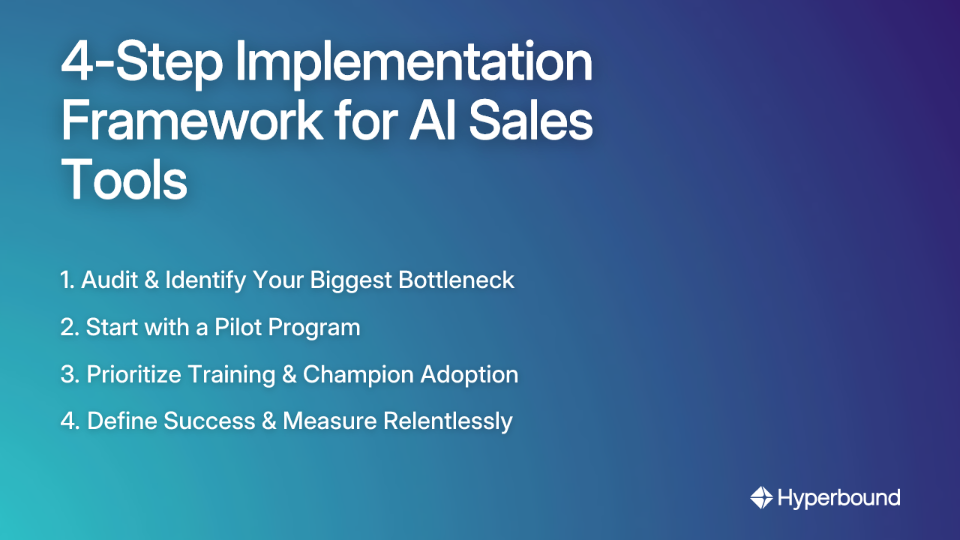
Is your team's biggest issue poor email quality? Inconsistent call performance? Or a long ramp time for new hires? Be honest about your primary pain point.
For example, if your SDRs are sending high volumes of emails with minimal personalized follow-up and poor response rates, start with an email coaching tool like Lavender.
Don't roll a new tool out to everyone at once. Select a small group of SDRs (a "pilot pod") to test the tool, gather feedback, and prove its value.
"We started with just five SDRs on Hyperbound. Within two weeks, they were booking 30% more meetings than their peers. That data made rolling it out team-wide a no-brainer." — SDR Manager at a telemarketing solutions company
Most AI tools require 1-2 weeks of focused training for teams to integrate them effectively. Appoint a "power user" or champion on the team who can help their peers and evangelize the tool's benefits.
Avoid the trap of treating AI tools like an automated voice avatar that works on autopilot. The most successful implementations involve managers who actively coach on tool usage.
Set clear KPIs before you start:
The most effective AI tools don't replace your SDRs—they empower them. They turn good reps into great ones by augmenting their skills and helping them develop faster.
When evaluating AI tools for your team, remember:
Your job as an SDR manager isn't just to hit a number—it's to build a team of exceptional performers. The right AI tools are your force multiplier in that mission. Choose wisely, implement thoughtfully, and coach relentlessly.
"The best AI tools aren't the ones that do the job for you—they're the ones that help your people do their jobs better."
The best AI sales tool to start with depends entirely on your team's biggest bottleneck. First, audit your team's performance to identify the primary pain point—whether it's poor email quality, inconsistent call performance, or long new hire ramp times—and then choose a tool from the corresponding category to solve that specific problem.
To ensure team adoption, start with a small pilot program involving a few motivated SDRs to prove the tool's value. Appoint a "power user" or champion to evangelize the tool's benefits, and prioritize ongoing training. Most importantly, managers must actively coach on tool usage rather than expecting it to work on autopilot.
No, the most effective AI tools are not designed to replace SDRs but to empower them. They act as a co-pilot, augmenting an SDR's skills in areas like email writing, conversation analysis, and practice. AI handles repetitive tasks and provides data-driven insights, freeing up reps to focus on high-value human activities like building rapport and closing deals.
Conversation Intelligence (CI) tools analyze past conversations to tell you what happened, while AI Sales Roleplay tools help prepare your team for what's next. CI platforms like Gong record and analyze real customer calls to provide insights, whereas platforms like Hyperbound use those insights to create realistic practice simulations, allowing SDRs to hone their skills before engaging with live prospects.
The time to see a return on investment (ROI) varies by tool category and implementation effectiveness. Lighter tools like email coaches can show results, such as improved reply rates, within 30 days. More comprehensive platforms for conversation intelligence or sales readiness may take 3-6 months to demonstrate significant impact on metrics like win rates or reduced ramp time. A successful pilot program is key to proving ROI quickly.
When choosing between similar AI tools, focus on three key factors: integration, user experience, and coaching capabilities. The tool should integrate seamlessly with your existing tech stack (CRM, email). It must be intuitive for SDRs to use daily. Finally, prioritize tools that coach and develop your team's skills rather than just automating tasks.
Looking to improve your SDR team's conversation skills through realistic practice? Hyperbound's AI Sales Roleplays provide a safe environment for your team to master cold calls, objection handling, and discovery conversations without risking live deals. Request a demo to see how it works with your specific sales scenarios.










Use Cases
Legal