
Here's a number that should stop any CRO in their tracks: frontline sales managers spend just 5–8% of their time on coaching. And for teams with call recording, manually reviewing even 1% of those recorded calls is considered an optimistic goal.
Be honest about what that actually means, because most of this category won't be: 1:1 deal coaching does not scale with headcount, and it never will. A manager with eight reps has time to work maybe three deals a week. The three that get reviewed are the ones already flagged as important, which means the deal quietly going sideways in week three is exactly the deal nobody talks through. Hiring more managers doesn't fix this. It just means you're paying for more people who can each only reach a handful of deals.
That math simply doesn't work. Your team is generating hundreds of calls a week, reps are burning real pipeline while learning on the job, and your managers are already stretched across 1-on-1s, pipeline reviews, forecasting calls, and their own quota. As one sales manager put it in a community discussion, "the player-coach model creates imbalances, leaving little time for necessary coaching."
The problem isn't a lack of intent. Managers want to coach. Sales enablement leaders want training to stick. CROs want consistent execution across the team. The problem is that traditional coaching approaches don't scale; they depend entirely on manager bandwidth that doesn't exist. And adding bandwidth doesn't change that equation, it just enlarges it.
But here's the shift that's changing how modern GTM teams think about this: ai sales coaching scalability is no longer a people problem. It's an operational leverage problem. The teams winning today aren't hiring more managers; they're building smarter systems that turn data into action, automatically. This is the core idea behind Revenue Activation: stop just analyzing what happened on calls and start using that data to change outcomes in real time.
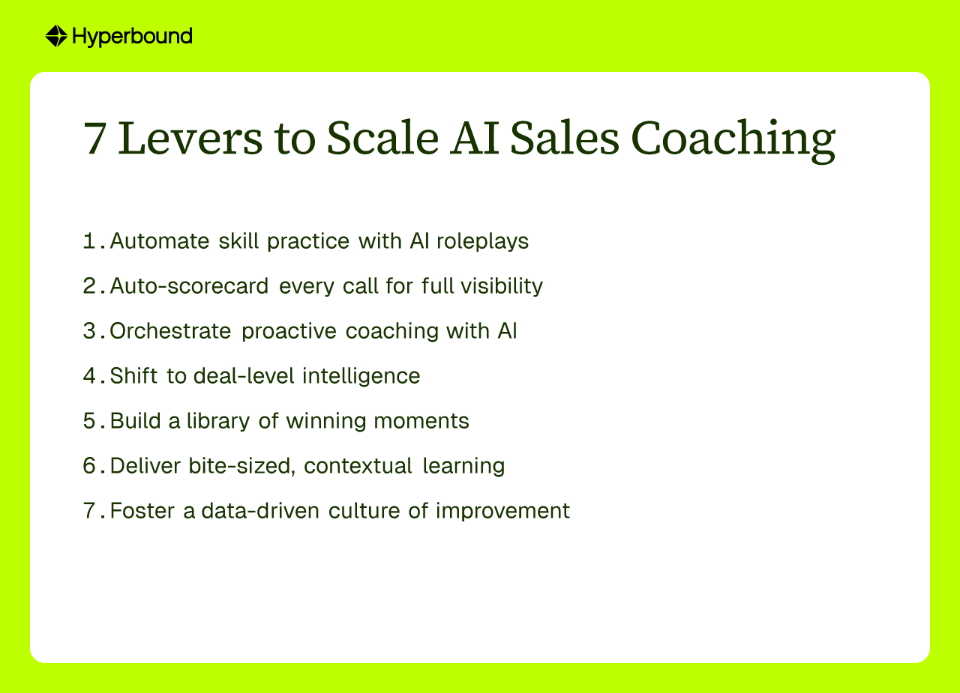
Below are 7 concrete operational levers to get there.
The biggest hidden cost in sales isn't your tools: it's reps burning live pipeline while learning the ropes. New BDRs stumble through cold calls. AEs mishandle discovery questions in real meetings. Tenured reps let their talk tracks go stale during low-volume periods.
The fix isn't more manager-led roleplays. It's removing the scheduling bottleneck entirely.
Hyperbound Practice lets reps practice cold calls, discovery, objection handling, renewals, and demos with AI buyer personas built from 2M+ hours of real B2B sales conversations, not generic scripts. These roleplays are embedded directly in your calendar, CRM, LMS, and Slack, so practice happens where work already happens.
A few standout features that address real-world sales complexity:
The result: reps get more at-bats without touching a single real prospect, and managers don't have to coordinate a single session.
Most sales coaching runs on a sample size of one or two calls per rep per month, if that. The feedback reps receive is shaped entirely by which calls a manager happened to listen to, making it inherently inconsistent and potentially unrepresentative of a rep's actual performance.
The operational lever here is simple: stop sampling and start scoring everything.
AI auto-scorecards evaluate 100% of recorded calls against your team's specific methodology, measuring talk-time ratios, discovery question depth, methodology adherence (MEDDPICC, BANT, SPIN), and key selling moments. Every rep, every call, every week.
What makes this even more practical is auto-scorecard routing: the ability to automatically apply the right scorecard based on meeting type. A cold call gets scored differently than a late-stage demo or a QBR. With Hyperbound Perform, scorecards are routed based on meeting content and type, so feedback is always contextually relevant rather than generic.
The manager's role doesn't disappear; it evolves. Instead of listening to recordings to find problems, they're analyzing trends, patterns, and skill gaps across the entire team. That's a much better use of five hours a week than sitting in on calls.
Most coaching is reactive. A deal goes dark. A manager overhears a bad call. A rep misses quota. Then a coaching conversation happens.
By that point, the moment has passed.
Research consistently shows that generic coaching fails to address individual rep needs, and that most training content is forgotten within weeks when it's not reinforced in context. The conversation in r/techsales captures this well: "most tools will identify patterns but then leave managers hanging on what to actually DO with that info."
The answer is proactive, personalized coaching that's triggered automatically, without requiring a manager to spot the problem first.
Kota Activate is Hyperbound's AI assistant that sits above both Practice and Perform, analyzing all deal and performance data simultaneously. It operates directly in Slack or Microsoft Teams, where your team already works. When Kota detects that a rep is consistently struggling with a competitor objection across multiple real calls, it can automatically recommend and push a targeted Bitesized Roleplay to that rep in Slack, with no manager intervention required.
This closes the "intervention gap": the time between when a coaching moment occurs and when it actually gets addressed. The coaching is personalized, timely, and delivered where it's most likely to stick.
One call rarely tells you the full story of a deal. Traditional conversation intelligence tools analyze conversations in isolation, but deals are won or lost across multiple touchpoints, not a single meeting.
As one sales professional noted in this r/sales thread, what teams actually need are "tools that analyze patterns across multiple calls for effective coaching." A discovery call that went well doesn't offset a demo where the economic buyer went unengaged. A single call score doesn't tell you whether your champion is still active or whether deal momentum is stalling.
The operational lever is deal-level intelligence, which rolls up insights from all calls, emails, and interactions in a deal to give you a complete picture of what's actually happening.
Hyperbound Perform is built specifically for this. It connects real call behavior across the entire deal lifecycle to surface early risk signals and recommend the next best action while the deal is still winnable. Think: champion gone quiet after three meetings, economic buyer not yet engaged at stage three, or a competitor name-dropped twice without a strong rep response.
This isn't a forecasting tool. It's a deal execution tool, giving managers and AEs guided actions to improve win rates based on what's actually happening in their pipeline, not what reps report in CRM fields.
There's a newer layer here worth naming, because it closes the specific gap this whole post started with. If a manager with eight reps can only reach three deals a week manually, the honest answer isn't to stretch the manager thinner. It's to give every rep a manager-grade debrief on every deal, on demand. Hyperbound's Deal Debrief Agent does exactly that: a rep hits "Deal Debrief" after a call, talks the deal through out loud, and gets a real read on the thing they can't see from inside the deal (single-threading, a missing economic buyer, a room that agreed because nobody in it has to pay). It drafts the follow-up email and flags the gap on the deal record before the conversation ends. The pattern recognition that used to only reach three deals a week now reaches every deal, every time a rep asks for it. The Deal Debrief Agent is in private preview, but it's the clearest statement of where revenue coaching is heading: the manager's judgment, scaled past the manager's calendar.
Every sales team has a handful of top performers who handle objections brilliantly, build champions effortlessly, and know exactly how to reframe a pricing conversation. The problem is that knowledge lives in their heads, and getting it out of their heads and into the hands of the rest of the team requires manager time that doesn't exist.
The operational lever here is using AI to do the curation automatically.
AI can scan thousands of recorded calls to surface the moments worth learning from: the perfect response to a "we already use a competitor" objection, the discovery question that unlocked a previously disengaged buyer, or the talk track that converted a stalled late-stage deal. These snippets become the foundation of a structured peer coaching program, one where managers aren't curating by hand.
As noted in community discussions, sales managers already know what good looks like. The bottleneck is time. Automating the identification of winning moments removes that bottleneck and scales the coaching value of your best reps across the entire team.
The manager's role in this model becomes curator and facilitator, not scout. They review highlighted moments, approve the best ones, and build them into structured team sessions. The AI does the legwork.
The traditional model of sales training is an event: a kickoff, a workshop, a certification day. The problem is that learning decays fast when it's not reinforced in context. This is why sales coaching tools struggle with adoption: reps often forget or ignore tools that exist outside their daily workflow.
The fix isn't longer training sessions. It's shorter, more contextual ones delivered at the right moment.
Using Kota Activate, a manager or the AI itself can push a relevant Bitesized Roleplay from Hyperbound Practice directly into Slack the moment a rep finishes a call where they stumbled on a specific objection. The rep gets five minutes of targeted practice, with immediate feedback, right when the experience is still fresh.
For teams with an existing LMS or sales enablement platform, Hyperbound's SCORM compatibility lets reps launch a roleplay directly from a product page or battle card, embedding practice into the exact workflow they're already in with no separate login, scheduling overhead, or friction.
This approach to ai sales coaching scalability works because it doesn't fight against rep behavior; it works with it, embedding coaching into tools and moments they're already engaged with.
Done wrong, coaching tools feel like surveillance. Reps get defensive. Adoption tanks. Managers get feedback that's been gamed rather than feedback that's genuine. As highlighted in research on coaching challenges, the framing of coaching matters as much as the content.
The operational lever is shifting the conversation from "we're watching you" to "here's how you're improving."
Start by using analytics dashboards to track skill development over time, not just where reps are today, but how far they've come. When the baseline is objective and the trajectory is visible, coaching becomes a conversation about progress rather than criticism.
Gamification plays a key role here too. Hyperbound Practice includes leaderboards, scoring systems, and certifications that drive healthy competition and make practice feel more like a game than a review. Reps are more likely to do a Bitesized Roleplay when there's a score attached and colleagues can see the result.
Finally, tie practice performance to real-world outcomes: demo conversion rates, quota attainment, and ramp timelines. When reps can see that the reps with the highest scorecard scores are also the ones closing deals fastest, the case for consistent practice makes itself.
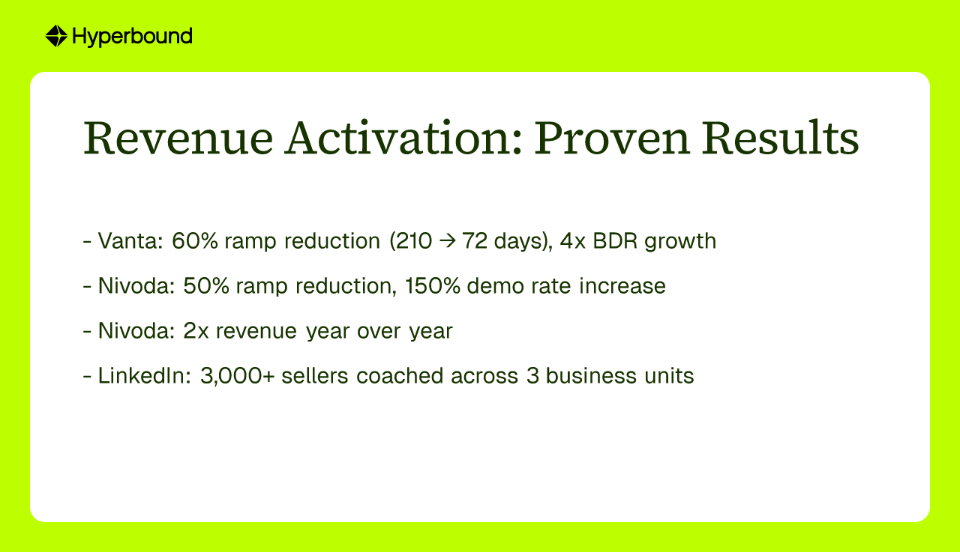
Scaling coaching without scaling headcount isn't a theory. It's what Revenue Activation looks like in practice.
Vanta scaled its BDR team 4x while simultaneously cutting ramp time by 60% (from 210 days down to 72 days) with no new coaching headcount required. Stevie Case, CRO at Vanta, cited this as a direct result of building a systematic, data-driven coaching infrastructure.
Nivoda reduced ramp time by 50% and saw a 150% increase in demo conversion rates, with 2x revenue YoY.
These aren't edge cases. They're what happens when GTM teams stop relying on manager bandwidth and start building operational systems that coach at scale.
The moment to change a deal's outcome isn't in the post-mortem. It's before the call, during the deal, while the outcome is still yours to influence. That's what Hyperbound's Revenue Activation Platform is built to do, connecting practice, real-world performance, and proactive coaching interventions into a single continuous loop.
Stop watching. Start winning.

AI sales coaching uses artificial intelligence to automate and scale the process of training, evaluating, and improving sales team performance. It moves beyond manual call reviews by leveraging AI to analyze 100% of sales conversations, provide personalized feedback, and deliver targeted practice simulations without requiring constant manager oversight.
AI helps scale sales coaching by transforming it from a time-intensive, manual process into an automated, operational system. Instead of relying on limited manager bandwidth, AI platforms can auto-score every call, identify skill gaps, proactively assign targeted practice roleplays, and surface winning moments from top performers, providing personalized coaching to every rep, for every deal.
Traditional sales coaching is ineffective at scale because it is entirely dependent on manager availability. With frontline managers spending only 5-8% of their time on coaching and manually reviewing less than 1% of calls, they lack the visibility and time to provide consistent, data-driven feedback. This results in inconsistent performance, slow ramp times, and missed revenue opportunities.
The primary difference is the shift from analysis to action. Traditional conversation intelligence (CI) tools are reactive; they analyze past calls to tell you what happened. AI coaching platforms, or Revenue Activation Platforms, are proactive; they use that data to trigger automated interventions—like targeted AI roleplays or deal-level risk alerts—to change the outcome of future deals while they are still in progress.
AI roleplays improve sales readiness by giving reps unlimited, on-demand practice without burning live pipeline. Reps can simulate cold calls, objection handling, and discovery sessions against realistic AI buyer personas. This allows them to build muscle memory, refine their talk tracks, and gain confidence before ever speaking to a real prospect, significantly reducing ramp time and improving in-call performance.
Adoption is ensured by embedding coaching directly into the rep's existing workflow and framing it as a tool for improvement, not inspection. By integrating with tools like Slack, CRMs, and LMS platforms, and using gamification elements like leaderboards and scoring, AI coaching becomes a seamless, engaging part of a rep's day. Tying practice performance to real-world outcomes like quota attainment further demonstrates its value and incentivizes use.
Companies using AI sales coaching platforms report significant, measurable business results. For example, customers have seen up to a 60% reduction in new hire ramp time, a 150% increase in demo conversion rates, and multi-fold growth in team size without adding more coaching staff. These outcomes are driven by building a more consistent, data-driven, and effective sales motion across the entire team.
See how Hyperbound can help you scale coaching without scaling headcount →










Use Cases
Legal