You've been in this situation before. A promising sales call is going well when suddenly it stalls. The prospect seems interested but isn't sharing their real challenges. You sense there's more beneath the surface, but you're hesitant to dig deeper. Perhaps you're even afraid of "quantifying the pain" like many sales professionals admit.
Sound familiar?
The difference between average and exceptional sales performance often comes down to one critical skill: the ability to uncover your prospect's true pain points—not just the surface-level problems they initially mention, but the deeper business and personal impacts that create genuine urgency to buy.
This is where the Sandler Pain Funnel comes in—a systematic questioning framework that transforms ordinary discovery calls into powerful consultative interviews that build trust, create urgency, and significantly increase your chances of closing deals.
The Sandler Pain Funnel is a structured series of increasingly focused questions designed to uncover a prospect's pain points at three progressively deeper levels:
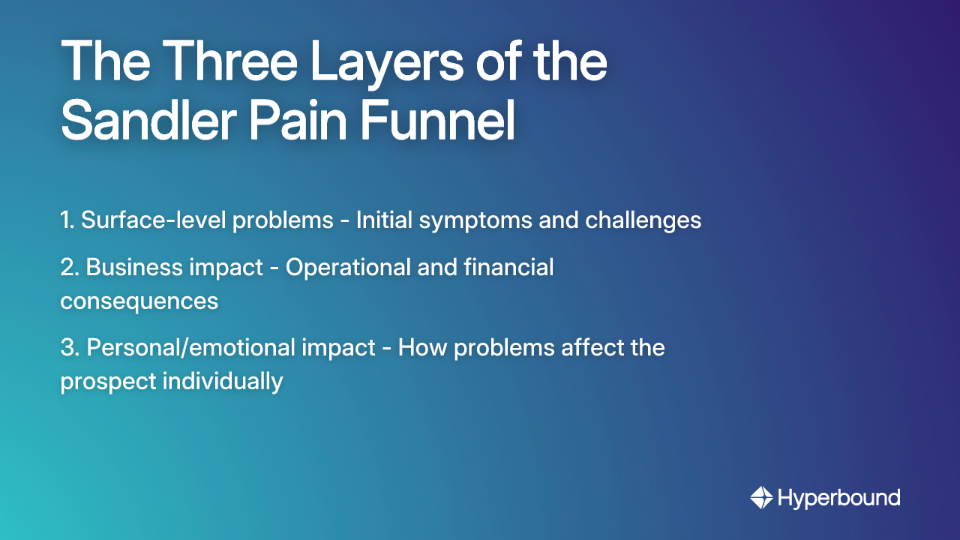
Developed as part of the broader Sandler Selling System, the Pain Funnel shifts the traditional sales dynamic. Instead of pitching features, you become a trusted consultant who helps prospects articulate their own challenges—creating a foundation of trust that dramatically improves your closing rate.
According to MeetRecord, 88% of sales reps report significant improvement in their strategy after implementing Sandler techniques. Why? Because the Pain Funnel answers a fundamental truth in sales: without understanding pain, there can be no urgency—and without urgency, there's no sale.

To master the Pain Funnel, it helps to understand where it fits within the complete Sandler methodology:
.png)
The Pain Funnel operates primarily in stage three, but its impact resonates throughout the entire sales cycle. By uncovering genuine pain points early, you create the foundation for a consultative relationship rather than a transactional one.
The funnel begins with broad, open-ended questions designed to get the prospect talking about their current situation. Many sales reps rush through this stage, eager to present solutions, but patience here is crucial.
Sample questions for Layer 1:
These questions help identify the surface problems but rarely reveal the true motivation to buy. That's why we need to go deeper.
Many sales professionals admit they're "ALWAYS scared of quantifying the pain" as one rep confessed on Reddit. Yet this second layer is where you connect the surface problem to tangible business consequences.
Sample questions for Layer 2:
A useful formula from sales experts: (High-frequency problem + intensity of problem) + (how they've tried to solve in the past) = URGENCY.
The deepest level explores how the problem affects the prospect personally. This creates emotional urgency that often drives the final buying decision.
Sample questions for Layer 3:
At this stage, the "labeling technique" can be particularly effective. Statements like "It sounds like this has really beaten you up" or "It seems this has prevented you from delivering on your strategy" validate the prospect's feelings and encourage them to open up further.
As one sales professional noted, "The important thing isn't what pain they're voicing, just that they're voicing pain." When prospects articulate their own pain, they're much more likely to seek a solution.
To illustrate how the Pain Funnel works in a real conversation, here's a sample call transcript between Sarah (sales rep) and Mark (prospect, VP of Sales):
Sarah: "Thanks for your time today, Mark. To start, can you walk me through your current process for tracking sales activities and managing your pipeline?"
Mark: "Sure. Right now, it's a mess. We use our CRM, but a lot of reps are still using spreadsheets to track their own leads. We just don't have enough resources to handle all of our leads. It's overwhelming!"
Sarah: "I see. How long has that been a problem?"
Mark: "It's gotten really bad over the last year as we've tried to scale the team."
Sarah: "What kind of impact would you say that's having on the business? For example, on your conversion rates?"
Mark: "It's a disaster. Our forecast is never accurate, and I know we're losing deals because follow-up is inconsistent. It's also preventing sales and causing some of our top talent to leave."
Sarah: "It sounds like this has really beaten you up."
Mark: (Pauses) "Yeah, it has. I'm spending my weekends trying to clean up data instead of focusing on strategy. I'm frustrated and my boss is starting to ask questions about our numbers."
Sarah: "What happens if you don't solve this problem in the next quarter?"
Mark: "Honestly? I might not make my numbers again, which could put my position at risk. And even if I keep my job, I'll continue being stressed and overworked."
Sarah: "I appreciate you sharing that, Mark. Based on what you've told me, it sounds like you're dealing with three main challenges: inconsistent CRM usage that's affecting your forecasting, inefficient lead management that's costing you deals, and the personal stress of working weekends just to keep things afloat. Is that accurate?"
Mark: "That's exactly right."
Sarah: "If we could address these specific issues, would you be interested in exploring how our solution might help?"
Mark: "Absolutely. What did you have in mind?"
Notice how Sarah progressed from surface-level questions to business impact and finally to personal consequences. By the end of the conversation, Mark has articulated his own pain points and is now eager to hear about a solution.
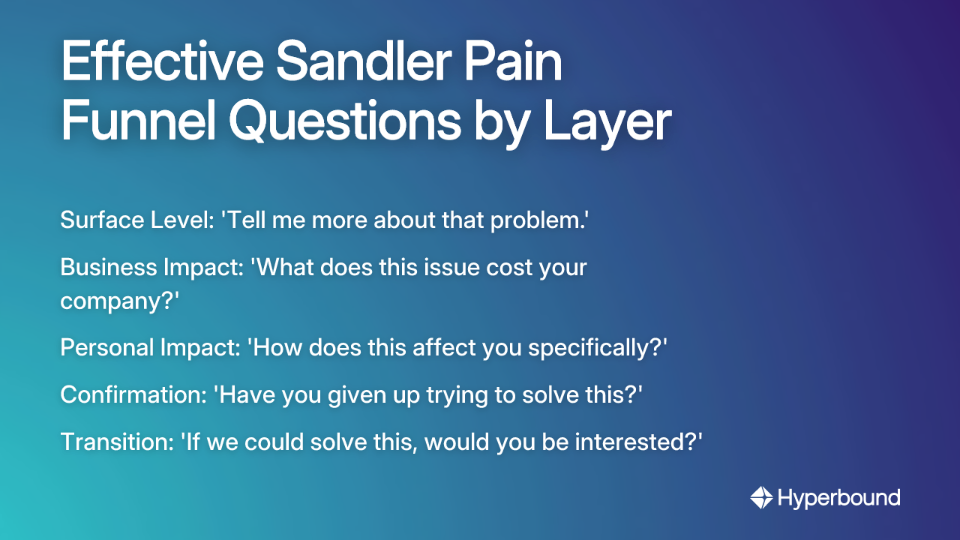
Here's a comprehensive set of Sandler pain funnel sample questions you can adapt to your own sales conversations:
Before diving into pain, establish clear parameters for your conversation. A proper UFC covers the meeting objective, agenda, and expected outcome, which builds trust and shows respect for the prospect's time.
When a prospect asks a premature question like "How much does it cost?", respond with another question to maintain control: "That's a great question. To give you an accurate answer, I need to understand your situation better. Can you tell me more about...?"
Periodically recap what you've heard to ensure accuracy and show active listening: "So what I'm hearing is... Is that correct?"
Once you've fully explored the pain:
The Sandler Pain Funnel transforms the traditional sales approach by focusing on your prospect's problems rather than your product's features. By systematically uncovering pain at progressively deeper levels, you build trust, demonstrate value, and create genuine urgency to buy.
As one sales professional put it, "Without trust and commitment, there's no sale." The Pain Funnel helps you establish both—trust through your consultative approach and commitment through the prospect's own articulation of their pain.
Start implementing these Sandler pain funnel questions in your next discovery call. With practice and patience, you'll find yourself closing more deals by solving real problems rather than simply selling products.
The main purpose of the Sandler Pain Funnel is to systematically uncover a prospect's deep-seated business and personal challenges, creating a sense of urgency for them to seek a solution. Instead of a salesperson pushing a product, this questioning framework guides the prospect to articulate their own problems across three levels: surface issues, business impact, and personal impact. This process builds trust and transforms the sales dynamic from a pitch into a consultative partnership.
Identifying personal pain is crucial because purchasing decisions are often driven by emotion and justified by logic. While business pain (like lost revenue or inefficiency) creates a logical reason to buy, personal pain (like stress, frustration, or fear for one's job) creates the emotional urgency that compels a prospect to act. The Sandler method recognizes that connecting your solution to the prospect's personal stakes is a powerful motivator for change.
There is no fixed number of questions in the Sandler Pain Funnel; it is a flexible framework, not a rigid script. The funnel provides a structure and examples of questions for each level (surface, business, personal). A skilled salesperson adapts their questioning based on the flow of the conversation, using as many or as few questions as needed to thoroughly understand the prospect's pain. The goal is to have a natural, diagnostic conversation, not to check off a list of questions.
If a prospect genuinely has no identifiable pain, they are likely not a qualified buyer at this time, and it's best to disqualify them respectfully. The Sandler system emphasizes that "no pain, no sale." Attempting to sell to someone without a problem to solve wastes time for both you and the prospect. A key part of the process is discovering if there is a real need. If not, you can professionally conclude the conversation and move on to more qualified opportunities.
The Pain Funnel is primarily used in the third stage of the 7-stage Sandler Selling System, which is explicitly called the "Pain" stage. This stage comes directly after establishing rapport and setting an upfront contract. By uncovering pain early in the process, you ensure the rest of the conversation—covering budget, decision-making, and your solution—is relevant and grounded in solving the prospect's confirmed challenges.
To avoid the Pain Funnel feeling like an interrogation, focus on active listening, genuine curiosity, and a conversational tone. It's not just about asking questions, but how you ask them. Use techniques like summarizing what you've heard ("So, what I'm hearing is...") and labeling emotions ("It sounds like that's been frustrating...") to show you're engaged. The goal is to be a trusted advisor helping them diagnose a problem, not an inquisitor extracting information.
Remember, the most successful salespeople aren't those who talk the most—they're those who listen the best and ask the right questions at the right time.
.png)
Ready to transform your sales game? The Sandler Pain Funnel is your first step toward becoming the trusted advisor your prospects actually want to buy from.










Use Cases
Legal