
You've just been handed a budget for sales training. Maybe your company already runs Sandler. Maybe someone on your leadership team swears by it. But you're also hearing about AI sales training platforms that promise 50% faster ramp times and measurable behavior change — and you're wondering: is it time to switch, or is there something more nuanced going on here?
Here's the honest answer: it's not an either/or decision. But to get there, we need to fairly compare both approaches — and then reveal why the most effective enterprise sales training programs in 2026 are doing something different entirely.
Sandler has been a cornerstone of professional sales training for decades, and for good reason. Their Enterprise Selling program was purpose-built for exactly the kind of deal complexity most sales teams dread: long cycles, multiple stakeholders, political landmines, and competitive pressure from every direction.
.png)
The methodology is structured around seven sequential steps:
This isn't a loose framework — it's a systematic playbook for enterprise deal management. And when it works, it really works. Tony Rodoni, SVP of Commercial Sales at Salesforce, has credited Sandler's program with meaningfully boosting rep confidence and performance in complex environments.
Where Sandler genuinely shines:
But here's what the honest, boots-on-the-ground feedback sounds like. Sales reps on Reddit who've been through the program note: "It was nice when I was just starting out because it provided me with structure" — but also "if you've been in sales for five years or more... there's not a ton of groundbreaking stuff in there."
The most common critique isn't that Sandler is wrong — it's that the ROI diminishes for experienced reps, the 9-month commitment feels excessive, and some of the tactics "didn't fly in some markets." As one rep put it plainly: "the reason these programs are so long is simply for reinforcement."
That last point is worth sitting with. Reinforcement is the hardest problem in sales training — and it's exactly where the next generation of tools is winning.
Enter AI-native sales training platforms. And the most important thing to understand about this category is that the best ones aren't trying to replace methodology — they're trying to solve the reinforcement problem that every methodology, including Sandler, struggles with.
Hyperbound coined the term Revenue Activation to describe what happens when teams stop just analyzing call data and start using it to actually change outcomes. It's a meaningful distinction. Most sales training tells reps what to do. Revenue Activation changes what they actually do under pressure, on a live call, in a real deal.
The platform operates on a Practice → Perform → Activate loop:
The measurable outcomes are hard to ignore:
These aren't soft metrics. They're behavioral changes that show up in the pipeline.
Here's how these two approaches stack up across the criteria that matter most to sales leaders evaluating an enterprise sales training program:
.png)
.png)
The table tells a clear story. Sandler wins on methodology depth and structured deal strategy. AI platforms win on reinforcement, scalability, speed to ROI, and workflow integration. But here's the thing — they're not actually competing for the same job.
The most effective enterprise sales training programs in 2026 aren't choosing between a methodology and a behavioral platform. They're using both — intentionally, in combination.
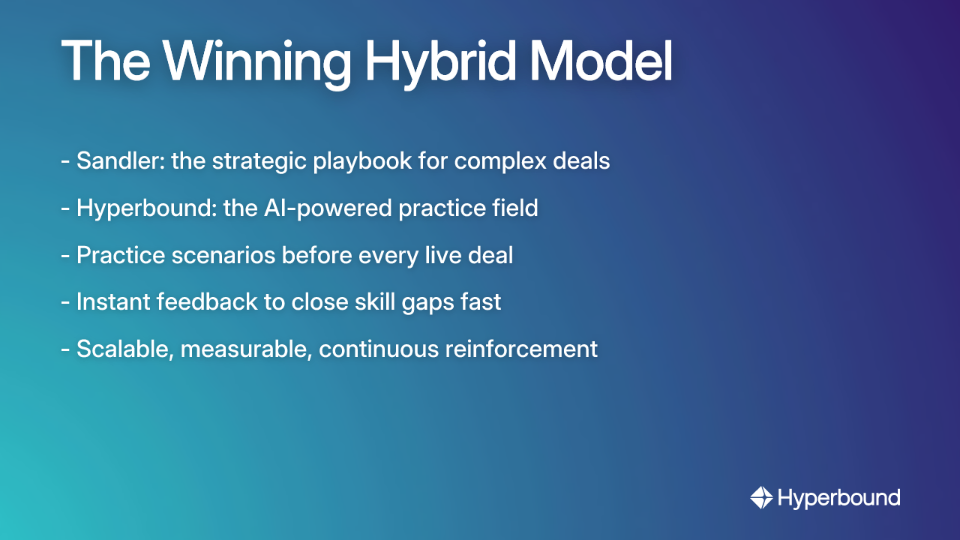
Think of it this way. Sandler gives your reps the playbook: the strategic framework for navigating complex deals, managing multiple stakeholders, and running a structured sales process. It answers what to do and why.
Hyperbound gives your reps the practice field: a flight simulator where they can run that playbook 50 times before their first live deal, receive instant feedback, identify gaps, and close them — before those gaps cost you a deal.
A professional athlete has a coach and a game plan. But they spend the majority of their time in the gym and on the practice field running drills — so that on game day, execution is automatic. That's the model.
The real insight from user research is that reps already intuitively understand this: "I would invest in one weekend seminar and then apply what you have learned during work until you have mastered it." That's the hybrid model in plain language. A focused methodology burst, followed by deliberate, repetitive practice until the behaviors are internalized.
What AI does is make that second phase scalable, measurable, and continuous — instead of relying on managers to schedule enough role-play time or hoping reps review their notes between calls.
This isn't theoretical. Some of the most sophisticated sales organizations in the world are already running this combined approach — using a structured methodology alongside Hyperbound's behavioral reinforcement platform.
Vanta is one of the most compelling examples. By integrating Hyperbound into their onboarding and ongoing enablement, Vanta achieved a 60% reduction in ramp time — cutting it from 210 days down to just 72 days. That single change enabled them to scale their BDR team 4x and grow pipeline 5x. CRO Stevie Case has been direct about the impact: the combination of structured process and AI-driven practice created a compounding effect on revenue outcomes that neither element would have delivered alone.
LinkedIn demonstrates what this looks like at enterprise scale. The company now uses Hyperbound to train over 3,000 sellers across three business units — LinkedIn Talent Solutions, LinkedIn Sales Solutions, and Sales Development — spanning both NAMER and EMEA. Senior PM Alex Herrmann has highlighted how embedding AI practice alongside their core sales training framework has created consistency across a historically difficult-to-standardize global team.
These aren't early adopters running experiments. They're large, mature sales organizations that have made a deliberate decision: methodology provides the strategy, behavioral reinforcement provides the execution engine.
Sandler Enterprise Selling earns its reputation. For teams navigating complex, multi-stakeholder enterprise deals, the methodology provides a structured, proven framework that gives reps clarity and confidence — especially earlier in their careers. If your organization has invested in Sandler, that investment has real value.
But in 2026, methodology alone isn't enough. The real problem in sales training has never been access to frameworks — it's reinforcement. Getting reps to internalize a method so deeply that they execute it under pressure, on a cold call, in a competitive deal, when the prospect pushes back hard. That's the gap.
AI-native platforms like Hyperbound close that gap. By analyzing the behaviors that actually win deals, building hyper-realistic AI practice scenarios, and connecting live call performance back to coaching and practice, Hyperbound turns your methodology from a workshop into a daily behavior. The result is measurably faster ramp times, higher conversion rates, and more consistent execution across your entire team.
The most successful sales leaders in 2026 won't be debating methodology vs. technology. They'll be asking how tightly they can integrate them — and how quickly they can create the kind of compounding behavioral reinforcement loop that separates elite enterprise sales organizations from everyone else.
Sandler Enterprise Selling is a structured sales methodology designed for navigating complex, long-cycle deals with multiple stakeholders. It provides a seven-step playbook that covers everything from market analysis and qualification to solution development and account expansion, giving sales teams a repeatable process for managing large opportunities.
The primary weakness of traditional sales training like Sandler is reinforcement. While the methodology itself is valuable, reps often forget much of what they learn within a month without continuous practice. This "forgetting curve" means the initial investment in training often fails to translate into lasting behavioral change on live sales calls.
AI sales training solves the reinforcement problem by providing a "practice field" for reps to apply their methodology. Platforms like Hyperbound offer AI-powered roleplays that allow sellers to practice specific scenarios (like objection handling or discovery calls) on-demand, receive instant, objective feedback, and build muscle memory before engaging with real prospects. This continuous loop of practice and feedback turns theoretical knowledge into a durable skill.
You don't have to choose; the most effective strategy is to combine them. The best approach uses a proven methodology like Sandler to provide the strategic "playbook" for what to do in complex deals, and an AI platform like Hyperbound to provide the "practice field" for reps to master the execution of that playbook. This hybrid model ensures that your strategic investment translates into consistent performance.
The key measurable benefits of using an AI reinforcement platform include significantly faster new hire ramp time, increased conversion rates, and improved pipeline generation. For example, companies using Hyperbound have reported outcomes like a 50-60% reduction in ramp time, a 150% increase in decision-maker to demo conversion rates, and a 2x faster time to a rep's first won deal.
Modern AI sales training platforms integrate directly into the tools your sales team already uses every day. This typically includes deep integrations with CRMs like Salesforce and HubSpot, communication tools like Slack, and learning management systems (LMS). By embedding practice and coaching within the existing workflow, these platforms make reinforcement a continuous, seamless part of a rep's daily routine, rather than a separate, time-consuming task.
No, AI sales training is valuable for sales reps at all experience levels. While it provides essential structure and accelerates ramp time for new hires, it allows experienced reps to refine specific skills, practice launching new products or messaging, and adapt their approach to changing market conditions. It provides a safe space for even top performers to experiment and improve without risking live deals.
Ready to see what that looks like in practice? Explore how teams at Vanta, LinkedIn, Monday.com, and Autodesk are using Hyperbound Practice to master the conversations that win enterprise deals.








Use Cases
Legal