
If you've ever sat through a demo for a "next-gen AI sales tool" and come away thinking, wait, so it just... summarizes my calls and writes follow-up emails? — you're not alone.
That's not AI-first. That's AI-flavored.
In 2026, the term "AI-first" has been applied to almost everything, diluting what it actually means for sales teams who need results, not features. The frustration is real: "The promise of these tools that they work on autopilot just isn't right."
So before we evaluate any Salesloft alternative, let's define the standard.
A genuinely AI-first sales tool isn't one that auto-generates your email copy, transcribes your calls, or fills out your CRM after a meeting. Those are table stakes now — useful, but nowhere near transformative.
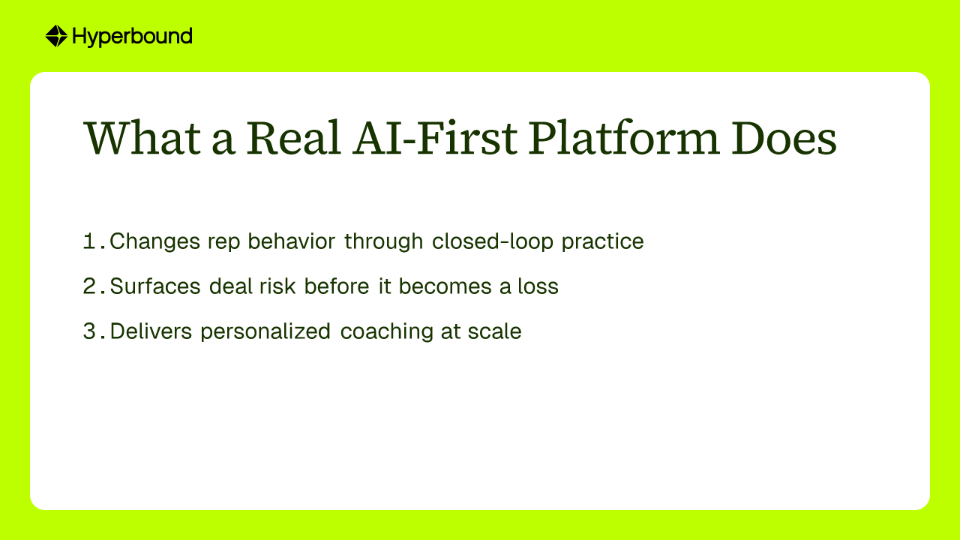
A real AI-first platform does three things that the others don't:
The biggest mistake teams make — as one sales ops leader put it — is "treating [AI] as a rep replacement instead of a workflow multiplier." The tools on this list are evaluated on how well they multiply rep performance, not how many features they've stapled an "AI-powered" label onto.
Here are five of the best Salesloft alternatives for AI-first sales teams in 2026.
Best for: Teams that want AI to close the loop between call intelligence, skill practice, and deal outcomes.
Hyperbound sits in a category of its own because it coined that category: Revenue Activation. Where most tools stop at analysis, Hyperbound starts there and keeps going — using what it finds to actually change what happens next on the floor.
The operational loop looks like this:
Score Real Calls → Identify Skill Gaps → Practice Roleplays → Score Real Calls
Hyperbound Perform automatically scores 100% of customer conversations against custom methodology scorecards. Crucially, it doesn't analyze calls in isolation — it looks across an entire deal's touchpoints to surface deal health insights and early risk signals that would otherwise stay buried until it's too late.
Once a skill gap is identified (say, weak objection handling or thin discovery on multi-stakeholder calls), Hyperbound Practice steps in with targeted AI roleplays — built from 2M+ hours of real B2B sales conversations, not generic scripts. Reps practice with AI buyer personas that respond the way real buyers do, in the exact scenario they struggled with. Bitesized Roleplays mean even tenured reps who'd roll their eyes at another hour-long training module can squeeze in focused reps before their next call.
Above it all sits Kota Activate — the AI Revenue Analyst that orchestrates the whole system, recommending the right coaching intervention at the right time based on what's happening in live deals and in practice sessions.
The numbers:
Hyperbound integrates with Gong, Salesforce, HubSpot, Outreach, Seismic, Highspot, Zoom, and more — so it augments your existing stack rather than replacing it.
Before signing any contract, pressure-test every platform against these three questions. They're designed to separate tools that activate performance from tools that just report on it.
1. Does it change rep behavior, or does it just surface data? Insights without action are just expensive dashboards. Look for a platform with a closed-loop system that includes practice and reinforcement — not just a scorecard. Most tools stop at the insight. Few close the loop.
2. Can it tie coaching directly to deal outcomes? If a vendor can't show you how improving a specific skill in their platform improved deal momentum or win rates, that's a red flag. You need to connect training investment to revenue, not just activity metrics.
3. Does it integrate with your existing call intelligence stack and CRM? Tool sprawl is one of the top complaints from sales ops leaders. An AI-first platform should augment Gong, Salesforce, or HubSpot — not force you to rip them out. Ask for a live integration demo, not just a logos page.
Best for: Teams that want deep call analytics and manager coaching support at scale.
Gong is the market standard for conversation intelligence — and for good reason. It captures, transcribes, and analyzes customer-facing calls with impressive depth, surfacing insights on talk ratios, topic coverage, competitor mentions, and key moments. Leaders like Christine Talcott at ADP have noted that "Gong allows our leaders to coach more effectively."
From an AI-first lens, Gong excels at the Score and Identify phases of the improvement loop. If you want visibility into what's happening across your team's calls, it delivers.
The gap: Gong tells you what happened. It doesn't give reps a native, scalable way to practice fixing it. After a call review where a manager identifies that a rep fumbled a pricing objection, the rep's next shot at that scenario is their next live deal. That's a costly classroom. The loop breaks at "Identify," and closing it still falls on managers with thin bandwidth.
If you're already using Gong and want to close that loop, Hyperbound integrates directly with it — layering practice and deal-level coaching on top of the call intelligence you're already getting.

Best for: Teams prioritizing outbound volume, cadence management, and pipeline top-of-funnel activity.
Outreach is a leading Sales Engagement Platform (SEP) that helps GTM teams build and execute multi-channel outreach sequences across email, phone, and LinkedIn. Its AI features focus on sequence optimization, reply sentiment analysis, and rep activity management.
From an AI-first lens, Outreach is strong on process intelligence — helping teams do more outreach, faster, with better timing. If your bottleneck is getting more at-bats, it's worth a look.
The gap: Outreach's AI is fundamentally oriented around engagement volume and workflow automation — not conversational skill development. As one Reddit user bluntly put it: "The real bottleneck for most small sales teams is not sending more emails." Getting into more conversations is different from winning more of them. Outreach doesn't meaningfully address objection handling, discovery quality, or demo execution. It helps you get to the call; it doesn't make you better on it.
Best for: Organizations that want a dedicated roleplay environment for onboarding and sales training.
Second Nature understands something that most call intelligence tools miss: practice matters. It offers AI-powered simulation environments where reps roleplay sales scenarios before going live. That philosophy is right.
The gap: The execution leaves a critical seam. Second Nature's simulations are built on pre-configured, generic scenarios — not dynamically generated from analysis of your team's actual winning calls. There's a meaningful difference between practicing a generic "CFO objection" persona and practicing the specific objection pattern your top reps handle on deals for your exact ICP.
More importantly, Second Nature operates largely in isolation from live deal performance. It doesn't automatically analyze real calls to identify what a specific rep needs to practice next, then prescribe the right scenario. The feedback loop requires manual setup. For enablement leaders already stretched thin — often one EP supporting 50–100+ reps — that admin overhead is a blocker, not a feature.
Best for: GTM teams that need to scale personalized outreach content without burning out their writers or reps.
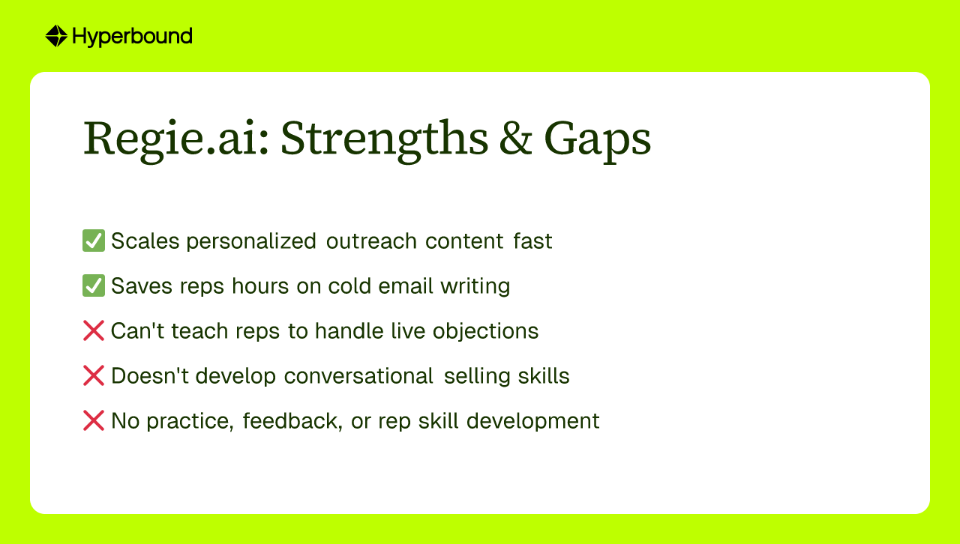
Regie.ai is a strong point solution for the content layer of the sales process — generating personalized emails, sequences, call scripts, and social posts at a pace no human team can match. If your problem is that reps are spending an hour writing a cold email that should take five minutes, Regie.ai solves that.
The gap: Regie.ai addresses the words on the page — not the skills of the person delivering them. It can give a rep a great cold call script. It cannot teach that rep how to handle the first five seconds when the prospect says "actually, we just signed with a competitor." You can have the world's best script and still lose the deal if the rep doesn't know how to think on their feet, navigate a skeptical stakeholder, or run a multi-threaded discovery call. Those are trainable behaviors — and they require practice, feedback, and repetition, not better copy.
In 2026, the question isn't which tool gives you the most data about your sales team. It's which tool does something useful with that data before your next deal slips.
Most Salesloft alternatives on the market have made real progress on one piece of the puzzle: better engagement cadences, richer call analytics, faster content generation. But the highest-performing teams in 2026 aren't choosing between insight and action — they're using platforms that deliver both in a continuous loop.
The shift is from "What happened in that deal?" to "What does my team need to practice to win the next one?"
That's the Revenue Activation model. And right now, Hyperbound is the only platform that closes the full loop — scoring real calls with Perform, turning gaps into targeted practice with Practice, and orchestrating it all with Kota so managers know exactly where to focus their coaching energy and when.
With 3.7M+ AI coaching insights delivered and proof points from LinkedIn, Vanta, Nivoda, and others — the results aren't theoretical. They're showing up in ramp times, demo rates, and pipeline.
If you're evaluating Salesloft alternatives and the AI-first standard we've laid out here is your benchmark, start by asking every vendor on your shortlist those three evaluation questions. Then see who can actually answer them.
An "AI-first" sales tool is designed to fundamentally change rep behavior and improve performance through a closed-loop system of analysis, practice, and coaching. An "AI-flavored" tool simply adds AI features like call summaries or email generation onto an existing workflow. The key difference is activation vs. analysis. AI-flavored tools stop at providing data, while a true AI-first platform uses that data to identify skill gaps, provide targeted practice with AI roleplays, and deliver personalized coaching at scale.
Call intelligence tools are excellent for identifying what happened on a call, but they don't provide a scalable way for reps to practice and fix the identified skill gaps. They tell you a rep struggled with an objection, but the rep's next opportunity to practice is on another live call with a real prospect—a costly way to learn. AI-first platforms like Hyperbound close this loop by turning insights from call intelligence into targeted AI roleplays that improve performance before the next deal is on the line.
A Revenue Activation Platform is a category of sales technology that connects sales enablement and coaching directly to revenue outcomes, moving beyond passive analytics to actively change sales behavior. Coined by Hyperbound, this model uses AI to create a continuous improvement loop: it scores real calls to find skill gaps, uses AI roleplays to let reps practice those skills, and provides AI-driven coaching to ensure the training sticks, thereby "activating" the full potential of a revenue team.
AI roleplay provides sales reps with a safe, scalable environment to practice specific scenarios, like objection handling or discovery questions, until they master them. It allows for unlimited repetitions without risking live deals. Advanced AI roleplay platforms like Hyperbound are built from millions of hours of real sales calls, meaning reps practice against AI buyer personas that respond realistically to their specific challenges. This targeted, on-demand practice builds muscle memory and confidence for better execution on live calls.
Yes, a true AI-first platform is designed to augment, not replace, your existing tools. It acts as a performance layer on top of your current systems. For example, Hyperbound integrates with your CRM (Salesforce, HubSpot), conversation intelligence tools (Gong), and engagement platforms (Outreach). It pulls data from those systems to identify coaching opportunities and then pushes performance insights back, maximizing the ROI of your entire tech stack.
The ROI of an AI sales platform is measured by improvements in core business metrics like reduced ramp time for new hires, increased conversion rates, and higher quota attainment. A Revenue Activation platform directly links coaching and practice activities to deal momentum and win rates. For instance, companies using Hyperbound have seen tangible results like a 60% reduction in ramp time and a 150% increase in demo rate, demonstrating a clear return on investment.










Use Cases
Legal