
You've got conversation intelligence dashboards, Salesforce reports, and a weekly pipeline review on the calendar. Your RevOps team is running queries. Your managers are adding fields to the CRM. And your win rate? Still stuck.
If you're leading a mid-market B2B SaaS sales team — somewhere between 10 and 100 reps, with a frontline manager layer and a RevOps function that produces more reports than results — this situation isn't unique to you. Most mid-market sales teams share the same problem: the average new hire takes months to become fully productive — and that's time your team is burning real pipeline while they're still learning. Ramp timelines are long, skill variance is wide, and the cost compounds every quarter.
The pain here is specific. Your top 10-20% of reps are hitting or exceeding quota. The rest of the team can't replicate what they do. Friday pipeline reviews feel like story time — reps give optimistic updates based on gut feel, and you have no reliable way to separate real momentum from wishful thinking. And every new AE you bring on is a bet: they're learning on live deals, at a cost that compounds across every quarter of underperformance.
Here's the uncomfortable truth: this isn't a data problem. You have data. The real problem is the insight-practice gap — the failure to turn what you know about winning into behaviors reps actually execute, deal after deal.
To close that gap, you need software that works across every stage of the sales execution cycle. This article organizes the best sales win rate improvement software by where it plugs in:
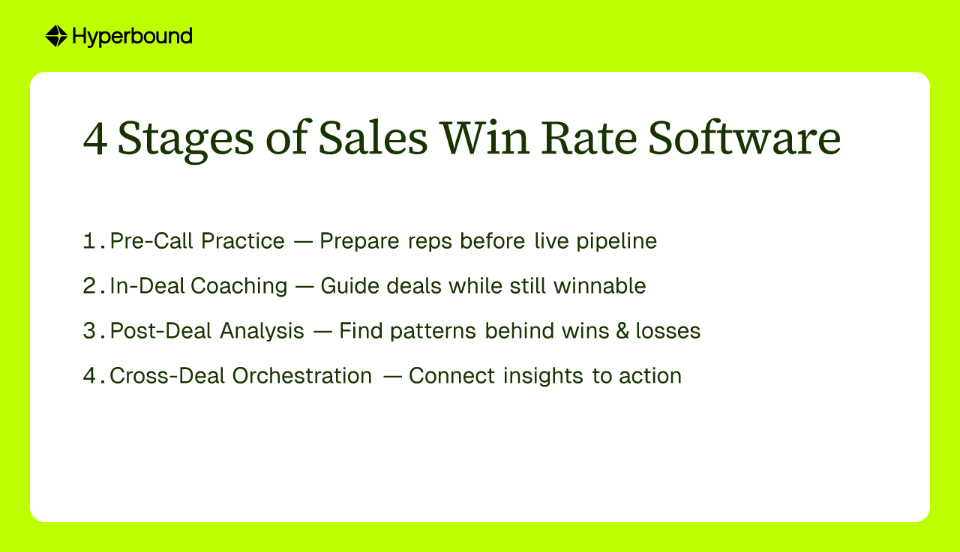
Let's break it down.
Training that "isn't practical and doesn't apply to real-life scenarios" is one of the most consistent complaints from sales reps — and it directly explains why ramp times stay long and skill variance stays wide. (Source)
The problem isn't effort — reps and managers both care. The problem is that most training gives reps knowledge without repetitions. They watch a recording, pass a quiz, and then face a live prospect for the first time in a real deal with real stakes.
AI roleplay platforms solve this by giving reps a safe environment to get at-bats before the pipeline is on the line.
Hyperbound Practice is the strongest sales readiness platform for mid-market B2B SaaS teams. Unlike tools built on generic scripts, Hyperbound's AI buyer personas are trained on 2M+ hours of real B2B sales conversations — and can be built from analysis of your own closed-won deals, so reps are practicing against the objections and buyer dynamics that actually exist in your market.
What makes it work for your team:
The proof points speak for themselves. Vanta reduced ramp time by 60% — from 210 days down to 72 — while growing their BDR team 4x and hitting 5x pipeline. Nivoda achieved a 50% ramp reduction alongside a 150% increase in DM-to-demo conversion rates.
Other tools in this space:
Your managers want to coach. The math just doesn't allow it. Frontline sales managers spend only 5–8% of their time on coaching and listen to less than 1% of their team's calls. Deal risk gets escalated in the weekly pipeline review — which means you find out too late to do anything about it.
The fix isn't more process. It's software that surfaces deal health signals automatically, so managers can focus their limited coaching time on the deals and reps where it matters most.
Most conversation intelligence tools analyze calls individually. They'll tell you a rep talked too much in one meeting or missed a discovery question. Useful — but incomplete.
Hyperbound Perform looks across all touchpoints in a deal — every recorded call, email interaction, and stakeholder engagement — and surfaces what's helping or hurting the opportunity at the deal level. It identifies risks while deals are still winnable, not after they've slipped to "closed-lost."
Key capabilities for mid-market SaaS teams:
Important framing: Perform is not a forecasting tool. It provides the behavioral signals — what's actually happening in buyer conversations — that make your forecast inputs more trustworthy. The result may be better forecast accuracy, but that's an outcome of better execution, not the pitch.
"We closed our strongest quarter ever using Perform internally before customer release." — Atul Raghunathan, Co-founder, Hyperbound

Other tools in this space:
After a deal closes — won or lost — an important question goes unanswered: why?
Win/loss reviews based on rep self-reporting are notoriously unreliable. Reps attribute losses to pricing, timeline, or "we just weren't a fit." Rarely do they flag their own discovery gaps, failure to multi-thread, or inability to quantify business impact. The behavioral patterns that actually predict outcomes stay buried.
Conversation intelligence platforms exist to surface those patterns at scale.
Here's where most of these tools hit a wall: they tell you what happened. They don't close the loop on changing it. You get a dashboard showing that reps who fail to multi-thread lose at 2x the rate. That's a valuable insight. But insight alone doesn't make your reps better at multi-threading next quarter. That's the insight-practice gap — and closing it is the job of the final stage.
Data from Gong stays in Gong. Coaching notes from managers stay in spreadsheets. Practice modules sit in your LMS untouched. Nothing is connected, and nothing compounds.
This is why win rates stagnate despite growing your tech stack. You're not suffering from a lack of tools — you're suffering from a lack of orchestration.
Hyperbound coined the term "Revenue Activation" to describe what happens when teams stop analyzing data and start using it to change outcomes. The orchestration layer that makes this possible is Kota Activate.
Kota is Hyperbound's AI assistant — an AI Revenue Analyst that sits above Practice and Perform, connecting deal-level insights to targeted coaching and practice interventions in real time.
The operational loop looks like this:
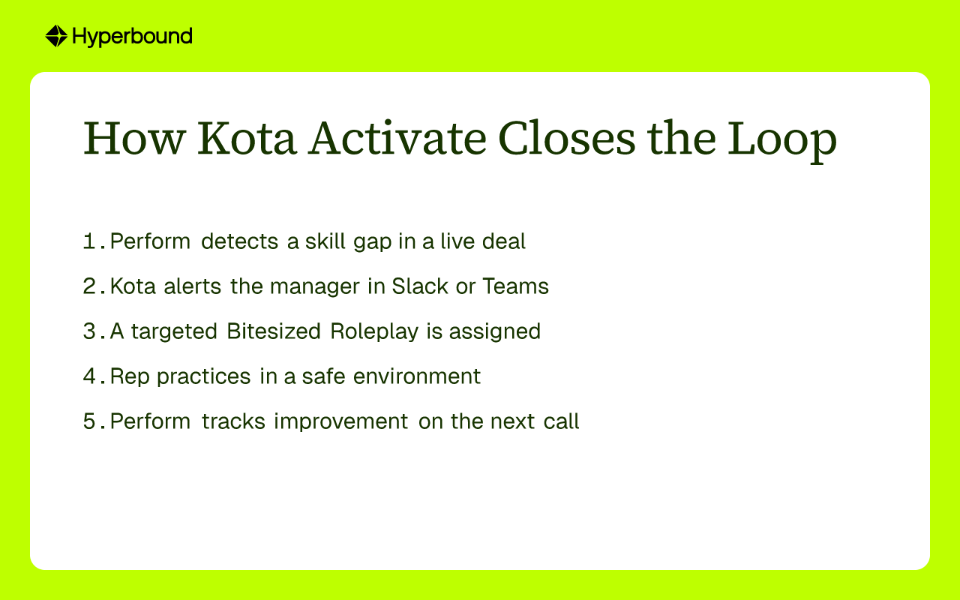
Key capabilities:
Customers like Monday.com, Notion, and Supabase use Hyperbound's connected Practice-Perform-Activate model to build consistent execution across their sales organizations — not just top-performer outliers.
Before you invest in any of this software, you need to know what you're measuring against. According to Sales Motion's 2026 Benchmark Report, the average B2B win rate is approximately 21% across all opportunities and ~29% for qualified opportunities. A healthy range for most B2B SaaS teams sits between 20-35% — but the right target depends heavily on your ACV.
.png)
(Source: optif.ai B2B SaaS Win Rate Benchmarks by Deal Size)
Factors that drive meaningful win rate improvement:
The most important benchmark, though, is your own. If your win rate on qualified opportunities has been flat for two or three quarters, that's your signal that more data isn't the answer. It's time to change what happens in the room.
If you've read this far, you likely recognize your team in more than one section above. That's by design. Win rate isn't a single-point problem — it's a system problem.
The software categories above each address a real gap: Pre-Call Practice builds reps before they burn pipeline. In-Deal Coaching catches risk while deals are still recoverable. Post-Deal Analysis shows you the patterns behind your wins and losses. And Cross-Deal Orchestration is what connects them all — turning insights into behavior change that actually compounds over time.
Most tools solve one piece. Hyperbound is the only Revenue Activation Platform built to connect all four stages — closing the insight-practice gap that keeps win rates stuck for mid-market SaaS teams with the data, the managers, and the ambition to grow.
The insight-practice gap is the failure of sales teams to turn data-driven insights about what wins deals into consistent behaviors that reps execute on live calls. Many teams have access to analytics that reveal winning patterns, but this knowledge often stays in dashboards. Reps don't get enough targeted practice to apply these insights under pressure, leading to stagnant win rates despite having more data.
Sales win rate improvement software works by addressing the entire sales execution cycle, from pre-call practice and in-deal coaching to post-deal analysis. The most effective platforms connect these stages, using insights from live deals to automatically assign targeted practice. This creates a continuous improvement loop that builds winning skills and behaviors across the team.
Revenue Activation is the process of turning sales data and insights into measurable changes in rep behavior and, ultimately, better sales outcomes like higher win rates. Coined by Hyperbound, this concept moves beyond passive data analysis to an active system that connects insights about what works directly to targeted, automated practice and coaching interventions.
AI sales roleplays are more effective because they provide a safe, scalable, and personalized environment for reps to get realistic practice before engaging with live prospects. Unlike traditional training which focuses on knowledge transfer, AI roleplays build muscle memory. Reps can practice handling specific objections and navigating complex conversations, which builds confidence and competence without risking live pipeline.
A good B2B SaaS win rate for qualified opportunities typically falls between 20% and 35%, but it varies significantly based on your average contract value (ACV). For smaller deals (under $10K ACV), a win rate around 31% is strong, while for large enterprise deals (over $100K ACV), the rate is often closer to 15%. The most important benchmark is your own trend; if your win rate has been flat for several quarters, it signals a need to improve sales execution.
While tools like Gong and Chorus are excellent for analyzing calls and identifying what happened, Hyperbound is designed to actively change what happens on the next call. Hyperbound is a complete Revenue Activation platform that connects insights to action. It uses its analysis of live deals to automatically trigger targeted AI roleplay practice, closing the insight-practice gap where other tools only provide data.
Ready to see how Vanta, Monday.com, and Notion activate their revenue? Start a conversation with Hyperbound.










Use Cases
Legal