
You're staring at your CRM dashboard. The win rate is stuck at 22% — same as last quarter, same as the quarter before that. You have call recordings piling up in your conversation intelligence platform, a pipeline full of data, and a team full of reps who are working hard. But the number won't budge, and you don't have a clear playbook for what to actually do about it.
This is the most common frustration in sales leadership: the gap between insight and action. Many managers have the data. Few have a structured system for turning it into rep behavior change.
There's another wrinkle. When you do roll out a coaching methodology, your reps push back. They say it makes them "come off as a complete phony." They lose the authentic connection that actually builds trust. As one rep put it, "prospects can smell it" when a conversation is overly scripted. They're not wrong.
The goal of a coaching framework isn't to turn reps into robots. The best ones are "training wheels to boost your confidence," not rigid scripts. They build a shared language for improvement and create consistent feedback loops that compound over time.
Below are 7 sales win rate coaching frameworks, ranked by their potential impact — from foundational tactics to a complete, data-driven system. Each includes a "what it looks like in practice" section and an honest look at where it breaks down.
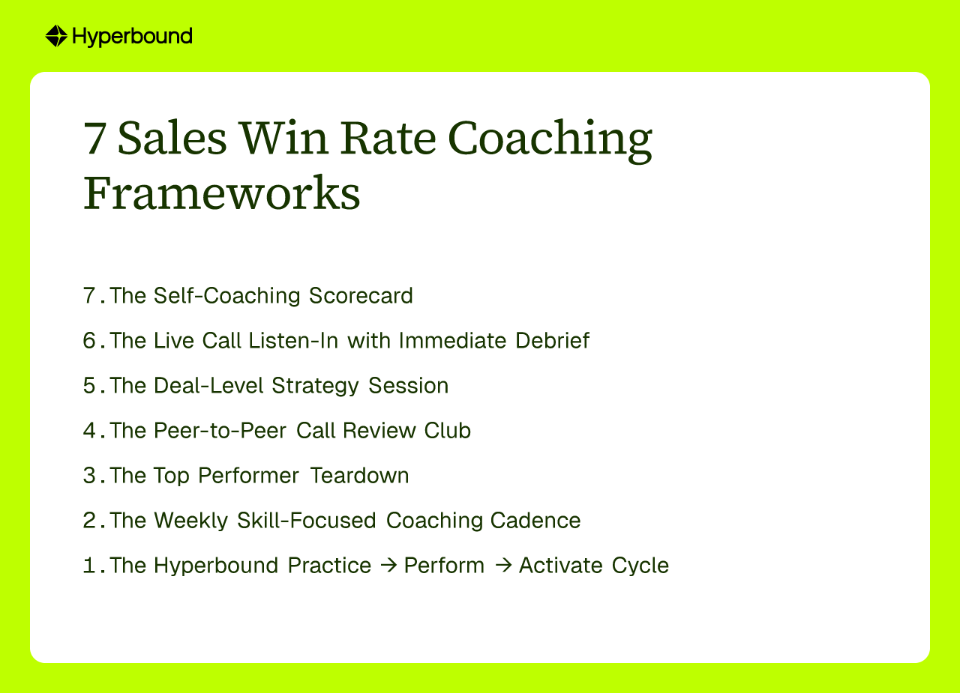
The most accessible starting point for any team. This framework empowers reps to build self-awareness by grading their own performance against a standardized rubric after each call.
What it looks like in practice:
Where it breaks down: Without external feedback, reps can't identify their own blind spots. Self-assessments are prone to bias — reps tend to rate themselves favorably on the skills they're weakest in. Progress is slow and inconsistent without a manager or peer to challenge their perspective.
The classic manager "ride-along," updated for remote selling. A manager silently joins a live call and provides immediate, contextual feedback in a short debrief the moment the prospect hangs up.
What it looks like in practice:
Where it breaks down: It's fundamentally unscalable. Research shows managers spend only 5–8% of their time coaching and listen to less than 1% of their team's calls. And when reps know they're being observed, many become less natural — as one rep noted, "I actually come off less authentic when I'm too focused on 'doing it right.'"
This framework zooms out from a single call to the overall strategy for a critical deal. Instead of coaching conversational skills in isolation, it focuses on pipeline integrity and deal execution — multithreaded deal alignment, qualifying the compelling event, and confirming champion influence.
What it looks like in practice:
Where it breaks down: These sessions frequently devolve into pipeline reviews in disguise. As many VPs and CROs experience firsthand, they're often "hours of guesswork" because the data is filtered through the rep's optimistic summary — not objective signals from actual buyer conversations. You identify what needs doing, but not how to coach the rep to do it better next time.
A structured, recurring session where reps review and critique each other's calls in a group setting. This leverages the team's collective experience and builds a culture of shared accountability that doesn't rely entirely on manager bandwidth.
What it looks like in practice:
Where it breaks down: This only works in a high-trust environment. Without strong facilitation, sessions can devolve into unproductive feedback or reinforce bad habits if the strongest performers aren't actively engaged. It also shares a blind spot with the self-coaching scorecard — the team may collectively miss patterns that only become visible across many calls.
Instead of coaching from intuition, this framework reverse-engineers success. You systematically analyze the calls of your top performers to extract the specific "winning behaviors" that correlate with closed-won deals — then use those findings as the objective standard for coaching everyone else.
What it looks like in practice:
Where it breaks down: Manually reviewing even a handful of calls takes hours. And as one sales veteran puts it, "what works for one person isn't necessarily going to work for me" — a top performer's instinctive style doesn't always transfer. You may also mistake correlation for causation: a behavior that accompanies winning may not be the behavior driving the win.
A highly structured, recurring 1-on-1 dedicated exclusively to skill development. The key differentiator from standard pipeline check-ins: this framework enforces a hard separation between coaching and deal review, which is one of the most common failure points for frontline managers.
Research shows that reps who receive consistent coaching hit quota at higher rates, and teams with consistent coaching see measurably better revenue outcomes. The structure matters.
What it looks like in practice:
A tight 30-minute weekly agenda:
Where it breaks down: The effectiveness ceiling is entirely determined by the manager's coaching skill. Most frontline managers were promoted for being great sellers — not great coaches. The roleplay portion especially suffers without a realistic, pressure-tested simulation environment. At scale across a large team, the time investment also becomes unsustainable.
The most complete and data-driven sales win rate coaching framework on this list. Where every other framework on this list relies on manager availability, manual data gathering, or rep self-reporting, this one closes all three gaps simultaneously by connecting real-world deal performance to targeted practice — automatically, at scale.
This is the core of Revenue Activation: turning insights into outcomes, not just reports.
What it looks like in practice:
Where it breaks down: This framework requires leadership commitment to a data-driven coaching culture — and investment in a platform to run it. It amplifies and scales great coaching, but it doesn't replace the human judgment required for deal strategy, motivation, or managing complex team dynamics. Adoption also requires organizational buy-in to move past "the way we've always done it."
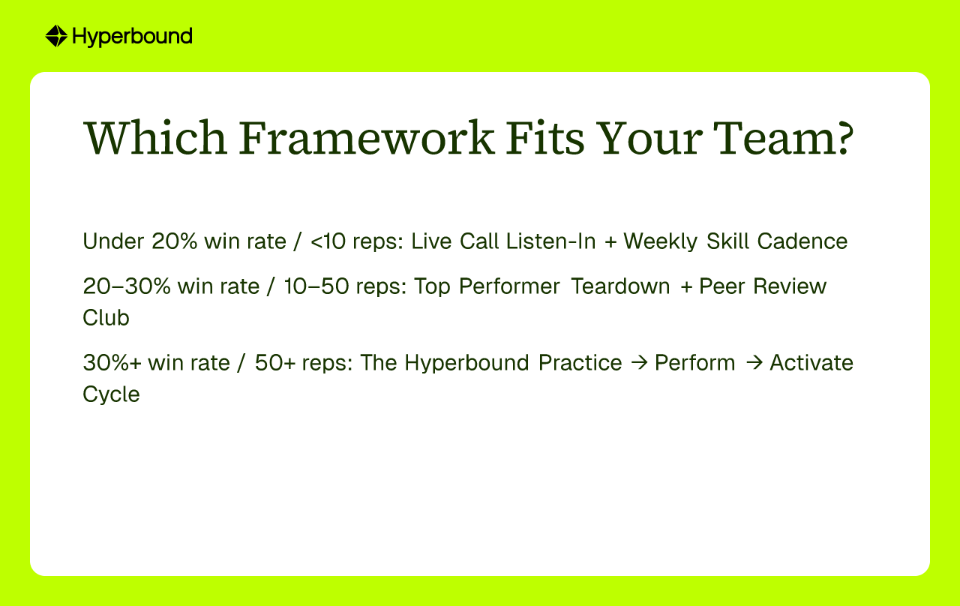
Not every team needs the same starting point. Here's a practical guide based on team size and current win rate:
Win rate under 20% | Team under 10 reps Focus on direct, high-frequency intervention. Start with #6 (Live Call Listen-In) and #2 (Weekly Skill-Focused Cadence). Your biggest lever right now is manager-to-rep face time and consistent feedback. Keep it simple.
Win rate 20–30% | Team of 10–50 reps You've found your baseline — now build consistency. Use #3 (Top Performer Teardown) to create a data-backed coaching playbook, and #4 (Peer Review Club) to leverage your team's collective knowledge. This is also the ideal stage to introduce technology that automates the manual work in those frameworks.
Win rate above 30% | Team of 50+ reps At this scale, you're not looking for dramatic fixes — you're compounding marginal gains across a large floor. Manual coaching can't get you there. #1 (The Hyperbound Cycle) is the right framework. You need an automated system that identifies 1–2 behavioral improvements across every rep and turns them into consistent action. Vanta used this system to achieve a 60% ramp reduction — cutting time to productivity from 210 days to 72 — while scaling their BDR team 4x.
Every framework on this list has merit. The ones that fail tend to fail for the same reason: the gap between insight and action. A manager spots a pattern on a call recording, makes a mental note, and then the week moves on. A rep gets feedback in a 1-on-1 but has no structured way to practice the new behavior before their next real call. Call scoring without practice loops is just expensive reporting.
The frameworks that actually move your sales win rate number share one thing in common — they create a tight, repeatable cycle between identifying what needs to change and verifying that the change happened.
If you're ready to build that loop at scale, see how Hyperbound's Revenue Activation platform connects Perform, Practice, and Activate into a single coaching engine.
A sales win rate coaching framework is a structured system designed to improve a sales team's performance by turning data and insights into consistent, repeatable rep behaviors. Its goal is to provide a shared language for improvement and create feedback loops that directly impact the percentage of deals won.
Many sales coaching efforts fail due to the "gap between insight and action." Managers may have access to call recordings and performance data but lack a systematic process to translate those insights into behavioral changes. Coaching often becomes inconsistent, unscalable, or gets deprioritized in favor of pipeline reviews, meaning valuable feedback is never implemented.
The best coaching frameworks act as "training wheels," not rigid scripts, to build confidence and skill. Focus on core principles and behaviors—like asking better discovery questions or handling specific objections—rather than word-for-word lines. This empowers reps to adapt the techniques to their own authentic style, building genuine connections with prospects rather than sounding like a "phony."
The right framework depends on your team's size and current win rate. For smaller teams with low win rates (<20%), start with direct, high-touch methods like the Live Call Listen-In (#6) and a Weekly Skill-Focused Cadence (#2). For larger, more established teams, focus on scaling consistency with a Top Performer Teardown (#3) and Peer Review Club (#4), or implement a fully automated system like The Hyperbound Cycle (#1) for marginal gains at scale.
Deal-level coaching (like The Deal-Level Strategy Session, #5) focuses on the overall strategy to win a specific opportunity, such as multithreading or identifying a compelling event. Skill-level coaching (like The Weekly Skill-Focused Cadence, #2) zooms in on specific conversational competencies, such as objection handling or setting next steps. An effective coaching program needs both to ensure deals are strategically sound and executed with skill.
AI can solve the core scalability problem in sales coaching. It can automatically analyze 100% of sales calls to identify skill gaps and winning behaviors, eliminating the manual review bottleneck. Platforms like Hyperbound can then trigger targeted, automated practice sessions (like AI roleplays) to help reps fix those gaps, creating a closed loop between performance insight and skill development that managers can't replicate manually across an entire team.









Use Cases
Legal