
Ask any sales leader what happened to their last big training rollout, and you'll hear a familiar story. "We spent $ rolling out one of the big names and it ended up being 15% of the people actually logging in." Sound familiar? Most sales training platforms look impressive in a demo, then quietly become another tab your reps ignore.
The core problem isn't that sales teams don't want to get better. It's that most tools measure completion, not behavioral change. Research consistently shows that 80% of training content is forgotten within 30 days — and yet most platforms still report a green checkmark and call it a win.
Connecting sales training to revenue outcomes requires a fundamentally different approach. Instead of asking "Did the rep finish the module?", the right tools ask "Did this practice change how the rep performs on live deals?" Here are five platforms that actually generate revenue signals — and how they fit together.
Revenue signal: Direct, measurable link between practiced behaviors and live deal performance.
Hyperbound is built on a straightforward premise: data alone doesn't change outcomes. You need a way to turn insights into practice, and practice into better execution on real deals. Hyperbound calls this "Revenue Activation," and it works across three connected layers.
Practice: Reps master conversations before high-stakes calls using AI roleplays trained on 2M+ hours of real B2B sales conversations — not generic scripts. The AI buyer personas push back the way real prospects do, covering cold calls, discovery, objection handling, demos, renewals, and upsells. Critically, Bitesized Roleplays let reps practice in 5–10 minute sessions embedded directly in their Slack, calendar, CRM, or LMS — so the tool plugs into daily workflows instead of living in a forgotten tab.
Perform: Hyperbound Perform analyzes live deal activity across all touchpoints in a deal — not just a single call in isolation. Where most call tools review conversations one at a time, Perform rolls up insights across every interaction in an opportunity to surface deal momentum, early risk signals, and specific next steps. Managers get scalable deal inspection without needing to listen to recordings manually.
Activate: Kota, Hyperbound's AI agent, sits above both products and orchestrates coaching. It analyzes practice performance alongside real-call data, identifies skill gaps, and can automatically generate a targeted roleplay based on an objection a rep fumbled on a live call. Available in Slack, Teams, or inside the platform.
The operational loop looks like this: Score Real Calls → Identify Skill Gaps → Practice Roleplays → Score Real Calls. Every cycle tightens execution.
The results bear it out. Vanta used Hyperbound to cut ramp time by 60% (from 210 to 72 days) and grow pipeline 5x. Nivoda saw a 50% ramp reduction alongside a 150% increase in demo conversion rate. These aren't completion metrics — they're revenue outcomes tied directly to training behavior.
What it can't do alone: Hyperbound's power compounds when integrated with a call intelligence platform like Gong and a CRM like Salesforce or HubSpot. Its built-in Call Recorder covers teams without an existing recording solution, but teams with deep Gong investments benefit from connecting both.
Revenue signal: What top performers say and do differently to close deals.
Conversation intelligence platforms record, transcribe, and analyze real customer-facing conversations to surface patterns that drive outcomes. They build a direct correlation between conversation behaviors — talk-listen ratio, question frequency, topics raised — and results like win rates and sales cycle length. Managers can clip and share the best moments from call recordings to scale coaching without scheduling ride-alongs.
These tools also generate deal risk alerts based on conversational cues — flagging opportunities where key stakeholders have gone quiet or critical topics never came up. For pipeline reviews, that's a significant upgrade over rep intuition.
What it can't do alone: Conversation intelligence is exceptional at post-call analysis — it shows you what happened and where the conversation went sideways. But it doesn't offer a structured, safe environment for reps to practice and correct those mistakes before the next high-stakes call. It identifies the problem; it doesn't provide the repetitions needed to fix it. That practice layer is exactly what Hyperbound fills — and because Hyperbound integrates directly with leading conversation intelligence tools like Gong, identified skill gaps from real calls can automatically feed into targeted AI roleplays.
Revenue signal: Content completion and knowledge consumption baselines.
Platforms like Seismic and Highspot serve as the centralized repository for everything a rep needs to know: playbooks, messaging guides, competitive battlecards, onboarding modules, and product training. For teams that have struggled with scattered resources across different logins, having one place where new reps can find every script, process, and training asset dramatically reduces ramp friction.
Using SCORM tracking, these platforms measure who has completed required training modules and how they scored on knowledge checks. It's a foundational signal: Did the rep consume the material?
What it can't do alone: Consumption isn't application. A rep can score 100% on a SCORM module about objection handling and still freeze up when a prospect says "your competitor is half the price." These platforms deliver static content — they can't provide the dynamic, interactive repetitions that build real skill. The good news: Hyperbound's SCORM integration lets you embed live AI roleplays directly inside Seismic or Highspot, bridging the gap between knowing the playbook and being able to execute it under pressure.
Revenue signal: Correlation between framework adoption and sales performance metrics.
Dedicated methodology platforms — those built around Challenger, MEDDIC, SPIN Selling, or similar frameworks — provide structured curriculum and certification that gives sales teams a common language and a repeatable process. The idea is that consistent application of a proven framework should show up in higher win rates, larger average deal sizes, and shorter sales cycles over time.
Training Industry research points to methodology adoption as one of the more reliable lagging indicators of training effectiveness: if quota attainment climbs after a MEDDIC certification initiative, you can draw a reasonable line between the two. These platforms also give managers a consistent vocabulary for deal coaching — both sides of the conversation know what "identified economic buyer" means.
What it can't do alone: Methodology is a framework, not a script. Passing a certification exam doesn't guarantee a rep can apply MEDDIC on a live discovery call with a skeptical CFO. Reps typically leave certification workshops energized, then gradually revert to old habits under the pressure of a real pipeline. The missing layer is ongoing application feedback — a way to score whether the methodology is actually showing up in live conversations. Hyperbound's AI scorecards can evaluate real calls against a specific methodology, turning a one-time certification into a continuous compliance signal.
Revenue signal: Predictive insights into deal health and pipeline risk.
Revenue intelligence platforms sit on top of your CRM and analyze deal-stage velocity, stakeholder engagement, activity gaps, and historical patterns to flag opportunities that are at risk of stalling or being lost before the quarter closes. They transform pipeline reviews from hours of reps giving optimistic updates into a data-driven conversation grounded in actual sales activity.
Where conversation intelligence platforms surface risk through conversational signals, revenue intelligence tools surface it through CRM activity patterns — complementary lenses on the same problem. Both help managers move from "happy ears" to an evidence-based view of what's actually likely to close.
What it can't do alone: Revenue intelligence tools are excellent at identifying what is happening in the pipeline but often can't explain why. A deal that has stalled after a demo is a data point — but the root cause is almost always behavioral. Did the rep fail to establish a champion? Miss a key pain question? Get outmaneuvered on a competitive objection? Without the conversational layer from a conversation intelligence tool or the behavioral training data from Hyperbound, the "why" stays a black box. Fixing a stalled deal requires knowing which specific behavior broke down — and then giving the rep a way to practice doing it differently.
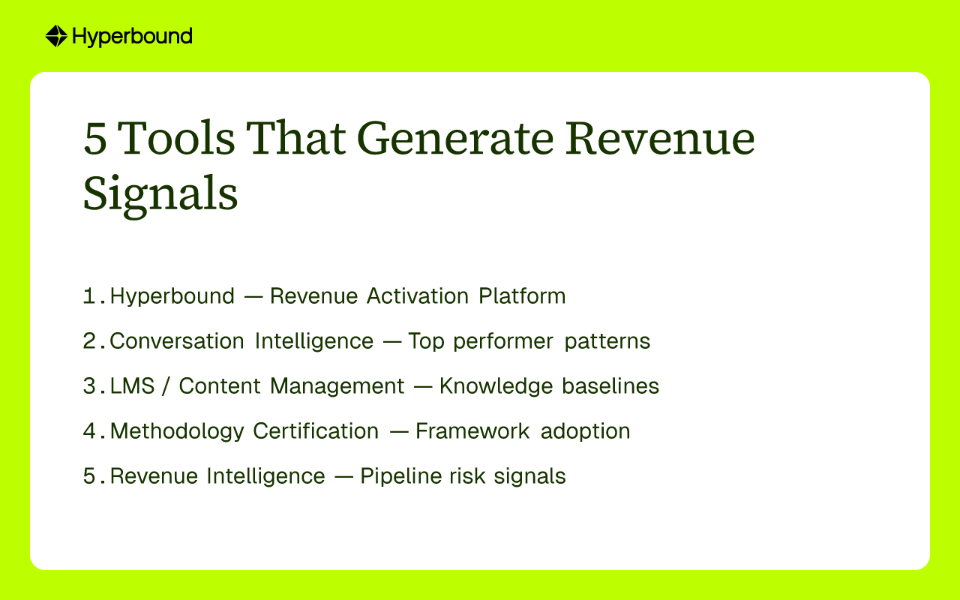
Each tool in this stack contributes a distinct revenue signal:
The modern sales enablement challenge isn't a shortage of data. It's that the signals live in separate systems with no coherent path from observation to action. Hyperbound functions as the orchestration layer: it pulls skill gap signals from Gong recordings, validates knowledge consumption from your LMS, scores real calls against your methodology, and generates targeted AI roleplays to close the gaps — then measures whether live call performance actually improved.
That's the continuous improvement cycle that connects sales training to revenue outcomes: Score Real Calls → Identify Skill Gaps → Practice Roleplays → Score Real Calls. Repeat every week, for every rep, at scale.
Stop measuring training success with green completion checkmarks. The teams pulling ahead aren't the ones with the most content — they're the ones with the shortest feedback loop between what happened on a call and what the rep practices next.
The biggest problem is that they measure activity completion, not behavioral change that impacts revenue. Most platforms focus on whether a sales representative has finished a module, but this fails to connect training efforts to actual performance improvements on live deals, especially since 80% of training content is forgotten within 30 days.
A Revenue Activation Platform like Hyperbound focuses on turning insights into practice and improved performance, while a standard LMS (Learning Management System) primarily serves as a repository for content and tracks knowledge consumption. An LMS can confirm a rep has reviewed a playbook, but Hyperbound provides AI roleplays to ensure they can actually execute that playbook under pressure and measures the impact on real calls.
AI role-playing provides a safe, scalable, and consistent environment for reps to practice real-world sales scenarios without risking live deals. Unlike traditional role-playing, AI allows for unlimited repetitions on-demand. Platforms like Hyperbound use AI trained on millions of real sales calls to simulate realistic objections, providing instant, unbiased feedback to help reps master their skills quickly.
They provide data-driven insights into sales activities, but from different angles. Conversation Intelligence tools (e.g., Gong) analyze what is said on calls to identify winning behaviors and conversational risks. Revenue Intelligence tools analyze CRM data to flag pipeline risks based on activity patterns and deal velocity. Both are excellent at identifying problems, which a platform like Hyperbound then helps solve through targeted practice.
Yes, a key strength of a Revenue Activation Platform like Hyperbound is its ability to integrate with and enhance your existing tools. It can pull skill gap insights from conversation intelligence platforms, embed practice modules directly into your LMS, and correlate practice data with deal outcomes in your CRM. This creates a closed-loop system from insight to action to results.
The return on investment (ROI) is measured in direct revenue outcomes, not just training completion. Companies that connect training to performance see tangible results like faster ramp times for new hires, higher conversion rates, and increased quota attainment. For example, by focusing on this model, Vanta cut new hire ramp time by 60% and grew their pipeline 5x.
Curious how Hyperbound fits into your existing stack? See how it works →










Use Cases
Legal