
Most sales onboarding programs are built around a flawed premise: if reps know enough, they'll sell enough.
So companies spend weeks transferring knowledge (product demos, company history, CRM walkthroughs) and then wonder why new hires still can't close anything. As one sales professional put it on Reddit, "Sales training tends to just be recorded product demonstrations with no real selling experience involved." The rep graduates onboarding knowing the product cold, but freezes the moment a real buyer pushes back.
That gap between knowledgeable and deal-ready is where revenue gets lost.
The numbers make this painful to ignore. Sales enablement leaders know that most training content is forgotten within weeks without consistent reinforcement. Frontline managers, the people best positioned to close the gap through coaching, dedicate only 5–8% of their time to it. The rest gets swallowed by pipeline reviews, admin, and firefighting. And every week a new rep spends learning on the job costs you deals, pipeline, and real money.
The industry is waking up to a better approach. The shift isn't about more call recordings to review. It's about intervening before the rep burns live pipeline. It's about creating safe environments where reps can fail fast, get corrected instantly, and walk into their first real conversation already confident. This is the core idea behind the emerging Revenue Activation category: stop watching what happened on calls and start shaping what happens next.
Here are 7 practical sales training tactics designed to close the readiness gap and shorten time to first revenue for every rep you hire.
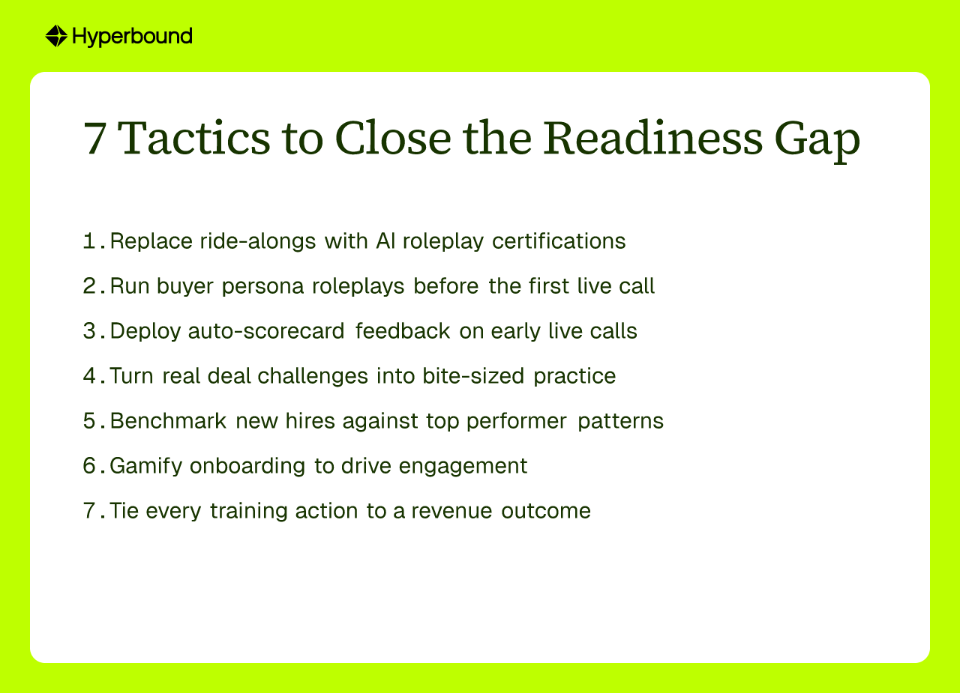
The standard onboarding model leans heavily on shadowing. A new AE follows a top rep around for two weeks, sits in on calls, and is expected to absorb what makes a great seller through proximity. The problem? It doesn't scale, and it actively hurts your best performers.
As one sales manager noted online, after management kept assigning top reps to every new hire for shadowing, "his numbers tanked", with one rep doing "30% less selling because she's babysitting."
The fix is to make certification objective, scalable, and decoupled from your top reps' calendars.
Hyperbound Practice replaces subjective ride-alongs with standardized AI roleplay certifications. Reps practice cold calls, discovery conversations, and objection handling against AI buyer personas trained on 2M+ hours of real B2B sales conversations, not generic scripts. They can fail safely, iterate quickly, and receive instant feedback from AI Scorecards tracking talk-listen ratio, methodology adherence, and messaging clarity.
Managers are only looped in to review final certification attempts, not every practice repetition, saving an average of 3.5 workweeks of coaching time per onboarding class. Reps arrive at their first live call having already proven they can execute. That's the shift from knowledge transfer to deal readiness.
New reps learn what to sell. They rarely learn who they're selling to. Not really. They get a one-pager on the ICP and a deck on personas, but they've never had a conversation with a skeptical CFO who pushes back on price in minute two, or a technical buyer who hijacks the discovery call with product questions.
The result is reps who can recite the value proposition but fall apart the moment the buyer goes off-script. As experienced sellers often put it: "solve problems, don't sell features". But that instinct only develops through reps against real-feeling resistance.
Before a new AE makes a single live call, have them complete persona-specific roleplays for each of your core buyer types. Document the key goals, challenges, and top objections for each persona, then build them into AI simulation bots with distinct emotional states and conversational styles. Platforms like Hyperbound even support multiparty roleplays, so reps can practice navigating a call with both a champion and an economic buyer in the room simultaneously.
The reps who get these reps before going live don't just sound more polished. They think faster, listen better, and move deals forward instead of just surviving them.
Here's an uncomfortable truth: managers review less than 1% of recorded calls. That means a new rep could be reinforcing a bad habit on every single call for their first two months, with no one catching it until pipeline starts stalling.
Even when feedback does happen, it's often too late. A manager listening to a recording five days after the call might offer good coaching, but the rep has already made that same mistake a dozen more times.
The fix is to automate scoring on every early call, not just the ones managers happen to review.
Hyperbound Perform deploys AI scorecards that automatically analyze and grade live calls against your predefined rubric, immediately after each conversation. Its Auto-Scorecard routing applies different scorecards based on meeting type, so a discovery call gets scored differently from a demo or a closing call. Reps receive specific, actionable feedback right after the conversation ends. Managers get a prioritized view of where to focus their coaching energy without needing to listen to every minute of every call.
This doesn't replace manager coaching; it makes manager coaching far more targeted and effective. Instead of spending time identifying problems, managers spend time solving them.
Generic training has a short shelf life. Once a rep is managing active deals, a one-size-fits-all workshop on "handling objections" doesn't help them navigate the specific pricing pushback their champion just threw at them on a real call.
This is where most traditional sales training falls apart for experienced reps. As one sales manager put it online, "the biggest bottleneck is tribal knowledge: the stuff your best reps know but can't actually explain to anyone." Generic training can't fill that gap. Deal-specific practice can.
After a challenging call, identify the exact moment that went sideways: a competitor entered the conversation, the timeline is at risk, a new stakeholder appeared. Then create a short, targeted roleplay focused on that precise scenario. Hyperbound Perform can surface these automatically: it analyzes call data across an entire deal lifecycle and recommends bite-sized roleplays to address the specific skill gaps it identifies. Reps can also create their own custom scenarios to prep their opener for the next conversation.
Ten focused minutes practicing the right thing beats an hour of generic review every time.
The impact of closing this loop between deal activity and targeted practice is significant. Precious metals marketplace Nivoda achieved a 50% reduction in ramp time and a 150% increase in demo conversion rates after implementing this kind of performance-linked practice. This was a direct result of reps training on what actually mattered in their deals, not what a generic curriculum assumed they needed.
Top performer knowledge is almost always tribal. Ask your best AE why they win and they'll tell you something like "I build rapport early" or "I just know when it's a real deal." True, but impossible to teach.
What is teachable is the behavioral pattern underneath those instincts. Top closers ask different questions, at different moments, with different listening ratios. The challenge is surfacing those patterns at scale.
Kota Activate, Hyperbound's AI revenue analyst, analyzes closed-won and closed-lost calls simultaneously to identify the specific behaviors that correlate with winning at your company, not in the abstract. It can surface insights like which questions top reps ask before minute ten of a discovery call, or what talk-listen ratios show up in deals that close versus deals that stall.
Once you've codified these patterns, build them directly into your onboarding scorecards and certification criteria. New reps aren't learning a generic playbook; they're learning the exact behaviors that win deals in your market, with your buyers. That's a fundamentally different starting point, and it compresses the time it takes for new hires to reach the performance level of your top reps.
Here's the honest problem with sales training: most reps don't want to do it. Not because they're lazy, but because it's usually boring, generic, and disconnected from anything that feels real or competitive.
The same competitive instinct that makes great salespeople great can be turned toward training itself. Gamification isn't a gimmick; it's a mechanism for making practice feel like it matters.
Take the objective scores generated by AI roleplay platforms and turn them into a live leaderboard visible in Slack or Teams. Display who completed their certifications first, who has the highest discovery call scorecard average, who made the most improvement week-over-week. Hyperbound Practice includes built-in leaderboards and gamification features specifically designed to drive this kind of engagement across new hire cohorts.
Add small, meaningful rewards like a gift card, a team lunch, or a shoutout from the CRO, and watch completion rates and engagement climb. More importantly, watch the quality of the practice improve when reps know their scores are visible to peers.
A culture of continuous improvement doesn't emerge from mandates. It emerges from systems that make getting better feel like winning.
The deepest problem in sales enablement isn't a lack of content or effort. It's a lack of connection between training activity and revenue results. Enablement teams track completion rates and certification passes while CROs track quota attainment and time to first revenue, and these two dashboards rarely speak to each other.
That disconnect has a cost. Revenue Activation reframes enablement's purpose: the goal isn't training completion, it's measurable improvement in rep performance on real deals. Every practice session, every scorecard, every certification needs to trace back to a rep who closed faster, converted more demos, or ramped in half the time.
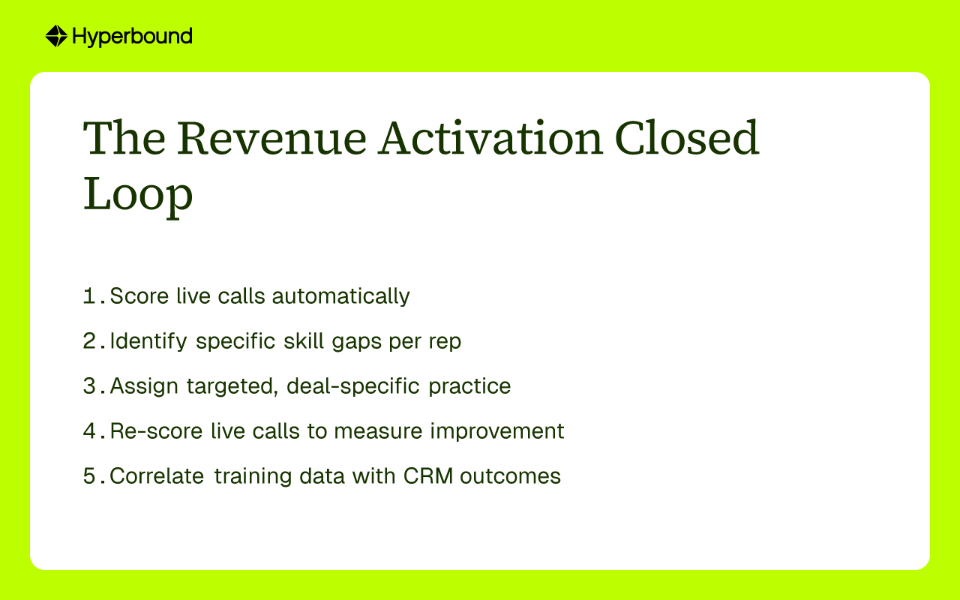
In practice, this means building a closed loop: score live calls, identify skill gaps, assign targeted practice, score live calls again. Use integrated reporting to correlate certification data with actual CRM outcomes: pipeline generated, deals won, time to first revenue. Then present that story to leadership in their language.
For example, Vanta used this kind of structured, outcome-linked approach to achieve a 60% ramp reduction (cutting time to productivity from 210 days to 72) while growing the BDR team 4x and building 5x pipeline. That's not a training metric. That's a revenue metric.
The gap between a knowledgeable rep and a deal-ready rep is where weeks of ramp time go to die. Closing that gap doesn't require more content, more workshops, or more ride-alongs. It requires a different philosophy: train to perform, not just to know.
By combining AI roleplay certifications, automated call scoring, deal-specific bite-sized practice, and top performer benchmarking, you build a system that actively improves rep execution: before, during, and after every deal conversation. That's not traditional sales training. That's Revenue Activation.
Your new reps don't have time to learn on live deals. Neither does your pipeline.
The main problem with traditional sales onboarding is its flawed premise that product knowledge equals selling ability. Most programs focus on transferring information but fail to prepare reps for real buyer conversations. This creates a gap between being knowledgeable and being deal-ready, leading to longer ramp times and lost revenue.
Revenue Activation is a modern approach to sales enablement that directly connects training activities to revenue outcomes. It shifts the focus from completing training modules to measurably improving a rep's performance on actual deals through a closed loop of call analysis, targeted practice, and performance measurement against CRM data.
AI roleplay improves sales training by providing a safe, scalable, and standardized environment for reps to practice realistic selling scenarios before engaging with buyers. Unlike traditional shadowing, AI roleplay allows reps to fail, iterate, and receive instant, objective feedback until they are certified as deal-ready, boosting their confidence and effectiveness from their first live call.
Automated call scoring is better because it provides immediate, consistent feedback on 100% of a rep's early calls, whereas managers typically review less than 1%. This immediate feedback loop prevents bad habits from becoming ingrained and allows managers to spend their limited time on targeted coaching to solve identified problems, rather than searching for them.
The ROI of a Revenue Activation approach is measured by tracking direct improvements in key revenue metrics. Instead of focusing on training completion rates, this method correlates practice and certification data with CRM outcomes like reduced ramp time, increased conversion rates, higher quota attainment, and greater pipeline generation.
No, this approach is designed for the entire sales team. While highly effective for accelerating onboarding, the same principles apply to the continuous development of tenured reps. By turning real challenges from active deals into bite-sized practice scenarios, experienced reps can refine their skills and prepare for specific high-stakes conversations.
A knowledgeable rep knows about the product, while a deal-ready rep can effectively sell the product in a live, unpredictable buyer conversation. Knowledge is the foundation, but readiness is the application of that knowledge under pressure. Traditional training builds knowledge; Revenue Activation builds readiness through practice and feedback.










Use Cases
Legal