
Every day a new sales rep sits unproductive, your Customer Acquisition Cost ticks upward. It's not just an HR problem — it's a financial one. You're paying full salary, benefits, and tooling costs while a rep is still figuring out your ICP, fumbling through discovery calls, and burning warm leads in the process.
Research on typical ramp timelines paints a sobering picture: the average rep takes 3 to 9 months to reach full productivity. In complex B2B sales, that window can stretch well past a year. That's a massive drag on revenue realization and ROI — and most sales organizations are quietly accepting it as the cost of doing business.
It doesn't have to be.
Vanta slashed their new rep ramp time by 60% — from 210 days down to just 72. Nivoda cut ramp time by 50% while simultaneously doubling revenue year-over-year. These aren't flukes. They're the result of building deliberate, stage-specific onboarding systems that go beyond knowledge transfer and actually develop sales skills at speed.
This guide breaks down the best sales training programs and approaches across three critical stages of early ramp: Product Knowledge, Core Conversations, and Objection Handling. For each stage, we'll map specific training methods to the outcomes you need — and be honest about where traditional programs fall short.
Most onboarding is product-focused, and that makes sense. Reps can't sell what they don't understand. The problem, as many sales leaders discover the hard way, is that knowledge dumps don't stick. New reps forget up to 80% of information-heavy training within 30 days if it isn't reinforced. A week of product training followed by a live pipeline is a recipe for expensive mistakes.
The other common failure mode? Product knowledge taught in isolation, disconnected from buyer context. As one rep put it bluntly in a Reddit discussion on sales onboarding: "Most onboarding is product-focused. The ICP, problems the solution solves, and practical examples are left to in the field."
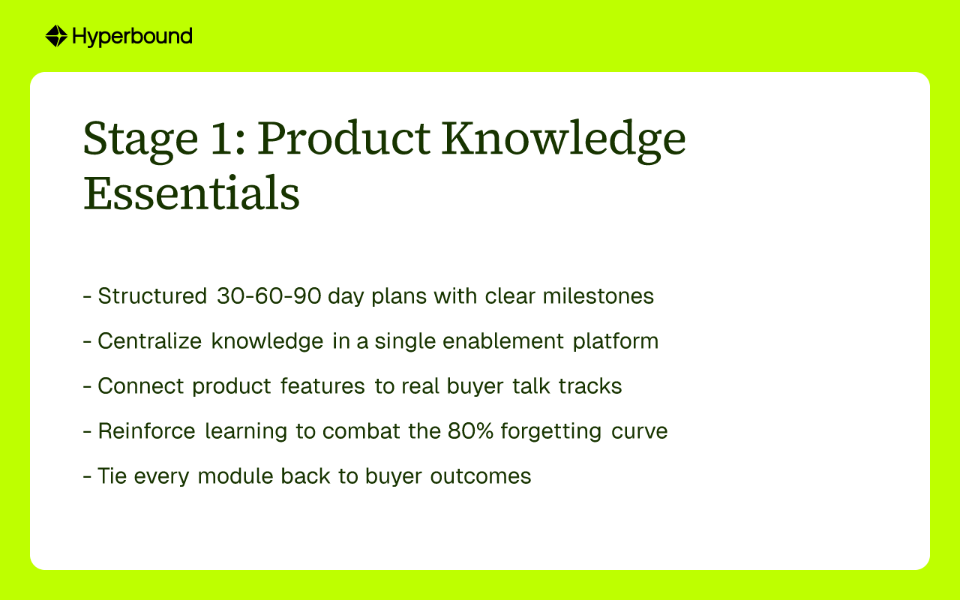
Structured 30-60-90 Day Plans with Milestones
Don't let the first 90 days be a free-for-all. Define clear, measurable deliverables at each checkpoint:
As one experienced sales manager noted in a Reddit thread on 100-day ramp plans: "Your managers should have a milestone requirement throughout the 30/60/90 with a quota achievement to be met for each milestone." Structure creates accountability — and accountability accelerates ramp.
Centralize Knowledge in an Enablement Platform
Scattered wikis, outdated decks, and Slack threads are the enemy of fast onboarding. Use a sales enablement platform to create a single source of truth for all training materials. Best-in-class product training focuses on bite-sized lessons that connect key features to specific buyer problems — not technical specs in a vacuum. Every product module should end with a clear answer to: "So what does this mean for the buyer?"
Connect Features to Talk Tracks
Product knowledge only becomes sales-ready when it's attached to language reps can use in the field. Equip new hires with social proof, case studies, and ready-made talk tracks that bridge product capabilities to buyer outcomes. This is the foundation everything else builds on.
Here's where most training programs lose the plot. You can teach a rep SPIN selling in a classroom, but that knowledge evaporates the second a skeptical prospect asks an unexpected question. The consensus among working reps is clear: "Those training courses are more for supplemental knowledge — they're absolutely useless unless you actually do the selling."
The harsh truth is that reps learn core sales conversations by doing. The problem is that "doing" traditionally means practicing on your real pipeline — burning leads and opportunities while they get their reps in.
Frontline managers can't close this gap. They're spending only 5–8% of their time coaching and listening to less than 1% of recorded conversations. The bandwidth simply isn't there.
1. Hyperbound Practice — AI Roleplay at Scale
Hyperbound is the most effective solution for giving new reps the high-volume, risk-free repetitions they need to master cold calls, discovery, and demos before they're in front of real buyers.
Reps practice with AI buyer personas trained on over 2 million hours of real B2B sales conversations — not generic scripts. The simulations respond dynamically, push back, go off-script, and behave like actual prospects. After each rep, an AI Scorecard delivers instant feedback on talk ratios, methodology adherence, key selling moments, and specific areas to improve.
A new SDR can run through their cold call opener 25 times in a single afternoon — refining tone, pacing, and messaging with coaching after every attempt — without burning a single real lead.
For demos specifically, Hyperbound's Screen Comprehension feature lets the AI bot actually read and react to the slides the rep shares during a mock demo, making practice sessions remarkably close to the real thing. Reps can also run Multiparty Roleplays to simulate complex deals with multiple stakeholders — a champion and an economic buyer in the same call, for example.
The results speak for themselves: Vanta's CRO Stevie Case credits this kind of scalable practice as a core driver of their 210-to-72-day ramp reduction.
2. Methodology Frameworks — The Strategic Playbook
Established sales methodologies are still valuable. They provide the structure reps need to navigate conversations with intent. A few worth building into your program:
Think of these frameworks as the sheet music. Hyperbound is where reps rehearse until the performance is second nature.
Objection handling is where deals are won or lost — and where new reps are most likely to freeze. Static battle cards are helpful reference material, but they don't train the instinctive, confident responses that come from genuine muscle memory. When a prospect says "We already use a competitor" or "Your price is too high," reps don't have time to mentally search a PDF.
Traditional manager-led role-plays are the classic solution. They work — but they're impossible to deliver consistently at scale. One manager, 10 new reps, each needing dozens of repetitions on a dozen different objections — the math doesn't work.
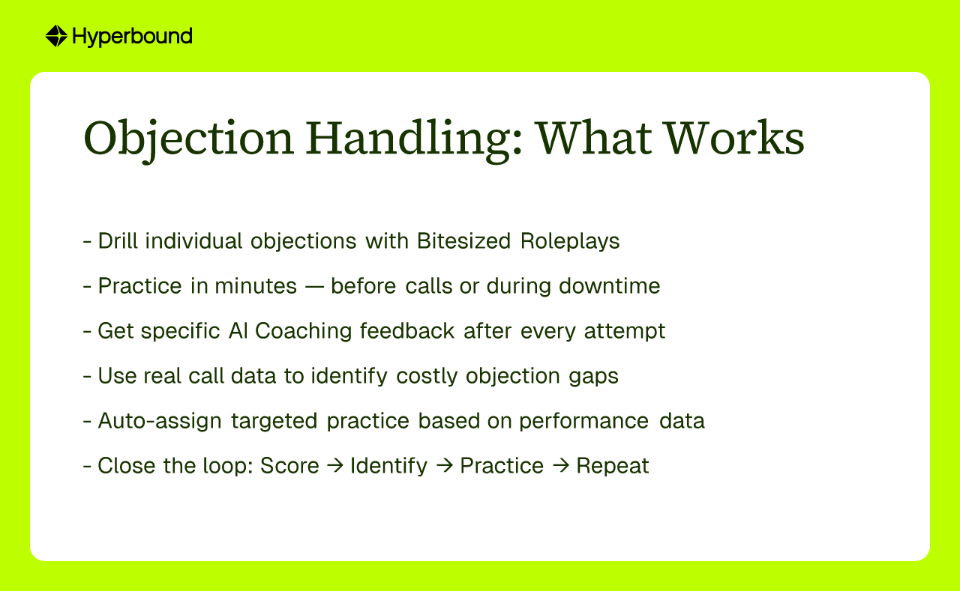
Targeted Bitesized Roleplays for Specific Objections
Hyperbound's Bitesized Roleplays are purpose-built for this problem. Instead of lengthy end-to-end practice sessions, reps can drill a single scenario — "your pricing is out of our budget," "we're locked into a contract with a competitor," "now isn't a good time" — repeatedly until the response becomes automatic.
Each session is short enough to complete in a few minutes, which means reps can squeeze in practice during downtime, before a call, or as part of a daily warm-up routine. The AI Coaching layer analyzes each response and provides specific, actionable feedback — not generic praise. Over time, reps build a library of confident, instinctive answers to their most common sticking points.
Closing the Loop: From Real Calls to Targeted Practice
The most advanced teams don't stop at pre-built objection libraries. They use real call data to identify which objections are actually costing them deals — and then build practice directly around those gaps.
Hyperbound Perform analyzes live sales conversations across an entire deal lifecycle, surfacing deal-level insights on what's helping or hurting opportunities in the field. Kota Activate then orchestrates the response — automatically assigning targeted Bitesized Roleplays to the reps who need them most, based on actual performance data. It's a continuous improvement loop: Score Real Calls → Identify Skill Gaps → Practice Roleplays → Score Real Calls again.
This is how Nivoda drove a 50% reduction in ramp time alongside a 150% increase in demo-to-meeting conversion rates. Practice wasn't a one-time onboarding event — it became an ongoing, data-driven habit woven into their sales culture.
The best sales training programs for new reps aren't the ones that deliver the most content. They're the ones that convert knowledge into repeatable performance — fast.
Traditional approaches — methodologies, LMS modules, battle cards — are still valuable. They give reps the playbook. But knowing the playbook and executing it under pressure are two entirely different things. That gap is where most ramp programs fail, and where most companies quietly accept that new hires will burn pipeline while they "find their footing."
The pattern behind elite outcomes like Vanta's 60% ramp reduction and Nivoda's 50% faster time-to-productivity is consistent: they built systems for deliberate, scalable practice alongside their knowledge training. Reps got hundreds of reps in a risk-free environment before they ever spoke to a real customer.
Hyperbound's AI roleplay layer is the missing piece that closes this gap for modern sales teams. Where traditional training delivers information, Hyperbound builds execution readiness — through realistic simulations, instant coaching feedback, and a continuous loop that connects real-call performance back to targeted practice.
Stop letting new hires burn your most valuable asset — your pipeline — while they learn on the job. The tools to arm them with real readiness from day one exist today.
A typical ramp-up time for a new sales representative is between 3 to 9 months. However, top-performing organizations are significantly shortening this period. For example, by implementing scalable practice systems, companies like Vanta have reduced their ramp time from 210 days to just 72 days, demonstrating that a much faster ramp is achievable with the right training program.
Most sales onboarding programs fail because they over-emphasize knowledge transfer and under-emphasize practical application. New reps often forget up to 80% of information-heavy training if it's not reinforced. Without a safe environment to practice core conversations and objection handling, they are forced to learn on live calls, burning valuable leads and slowing their development.
A more effective sales onboarding program should be structured across three critical stages: Product Knowledge, Core Conversations, and Objection Handling. Start with a structured 30-60-90 day plan that connects product features to buyer problems. Then, use AI roleplay to give reps scalable, risk-free practice on discovery calls and demos. Finally, drill specific objections with targeted practice to build muscle memory.
The most effective way to train objection handling is through high-volume, targeted practice that builds instinctive responses. While static battle cards are a useful reference, they don't prepare reps for real-time conversations. Using AI tools for "Bitesized Roleplays" allows reps to drill common objections like pricing or competitor mentions repeatedly until their responses become confident and automatic.
AI roleplay significantly reduces ramp time by providing a scalable and risk-free environment for new hires to practice their sales skills. Instead of learning on real buyers, reps can run hundreds of AI simulations of cold calls, demos, and objection scenarios. They receive instant, data-driven feedback on every attempt, allowing them to master their talk tracks and build confidence much faster than traditional methods allow.
AI sales training is designed to supplement and scale manager-led coaching, not replace it. Managers typically spend only 5-8% of their time on coaching and can't oversee every practice session. AI handles the high-volume, repetitive practice needed to build foundational skills, freeing up managers to focus on higher-level strategic coaching, deal reviews, and personalized feedback.
Ready to see what a 50–60% reduction in ramp time looks like for your team? Book a demo of Hyperbound and see how AI roleplay and coaching can transform your sales onboarding program.










Use Cases
Legal