
You just closed a strong hiring quarter. Five new BDRs start Monday, two AEs join mid-month, and your VP just signed off on another cohort for Q3. Headcount is moving fast — exactly what the board wanted.
But here's the tension nobody puts in the OKR deck: your training infrastructure is still sized for the team you had six months ago. Your senior reps are buried in pipeline. Your managers have maybe 5–8% of their week left for actual coaching — and that's the first thing to get cut when a deal heats up. New reps are learning by losing on live calls, burning real pipeline in the process.
The result? Ramp time blowouts. Inconsistent rep performance across cohorts. A leaky pipeline that grows wider the faster you hire. As one sales rep put it bluntly in a Reddit thread on AI training tools: "Seniors have no time, the newbies just end up losing to learn."
This is the defining challenge of sales headcount scaling training: inside sales is growing 10–15x faster than field sales, but the training infrastructure barely keeps pace. And without deliberate investment in that infrastructure, the cost shows up in slow ramp times, high CAC, and stagnant win rates.
This guide cuts through the noise. We've evaluated seven platforms by three criteria that actually matter at scale:
Each platform is mapped to a specific use case so you can match the right tool to your current growth stage.
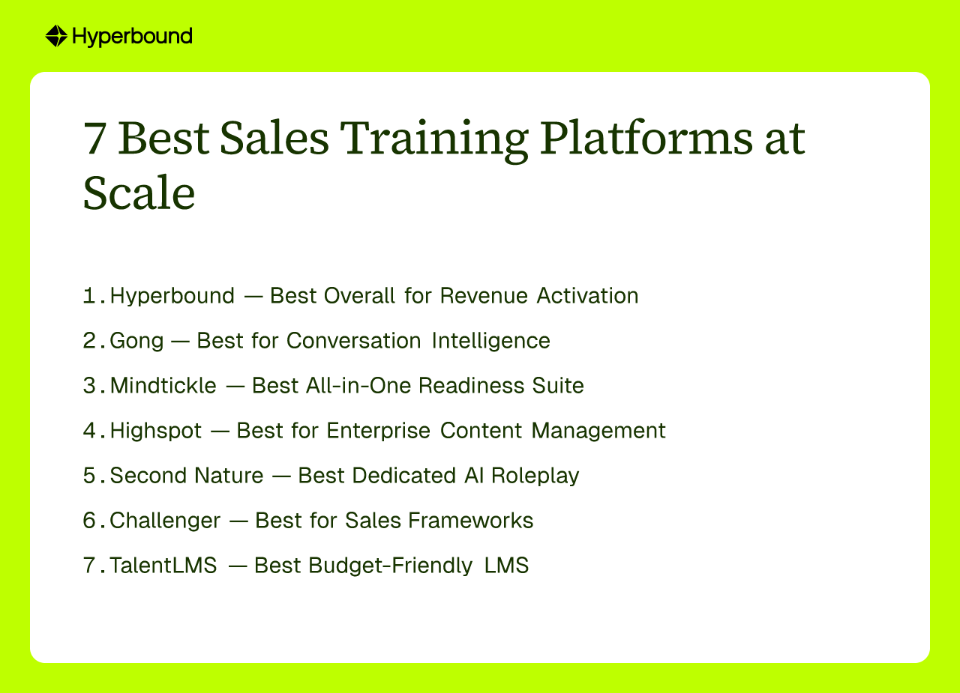
Best for: End-to-end sales headcount scaling training — onboarding, live deal coaching, reinforcement, and certification
If you only read one entry on this list, make it this one. Hyperbound is the only platform built around a closed-loop model that connects AI practice directly to real-world performance. The flywheel: score real calls → identify skill gaps → assign targeted roleplays → score subsequent calls → repeat. No dead ends, no static content libraries, no training that evaporates 30 days after onboarding.
Why it stands out on AI Fidelity: Hyperbound's AI buyer personas are trained on 2M+ hours of real B2B sales conversations — not generic scripts. You can build digital twins of specific buyer personas from LinkedIn profiles, clone voices, simulate multiparty calls (think: champion + economic buyer on the same call), and even run demo practice with screen comprehension. The simulations mirror what reps will actually face, which directly addresses the real concern that "AI simulations may overlook certain nuances" of live calls.
Why it stands out on Scalability: LinkedIn deployed Hyperbound across 3,000+ sellers in three business units — LTS, LSS, and Sales Dev — spanning NAMER and EMEA. The platform supports 25+ languages, making it viable for global GTM teams. Vanta scaled their BDR team 4x while using Hyperbound, cutting ramp time from 210 days to 72 — a 60% reduction — and generating 5x more pipeline in the process.
The three core products:
Integration Depth: Native integrations with Salesforce, HubSpot, Gong, Salesloft, Outreach, Chorus, Seismic, Highspot, Zoom, Google Meet, and MS Teams. Enterprise-grade security: SOC 2 Type II, GDPR, ISO 27001, HIPAA.
The numbers: 50% faster ramp, 2x faster time to first won deal, 3.5 workweeks of coaching saved per manager, 4.9/5 on G2 across 7,000+ companies.
Limitation: Hyperbound is the central intelligence layer for skill development — it's designed to sit alongside and amplify your existing CI tool (like Gong) and CMS (like Highspot), not replace them outright.
Best for: Recording, analyzing, and coaching on what actually happens in real sales calls
Gong is the market standard for conversation intelligence. It records every call, transcribes it, flags keyword patterns, and gives managers a library of what "good" and "bad" look like across their team. If you don't have a CI tool yet, it's a foundational layer for reality-based coaching.
AI Fidelity: Extremely high for analysis. Gong's AI is excellent at identifying deal risk signals, topic trends, and talk-time ratios across a large call library. Scalability: Proven at enterprise scale. Integration Depth: Deep CRM and sales engagement integrations.
The gap: Gong tells you what happened on a call. It doesn't help a rep practice what to do differently before the next one. As reps themselves note, "what actually moves numbers is combining AI practice with recorded call reviews." Gong is the insight layer. Hyperbound is what turns those insights into changed behavior. The two are purpose-built to work together — Hyperbound ingests Gong call data to build practice scenarios grounded in your actual deal reality.
Best for: Mid-market teams looking to consolidate LMS, coaching, and light roleplay into one platform
Mindtickle bundles content management, learning paths, coaching workflows, and AI simulation into a single interface. For teams trying to reduce tool sprawl, the consolidation appeal is real.
AI Fidelity: Moderate. Its roleplay capabilities exist, but they're not purpose-built on proprietary call data at the same depth as specialized platforms. Scalability: Solid for mid-market to enterprise user management. Integration Depth: CRM and core sales tool integrations are in place.
The tradeoff: All-in-one platforms often mean jack-of-all-trades depth. As outlined in Hyperbound's 2026 platform review, the AI roleplay fidelity lags behind purpose-built simulation platforms. If your primary bottleneck is ramp time and skill reinforcement, a specialized tool will outperform a bundled suite.
Best for: Organizing, distributing, and tracking sales content and messaging at enterprise scale
Scaling teams live or die by messaging consistency. Highspot solves the content chaos problem — one source of truth for battlecards, pitch decks, competitive intel, and playbooks, with analytics on what content actually gets used and what moves deals forward.
AI Fidelity: Focused on content recommendations, not conversational simulation. Scalability: Enterprise-grade, with advanced governance and analytics. Integration Depth: Excellent — deep Salesforce and Microsoft integrations.
The gap: Highspot ensures reps have the right message. It doesn't ensure they can deliver it under pressure. Effective training requires "ongoing coaching and reinforcement" beyond content access. The natural pairing: embed Hyperbound roleplays directly into Highspot via SCORM, so reps can practice delivering the messaging they just read — without leaving the platform.
Best for: Teams focused primarily on pitch practice and objection handling simulation
Second Nature is a well-regarded standalone AI roleplay platform that gives reps a safe space to rehearse conversations. It's a credible option for teams that need simulation without the full complexity of an integrated suite.
AI Fidelity: Good, with realistic conversation flow. Scalability: Strong for mid-market deployments. Integration Depth: Covers core integrations, though lighter on enterprise-grade connectivity.
The caveat: The personas aren't built from your company's actual winning calls. Generic practice is still practice, but it doesn't replicate the specific objections, buying dynamics, and stakeholder personalities your reps face daily. "The tools that work best are ones where you can customize the AI prospect to match your actual buyer personas" — which is where platforms with deeper customization and proprietary data win.
Best for: Establishing a shared sales language and structured deal approach across a growing team
Technology is not a substitute for methodology. Frameworks like The Challenger Sale or Sandler give your reps a common operating model — how to run discovery, how to build a champion, how to quantify pain. Without this foundation, you end up with reps practicing the wrong behaviors at high fidelity.
AI Fidelity: N/A — these are workshop and certification programs. Scalability: Can be deployed broadly, but reinforcement is the perennial challenge. Integration Depth: N/A.
The pairing: Methodology training tells reps what to do. It doesn't verify that they can do it when a prospect pushes back hard. The fix is direct: build your chosen methodology's criteria directly into Hyperbound's AI scorecards and certifications, so completion means demonstrated competency — not just course completion.
Best for: Early-stage teams that need structured onboarding content before investing in advanced tooling
For pre-product-market-fit teams or tight-budget environments, a traditional LMS organizes foundational knowledge: product overviews, company history, basic process documentation. It checks the box on asynchronous content delivery.
AI Fidelity: None. Content delivery and quiz-based assessments only. Scalability: Good for user and course management; does not scale skill development. Integration Depth: Basic HRIS and SSO integrations.
The ceiling: An LMS tells you if a rep watched the video. It has no idea if they can actually run a discovery call. 80% of training content is forgotten within 30 days without reinforcement mechanisms in place. As soon as your team hits the point where certifying practical skills matters — which happens faster than most leaders expect — layer in Hyperbound via SCORM to transform passive content into active practice.
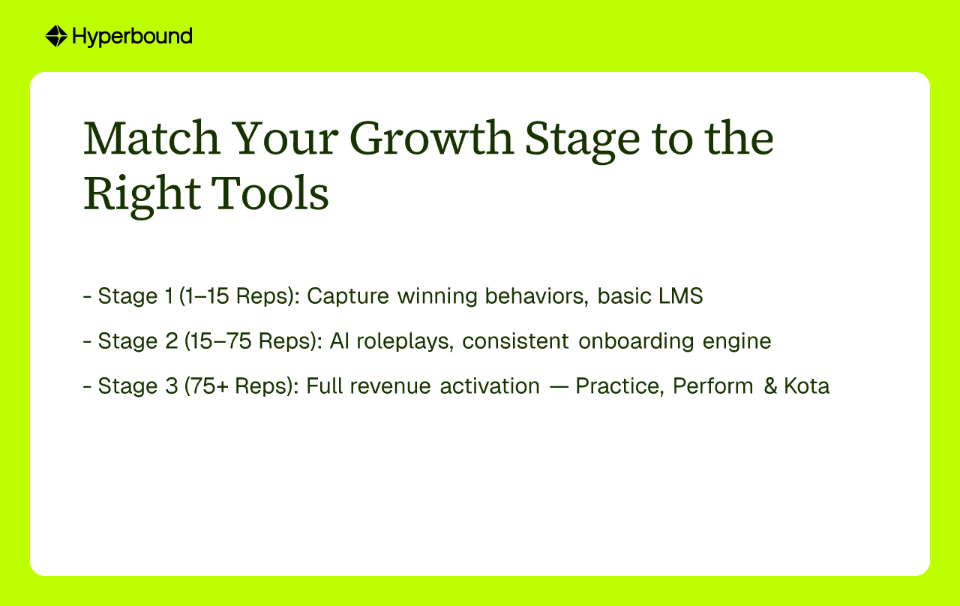
Not every team needs the full stack on day one. Here's how to think about sequencing your investment in sales headcount scaling training based on where you actually are.
The challenge: No dedicated enablement function, high dependency on founder-led selling, inconsistent process documentation.
Focus: Capture what "good" looks like before you scale it.
Recommended stack:
At this stage, your CRO or founding AE is still the methodology. Document it before you lose institutional memory.
The challenge: Ramp time is now a material cost. Manager coaching becomes a bottleneck. Messaging fragments as more reps join. Each manager coaches differently and your best senior rep is too busy closing to train the new cohort.
Focus: Build a repeatable, scalable engine for onboarding and skill reinforcement.
Recommended stack:
At this stage, Vanta's trajectory is instructive: they used Hyperbound to scale their BDR team 4x without proportionally scaling their enablement headcount, cutting ramp time from 210 days down to 72.
The challenge: Multiple product lines and business units, pressure to connect enablement spend to revenue outcomes, complex integration requirements, and the need to identify deal risk before it's too late to act.
Focus: Holistic revenue activation — connecting practice, real-world performance, and deal outcomes into a single operating loop.
Recommended stack:
Headcount growth without training infrastructure doesn't produce revenue — it produces noise. More reps burning more pipeline on calls they weren't ready for, managed by leaders who don't have the bandwidth to fix it manually.
The best platforms on this list don't just deliver training content. They create a closed loop between what reps practice and how they perform on real calls and real deals. That loop — score real calls, identify gaps, practice specifically, score again — is what separates a training program that produces results from one that produces completion certificates.
As your team scales, the question isn't whether to invest in sales headcount scaling training infrastructure. It's whether you invest before the ramp time blowouts and pipeline leakage make the cost obvious.
Sales headcount scaling training refers to the systems, processes, and tools designed to onboard, ramp, and continuously develop sales representatives effectively as a company rapidly increases its sales team size. It focuses on creating a repeatable and scalable training infrastructure that can handle large cohorts of new hires without sacrificing quality or overwhelming managers.
Traditional sales training often fails growing teams because it relies on manual, time-intensive methods like manager-led coaching and peer shadowing, which don't scale. As teams grow, managers have less time for individual coaching (often just 5-8% of their week), and senior reps are too busy with their own pipeline to mentor new hires. This leads to inconsistent training, longer ramp times, and new reps learning by losing on live deals.
When evaluating a sales training platform for a scaling team, focus on three key criteria:
AI sales roleplay significantly improves ramp time by providing new hires with a safe, on-demand environment to practice real-world call scenarios without risking live pipeline. This allows them to build practical skills, master messaging, and handle objections confidently before their first real sales call. Platforms like Hyperbound, trained on millions of B2B calls, reduce ramp time by providing consistent, objective feedback at a scale no manager can match, leading to faster competency and productivity.
Conversation intelligence (CI) tools like Gong record and analyze past sales calls to tell you what happened. They are excellent for understanding performance, identifying trends, and reviewing calls. A revenue activation platform like Hyperbound focuses on what to do next. It uses insights from past calls (often ingested from a CI tool) to create targeted AI practice scenarios, helping reps build the skills they need to improve future performance and change behavior. The two are complementary: Gong provides the diagnosis, and Hyperbound provides the cure.
The ROI of a sales training platform can be measured through several key metrics. Look for improvements in:
Ready to close your team's practice-to-performance gap? See how Hyperbound reduced ramp time by 60% and scaled teams 4x — without scaling the training burden.










Use Cases
Legal