
You bought an "AI-powered" sales training platform. Your reps clicked through the videos, passed the quizzes, and checked the boxes. Then nothing changed on the call.
Sound familiar? You're not alone. As one sales leader on Reddit put it, "sales training tools often fail during actual implementation" — and the reason is almost always the same: the "AI" is just a wrapper around the same passive content delivery that's existed for decades. Research consistently shows that 80% of training content is forgotten within 30 days. Without practice, there's no retention. Without realistic practice, there's no behavior change.
The real differentiator is AI roleplay. Not the scripted, choose-your-own-adventure bots that reps can game in two sessions — but dynamic, high-fidelity AI simulations that force reps to think, adapt, and respond like they would on a real call.
This list cuts through the noise. We looked at every major sales training platform on the market and filtered for one thing: genuine AI roleplay capability. That immediately eliminates the traditional LMS tools (Brainshark, Lessonly, TalentLMS) and the analytics-only conversation intelligence platforms that are excellent at what they do but don't offer practice.
For each platform that made the cut, we scored the realism of the AI persona — the single biggest determinant of whether practice actually transfers to performance:
A note on skepticism: One Reddit commenter put it bluntly: "AI still can't fully replicate the awkward silences, weird tangents, and emotional dynamics of real conversations." That's absolutely true — for low-fidelity AI. When a platform trains its models on millions of hours of real sales calls, the gap closes dramatically. The question isn't whether AI roleplay works. It's whether the AI is trained well enough to matter.
Traditional training fails for three reasons:
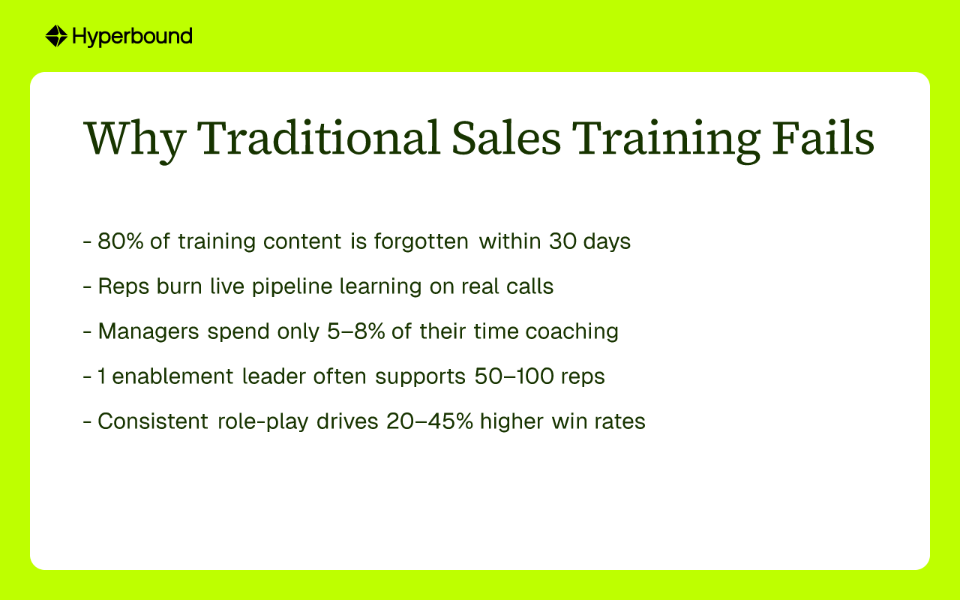
AI roleplay solves all three. It gives reps a repeatable, low-stakes environment to practice 24/7 — with instant scoring, methodology-aligned feedback, and no wasted pipeline. ServiceNow's AI coach, for example, cut new hire onboarding from three months to six weeks using AI-driven simulations.
.png)
.png)
G2 Rating: 4.9/5 | Roleplay Fidelity: High
If you've ever heard a rep say "the bot is too easy — I know exactly what it'll say" — that's a low-fidelity AI problem. Hyperbound solved this at the training data level. Its AI buyer personas aren't built on generic scripts — they're trained on over 2 million hours of real B2B sales conversations, which means they push back the way real buyers push back, ask the questions real buyers ask, and take conversations in directions that keep reps on their toes.
The result: 1.1M+ minutes of simulated calls delivered with a level of realism that actually changes behavior — not just completion rates.
Key features:
The Revenue Activation loop: Hyperbound doesn't stop at practice. Hyperbound Perform deploys AI scorecards on real calls (via Gong, Outreach, or Hyperbound's built-in recorder) to identify where live deals are at risk. Kota, the AI Revenue Analyst, then connects both data streams to recommend personalized coaching interventions — closing the loop between training activity and revenue outcomes.
Proof it works:
Best for: B2B revenue teams that want to connect training investment directly to performance metrics like ramp time, win rates, and conversion rates.
G2 Rating: 4.7/5 | Roleplay Fidelity: Medium
Second Nature covers a wide range of use cases — manager training, partner enablement, and rep certification — making it a reasonable choice for teams that want AI roleplay as part of a broader enablement suite. The platform is well-designed and easy to set up. Where it falls short is at the level of persona realism: the AI tends to be more predictable than platforms trained on real conversation data, which means experienced reps can find ways to navigate sessions without being genuinely challenged.
Best for: Teams looking for a multi-use-case platform that includes AI roleplay alongside certifications and manager training content.
G2 Rating: 4.7/5 | Roleplay Fidelity: Medium–High
Mindtickle is one of the most comprehensive sales readiness platforms available. It bundles onboarding, content management, call coaching (via "Call AI"), and AI-powered roleplay into a single ecosystem — which is genuinely valuable for enterprise teams that want one vendor to manage it all. The roleplay functionality is solid, but it's a feature within a larger product suite rather than a purpose-built simulation engine. Teams that need roleplay depth specifically may find the simulation fidelity doesn't match what's possible with dedicated platforms.
Best for: Large enterprises seeking a single, integrated platform for the full sales readiness lifecycle — from onboarding content to ongoing coaching.
G2 Rating: 4.6/5 | Roleplay Fidelity: Medium
Allego uses AI-driven scenarios and virtual avatars to create practice environments that are accessible and easy to deploy. Their own research found that 43% of revenue enablement leaders are now using AI-powered roleplay — a sign of how fast the category is maturing. Allego is built for speed: enablement teams can create and launch training scenarios without deep scripting overhead. The tradeoff is that the AI doesn't adapt as dynamically as higher-fidelity alternatives.
Best for: Enablement teams that need to quickly stand up and deploy practice scenarios across a large org without a heavy scripting lift.
G2 Rating: N/A | Roleplay Fidelity: High
TrainHQ positions itself around closed-loop performance management — the idea that practice should connect directly back to coaching conversations and skill development plans. The platform supports building custom, high-specificity scenarios for technical or complex sales environments and pulls practice data into reporting that managers can actually act on.
Best for: Teams with highly technical or specialized sales processes that require deeply customized roleplay environments and tight coaching accountability loops.
G2 Rating: 4.5/5 | Roleplay Fidelity: High
Quantified is particularly strong in regulated verticals — financial services, medical devices, pharma — where message precision and compliance matter as much as skills. The platform provides advanced analytics on communication patterns, clarity scores, and language adherence, making it well-suited for teams where off-script messaging carries real risk.
Best for: Sales teams in highly regulated industries where compliance-aligned messaging and objective communication scoring are critical.
G2 Rating: N/A | Roleplay Fidelity: Low
PitchMonster uses scripted conversation trees to guide practice sessions. This approach gives enablement teams tight control over the script — useful for ensuring reps follow a specific talk track. The limitation is that scripted trees are predictable: once a rep has run a scenario two or three times, they know exactly where it's going, which removes the productive friction that makes practice valuable.
Best for: Highly structured training environments where strict talk track adherence is the primary objective, and script deviation would be a problem to prevent.
G2 Rating: N/A | Roleplay Fidelity: Medium
Luster's approach centers on "predictive enablement" — identifying skill gaps before they show up in live deals — combined with gamified training elements like leaderboards designed to boost rep engagement. The gamification angle addresses a real problem: expensive tools with low adoption. Whether the predictive capability is robust enough to compete with platforms that score real calls remains context-dependent.
Best for: Teams looking to add engagement and gamification to their training program and proactively identify skill gaps before they affect pipeline.
G2 Rating: 4.8/5 | Roleplay Fidelity: Medium (Speech-focused)
Yoodli is primarily an AI speech coach — helping reps reduce filler words, improve pacing, build clarity, and communicate more confidently. It can be used in a sales training context, but its core value is communication mechanics rather than navigating complex buyer objections, competitive pushback, or multi-stakeholder dynamics. Think of it as a complement to, rather than a replacement for, a full-fidelity roleplay platform.
Best for: Onboarding new reps who need to improve the fundamentals of how they communicate — clarity, pacing, and confidence — before tackling more complex practice scenarios.
G2 Rating: 4.7/5 | Roleplay Fidelity: Medium (Cold call-focused)
Nooks is built for the top of funnel. It's primarily an AI-powered parallel dialer, but it includes an "AI Mock Cold Caller" feature that gives SDR/BDR teams a place to practice opening lines, pitches, and early-stage objection handling. Outside of cold calling, the platform offers limited customization for more complex sales scenarios like discovery, demos, or multi-stakeholder conversations.
Best for: SDR and BDR teams that need high-volume cold call practice specifically, and are already evaluating Nooks as a dialer solution.
G2 Rating: N/A | Roleplay Fidelity: Low
FullyRamped is a newer entry in the category, focused primarily on new hire onboarding and early cold call practice. As detailed in independent sales enablement technology reviews, the bot interactions can feel less realistic, and customizability is limited compared to more mature platforms. It's a functional starting point for small teams with minimal budget, but teams that outgrow it will feel the ceiling quickly.
Best for: Startups and small teams needing a basic, affordable entry point into AI roleplay for new hire ramp-up.
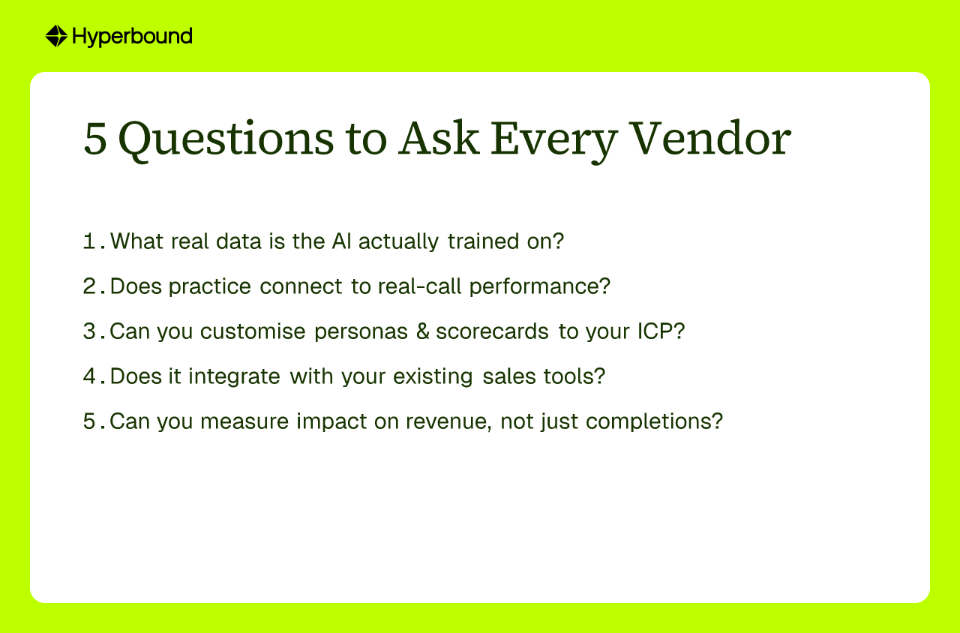
Before you book another demo, run every vendor through these five questions:
Most sales training platforms are still passive tools with an AI label. They're good at delivering content. They're not built to change behavior.
The platforms that actually move the needle share one thing in common: realistic, repeatable practice that mirrors the complexity of real buyer conversations — not scripted walkthroughs that experienced reps can click through in their sleep.
For teams serious about tying their training investment to measurable revenue outcomes, the training data behind the AI is everything. Platforms trained on millions of hours of real B2B conversations produce AI buyer personas that push back, go off-script, and force reps to develop the kind of muscle memory that survives contact with a real prospect.
That's the standard. Now you know what to look for.
AI roleplay is a sales training technology that uses artificial intelligence to simulate realistic sales conversations, allowing reps to practice their skills in a safe, repeatable environment. Unlike traditional methods like watching videos or scripted roleplays with managers, AI roleplay provides dynamic, on-demand practice sessions where sales reps interact with an AI-powered buyer persona that can respond to questions, raise objections, and behave like a real prospect.
AI roleplay is more effective because it solves the biggest problem with traditional training: the forgetting curve. It provides the active practice necessary for long-term skill retention and behavior change. Research shows that 80% of training content is forgotten within 30 days without application. AI roleplay provides unlimited "at-bats" for reps to apply what they've learned, 24/7, building the muscle memory needed to transfer skills to real-world sales calls.
AI roleplay improves sales performance by directly impacting key revenue metrics like ramp time, conversion rates, and win rates. It allows reps to master skills faster without burning live pipeline. By providing a safe space to practice objection handling, discovery, and closing techniques, reps enter real calls better prepared. The best platforms connect practice data with real-call performance, identifying specific skill gaps and recommending personalized coaching.
A "high-fidelity" AI roleplay is one where the AI persona is trained on massive datasets of real-world sales conversations, not generic language models or scripts. This training allows the AI to be unpredictable and realistic. Low-fidelity AI uses predictable, scripted conversation trees that reps can easily game. High-fidelity AI, trained on millions of call hours, can push back, go off-script, and ask challenging questions just like a real buyer, which is crucial for developing adaptable skills.
To choose the best platform, you should evaluate the realism of its AI, its ability to connect practice to real-call performance, its customization options, and its integrations with your existing sales stack. Always ask what data the AI is trained on—this determines its fidelity. The best tools will also score live calls to identify skill gaps and prove ROI by linking training activity to revenue outcomes like faster ramp times and higher win rates.
While no AI can perfectly replicate every nuance of human interaction, high-fidelity AI trained on millions of real sales calls comes remarkably close. It effectively simulates the challenges reps face on live calls. Generic AI or scripted bots fail to capture the unpredictable dynamics of a real call. However, AI models trained specifically on vast B2B sales datasets learn to replicate common buyer objections, questions, and conversational patterns with surprising accuracy, providing a challenging and productive practice environment.










Use Cases
Legal