You've just hired an enthusiastic new sales rep who's eager to hit the ground running. After a quick product demo and some basic onboarding, you send them into the field, confident they'll start closing deals right away. Three months later, they're still struggling to meet quota, frustrated by objections they can't handle, and considering whether sales is even the right career for them.
Sound familiar?
"So far I've always been disappointed by the lack of sales training at companies I've worked at. They are usually just a string of recorded product demonstrations made by marketing or someone not actually successfully selling the product(s)," laments one experienced sales professional in a recent Reddit discussion.
The hard truth is that most sales training programs fail to deliver meaningful results. They're often hastily assembled, focused on product features rather than selling skills, and lack the reinforcement needed to create lasting behavior change.
But it doesn't have to be this way.
Effective sales training isn't a one-time event—it's a strategic, ongoing process designed to develop the specific skills your team needs to excel in today's competitive marketplace. When done right, it transforms average performers into sales champions who consistently meet and exceed their targets.
In this comprehensive guide, you'll discover how to create a sales training plan that actually works—one that ramps up new hires faster, equips veterans with advanced techniques, and builds a culture of continuous improvement that drives sustainable revenue growth.
Before diving into the specifics of building your sales training plan, it's crucial to understand what sets exceptional training apart from the mediocre programs most companies implement.
While often used interchangeably, these terms represent distinct but complementary approaches:
For optimal results, your sales strategy needs both. Think of it this way: sales enablement without training leads to unused tools, while training without enablement leads to skilled reps hampered by inefficient processes.
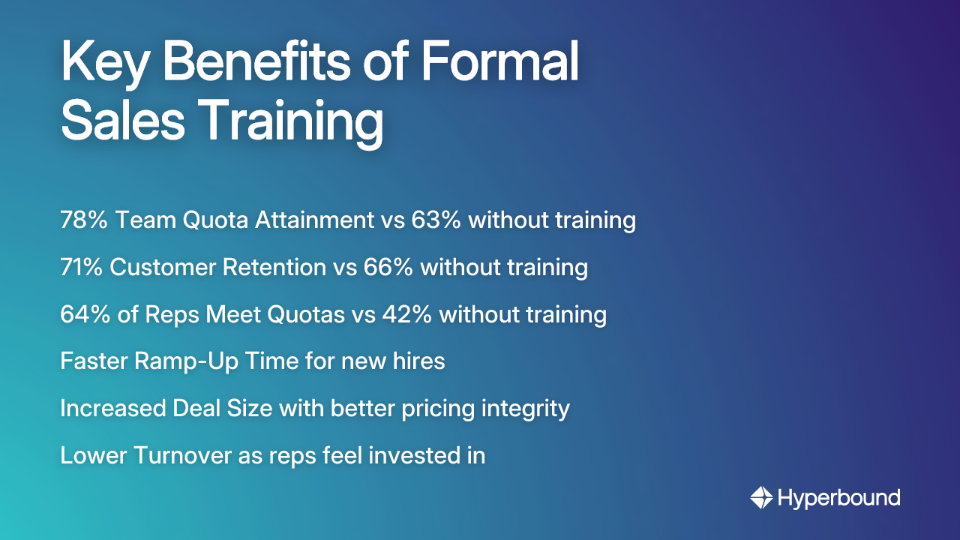
If you're wondering whether investing in a comprehensive sales training plan is worth the effort, consider these compelling statistics from an Aberdeen Group study:
Beyond these impressive numbers, effective training directly impacts other crucial metrics:
Understanding what separates exceptional training from mediocre programs will help you avoid common pitfalls:
.png)
As one sales rep shares from their most positive experience: "The best sales training I ever had was with a startup for a month. Learned the product inside out, tested, and felt like school. It made the sales cohort closer and better."
This testimonial highlights a crucial aspect of world-class training: it's immersive, thorough, and builds camaraderie among the team—all elements we'll incorporate into our blueprint for success.
Now that you understand why effective sales training matters, let's explore a systematic approach to building a program that delivers measurable results. This 10-step process will guide you from initial planning through implementation and continuous improvement.
Start with the end in mind by establishing specific business goals that your training will support. These should be measurable and directly tied to your company's strategic objectives.
Examples of well-defined training objectives include:
Next, conduct a skill gap analysis to identify the specific areas where your team needs improvement. This could involve:
As one sales manager noted in a recent forum discussion, "I'm asking in order to help speed up my learning curve as I have been struggling." Identifying these specific pain points is crucial for creating relevant training.
Translate your business goals into concrete learning objectives that describe what salespeople should be able to do after completing the training. Effective learning objectives are:
For example:
These clear objectives provide focus for your training content and make it easier to measure success later.
Anticipate obstacles that might hinder your training implementation:
Common Challenges:
By identifying these challenges early, you can develop strategies to address them before they derail your training efforts.
Move beyond the "recorded demonstration" model that frustrates so many sales professionals. A world-class sales training plan incorporates a blend of complementary approaches:
Instructor-Led Training (ILT):
Self-Directed Learning:
Role-Playing & Simulations:
Peer-to-Peer Learning:
On-the-Job Training:
The most effective sales training plans combine these methods in a thoughtful sequence that builds skills progressively while accommodating different learning styles.

Today's sales training technology can dramatically enhance the effectiveness and efficiency of your program:
Learning Management System (LMS):
AI Sales Coaching and Practice Platforms:
Mobile Learning Apps:
The right technology stack makes training more engaging, accessible, and measurable—critical factors for today's distributed sales teams.
With your objectives established and delivery methods selected, it's time to develop your training content. Structure your curriculum logically using an instructional design model like ADDIE (Analyze, Design, Develop, Implement, Evaluate).
Essential Components of Effective Sales Training Content:
Remember that content should be engaging, practical, and directly applicable to your sales process. As one sales professional noted, training fails when it's "just a string of recorded product demonstrations" rather than practical selling guidance.
Assessments serve two critical purposes in your sales training plan:
Effective Assessment Methods:
Design assessments to measure both knowledge (what reps know) and application (what they can do with that knowledge).
Before rolling out your training program company-wide, test it with a small pilot group. This approach allows you to:
Select a diverse pilot group including both new hires and experienced reps to ensure the training works for various experience levels.
Go beyond simple "smile sheets" that only measure satisfaction. Comprehensive feedback should assess:
Use this feedback to make immediate improvements to your sales training plan before the full rollout.
The biggest failure in sales training is lack of reinforcement. Research shows that without reinforcement, sales reps forget up to 87% of training content within 30 days.
Effective Reinforcement Strategies:
As one sales leader emphasizes, "Yes, I can do the best possible training, provide the person with recorded phone calls, success stories, motivation—but it will still take them time to find their voice while speaking with customers." Reinforcement bridges this gap between training and mastery.
.png)
A comprehensive sales training plan must cover certain fundamental skills, regardless of your industry or sales model. These core competencies form the foundation of sales success:
Sales Prospecting: Go beyond basic cold calling techniques. Your sales training plan should teach reps sophisticated approaches to:
Programs like Fanatical Prospector offer specialized training in this critical skill that determines pipeline health.
Curiosity & Discovery: The foundation of consultative selling is asking insightful questions and truly listening to understand customer needs. Train your team to:
As methodologies like Selling Through Curiosity emphasize, the rep who asks the best questions—not the one who talks the most—usually wins the deal.
Storytelling: Help your team move beyond feature-dumping to engage customers with compelling narratives:
Communication & Presentation Skills: Whether in virtual or face-to-face environments, how your team communicates matters tremendously:
Closing Skills & Objection Handling: Even the best discovery becomes meaningless without the ability to advance deals to closure:
The ability to "rebound better after losing a sale" is also crucial. Your training should build resilience and help reps learn from unsuccessful deals rather than becoming discouraged by them.
One size doesn't fit all when it comes to sales training. Your plan should include specialized content for different roles on your team:
SDRs/BDRs (Sales/Business Development Representatives): Focus on top-of-funnel activities:
Account Executives: Emphasize middle and bottom-of-funnel skills:
Account Managers: Concentrate on customer retention and growth:
By tailoring training to specific roles, you ensure that each team member receives relevant content that directly impacts their performance metrics.
A formal sales methodology provides a common language and process framework for your entire team. It's the key to predictable revenue and consistent execution.
Popular methodologies to consider include:
MEDDIC/MEDDPICC:A qualification framework that helps reps assess opportunity quality by identifying key elements:
Value Selling: Focuses on articulating and quantifying the specific value your solution delivers to each customer's unique situation.
The Challenger Sale: Emphasizes teaching prospects new insights about their business and constructively challenging their thinking.
Sandler Training: Centered on building trust through authentic conversations and creating "upfront contracts" that establish clear expectations at each stage.
Your chosen methodology must be reinforced throughout your sales training plan and integrated into your CRM to ensure consistent application. As one sales leader notes, "If it's not in the CRM, it doesn't exist."
How do you know if your sales training plan is actually working? The Kirkpatrick Model, used for over 60 years, provides a comprehensive framework for evaluating training effectiveness across four levels:
Goal: Measure how participants feel about the training experience.
Key Questions:
Measurement Techniques:
While important, this level only captures immediate impressions and doesn't indicate whether learning occurred or if behavior will change.
Goal: Assess the increase in knowledge, skills, and attitudes resulting from the training.
Key Questions:
Measurement Techniques:
This level confirms that learning occurred but doesn't guarantee application on the job.
Goal: Determine if participants apply their new knowledge and skills in their actual work.
Key Questions:
Measurement Techniques:
This level is critical because it bridges the gap between learning and results. As one sales leader noted, "No matter the good training, it still takes time to find their voice while speaking with customers." Level 3 evaluation helps track this crucial transition.
Goal: Measure the tangible business outcomes linked to the training program.
Key Questions:
Measurement Techniques:
This final level connects your sales training plan directly to business results, providing justification for the investment and insights for future improvements.
By systematically evaluating all four levels, you can:
Creating an effective sales training plan isn't a one-time project—it's an ongoing commitment to developing your team's capabilities in alignment with evolving market demands and business objectives.
The most successful sales organizations view training not as an event but as a continuous improvement system that:
As you implement your sales training plan, remember that patience and persistence are essential. "Yes, I can filter out the best person from the interviews. Yes, I can do the best possible training, provide the person with recorded phone calls, success stories, motivation—but it will still take them time to find their voice while speaking with customers," notes one sales leader.
This realistic perspective acknowledges that even the best sales training plan requires time to yield results. The key is creating a supportive environment where:
By approaching sales training as a strategic, ongoing process rather than a checkbox activity, you build a foundation for sustainable competitive advantage through sales excellence.
The journey to a world-class sales training program begins with a single step. Whether you're starting from scratch or improving an existing program, consider these initial actions:
Remember that the most effective sales training plan is one that's actually implemented, measured, and continuously improved. As the saying goes in sales, "Perfect is the enemy of done." Start where you are, use what you have, and build momentum through consistent execution.
By following the blueprint outlined in this guide, you'll create a sales training plan that transforms your team's capabilities, accelerates revenue growth, and establishes a culture of sales excellence that becomes your sustainable competitive advantage.
Your sales team is waiting. What will you teach them today?
Sales training focuses on developing a salesperson's skills (the how to sell), while sales enablement provides them with the tools and resources to sell more efficiently (the what they need to sell). For best results, a company needs a strategy that integrates both. Training without enablement leads to skilled reps who are inefficient, while enablement without training leads to unused tools.
Most sales training programs fail because they are treated as one-time events rather than an ongoing process. Common pitfalls include focusing too much on product features instead of core selling skills, lacking practical application through role-play, and failing to provide consistent reinforcement and coaching, which causes reps to forget up to 87% of what they learned.
A modern sales training program should focus on core competencies beyond product knowledge. Essential skills include sales prospecting, discovery and active listening, storytelling, communication and presentation skills, and closing and objection handling. These skills form the foundation for consultative selling and are crucial for adapting to various customer situations.
You can measure sales training ROI using a multi-level approach like the Kirkpatrick Model. This involves evaluating four key areas: 1) Reaction (participant feedback), 2) Learning (knowledge and skill acquisition), 3) Behavior (on-the-job application of new skills), and 4) Results (tangible business outcomes like increased win rates, larger deal sizes, and shorter sales cycles).
The best way to train a remote sales team is to use a blended learning approach that leverages modern technology. This includes virtual instructor-led training for interactive sessions, self-directed learning modules on an LMS for flexibility, and AI-powered platforms for scalable role-play and coaching. This combination ensures training is accessible, engaging, and accommodates different schedules and learning paces.
To make training effective for all experience levels, you must tailor the content and delivery. New hires need foundational training on product, processes, and core skills. Experienced veterans benefit more from advanced workshops, peer-to-peer learning with other top performers, and coaching on specific, nuanced skills. A one-size-fits-all approach is rarely effective.
The single most important factor is consistent reinforcement. Without it, sales reps forget most of what they learn within a month. Effective reinforcement includes ongoing manager coaching, scheduled refreshers, peer practice sessions, and integrating the trained concepts and methodologies directly into daily tools like the CRM. Training must be a continuous process, not a one-time event.









Use Cases
Legal