
You passed your licensing exam. You can explain the difference between term and whole life, recite liability limits in your sleep, and you know what an exclusion clause means. But now you're staring at a list of names, your dialer is loaded, and your manager just said "start calling."
You've never sold anything more complex than a retail transaction. Nobody told you how to run a discovery conversation. Nobody handed you a script for when someone says "I need to think about it." And nobody warned you that the first time a prospect hangs up mid-sentence, your confidence would take a hit you weren't prepared for.
This is the reality for most new insurance agents — and it's why so many wash out in the first 90 days. As one experienced agent on Reddit put it bluntly: "Many groups only train once or twice a week… that is just not enough." The product knowledge is there, but the sales training for insurance agents is often missing the practical, repeatable mechanics that actually build skill.
The good news? Success is a "numbers AND a skill development game." You can control both. This roadmap gives you a structured, 3-month plan to build those skills methodically — from your very first discovery call to multi-line accounts, referral conversations, and price objections that used to make you sweat.
Before you can handle objections, you need to be able to start and guide a conversation. Most new agents either over-pitch (talking too much about the product) or under-prepare (winging the whole thing). Neither works.
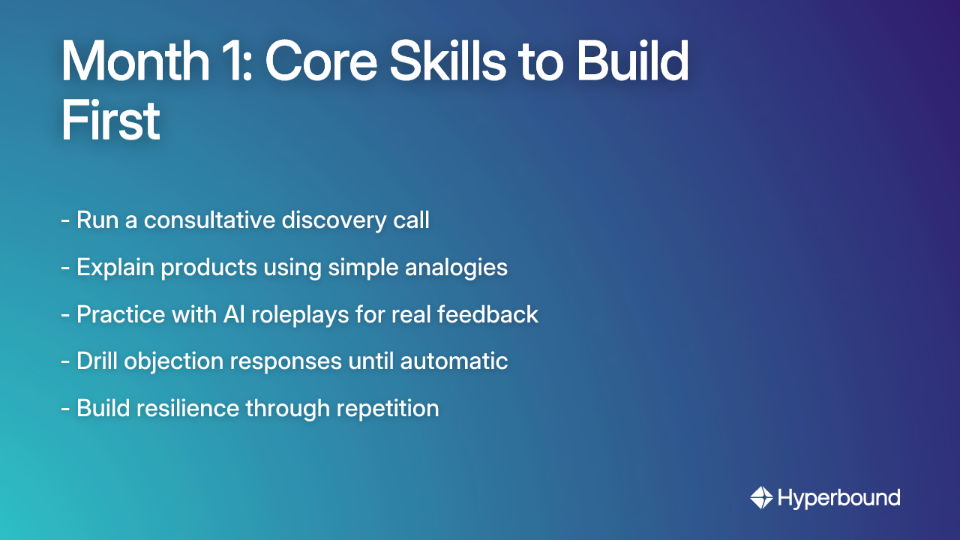
The Consultative Discovery Call
Your only job in a first call is to understand, not to sell. Switch from a "pitcher" mindset to a consultant mindset. Asking open-ended questions is the cornerstone of this approach — you want the prospect talking more than you are.
Start with questions like:
They're the specific words that get prospects to lower their guard and start sharing real information. Active listening — summarizing what you heard, confirming understanding — is what separates agents who sound like brochures from agents who sound like trusted advisors.
Explaining Products Without Sounding Like a Manual
When it's time to explain term vs. whole life, your goal isn't accuracy — your goal is relevance. Instead of reciting definitions, translate features into tangible benefits tied to your client's specific situation.
Try: "Term is like renting protection — great for covering your mortgage or income replacement while your kids are young. Whole life is more like buying — you're building cash value and it's with you forever." One analogy, under 30 seconds, and they get it.
Practice delivering that explanation until it sounds completely natural. The scripting is key — if you don't have a script, you're winging it, and winging it on a commission-on-the-line call is an expensive habit.
How to Practice: Hyperbound Practice
This is where Hyperbound Practice becomes the difference between theoretical knowledge and real-world readiness. Instead of burning through live prospects while you figure out your pacing, you can run dozens of simulated first calls with AI buyer personas that respond like real clients — asking follow-up questions, expressing skepticism, going cold when you pitch too early.
After each session, Hyperbound's AI Scorecards give you immediate, objective feedback: your talk ratio, how many open-ended questions you asked, whether you articulated value clearly. No manager needs to be in the room. You get coaching-grade feedback on every single rep — something that's simply not possible if you're training once or twice a week in a group session.
Here's the truth about objections: they're not rejections. They're requests for more information. The problem is that when you're new and you hear "I need to think about it" for the tenth time in a row, it feels personal — and that emotional challenge is one of the biggest reasons new agents lose momentum.
The antidote isn't tougher skin. It's prepared responses. Agents who follow a proven, structured process consistently close more policies — not because they're more charming, but because they don't freeze when the conversation gets uncomfortable.
Here are the objections you will hear, and the responses worth drilling:
"I need to think about it."
"I understand completely. What specific concerns do you have? If we can resolve those today, would you be ready to move forward?"
"It's too expensive."
"A lot of clients feel that way at first. Let's figure out what coverage actually makes sense for your situation — and then compare that to the real cost of being underprotected."
"I already have life insurance."
"That's great — you've already taken a responsible step. A lot of my clients say the same thing. Would you be open to a quick five-minute review? Often we find gaps or ways to save money they didn't know were there."
"I'm not interested."
"Totally fair — most people say that before they hear how this is different. Could I just take five minutes? How does tomorrow at 2pm work, or is 10am better for you?"
Reading those responses won't cut it. You need to internalize them — to the point where they come out calm and natural, not rehearsed and robotic.
How to Practice: Bitesized Roleplays
Hyperbound Practice's Bitesized Roleplays are purpose-built for exactly this kind of drilling. Pick one objection — say, the price objection — and run it 10 times in 15 minutes. The AI pushes back realistically. Hyperbound's AI Coaching flags weak language ("actually," hedging phrases, filler words) and identifies missed opportunities to redirect. By the end of Week 4, these responses should feel as automatic as your own name.

You've done the reps. Now you're making live calls. The shift from practicing in a simulator to performing on real prospect conversations is where most new agents hit a plateau — not because they stop learning, but because they stop looking at what they're doing.
As one seasoned agent put it: "Record your sales calls and listen to them. You'll hear all sorts of opportunities to improve." That's solid advice — but self-evaluation has limits. You'll naturally notice the wins and gloss over the uncomfortable moments. What you need is objective analysis.
Finding Your Patterns
The goal in Month 2 isn't to close every deal — it's to find the patterns in how your deals are going. Ask yourself:
These aren't random mistakes. They're skill gaps, and identifying them is the difference between plateauing at average and accelerating toward top-performer numbers. Start tracking your daily metrics: Connection Rate, Quality Connections, and Closing Rate. As agents who've been through this stage recommend, "Activity leads to 'app-tivity.' Tracking your numbers is critical to uncovering opportunities to improve your results."
Closing the Loop: From Real Calls Back to Practice
This is where Hyperbound's AI Real Call Scoring enters the picture. Simply connect your call recording tool, and Hyperbound automatically scores 100% of your calls against key competencies — not just the handful your manager happens to listen to.
The real power is in the loop it creates:
This continuous improvement cycle — Score Real Calls → Identify Skill Gaps → Practice Roleplays → Score Real Calls — is what separates structured sales training for insurance agents from the "wing it and hope" approach that leaves most new agents frustrated and stalled.
You've built the foundation, you're analyzing your calls, and your core objection responses are locked in. Now it's time to play offense — to pursue the higher-value conversations that separate an average agent from a top producer.
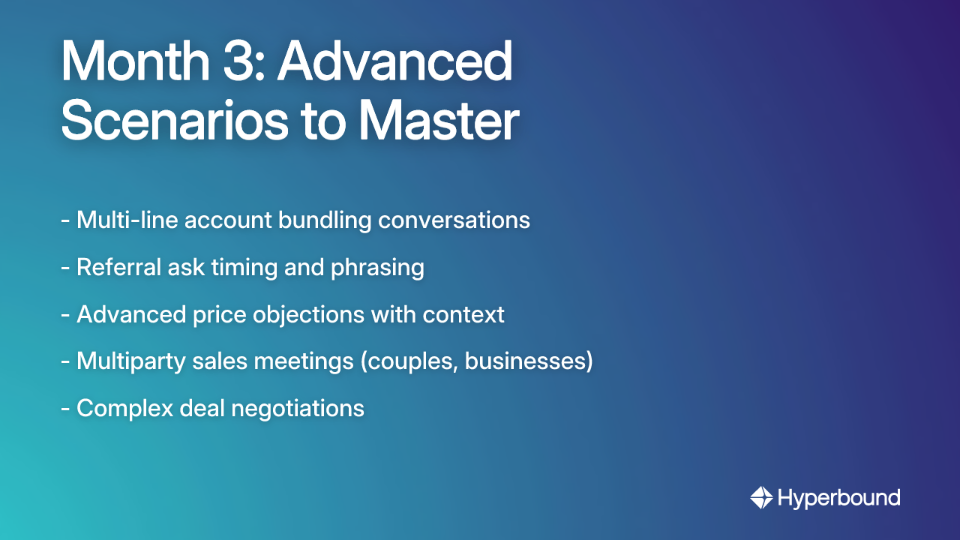
Single-line sales are a starting point, not a ceiling. The agents who build durable books of business learn to bundle — auto, home, life, and sometimes commercial lines under one household relationship. But pivoting a conversation from one product line to another takes finesse. Jump too fast and it feels like you're upselling. Stay too narrow and you leave money (and real value for the client) on the table.
The skill here is in the needs analysis: asking questions broad enough to surface adjacent risks without feeling like you're running a checklist. Practice transitions like: "Now that we've got your life coverage sorted, I always ask clients — when did you last do a full review of your property coverage? Most people are underinsured by the time we look."
Cold leads are expensive, inconsistent, and demoralizing. Top agents build self-sustaining pipelines through referrals. As one agent shared after hard-won experience: "I learned to work referrals instead of buying leads."
But asking for referrals is its own skill. The timing matters — post-claims resolution, after a policy review where you saved them money, or right after onboarding when satisfaction is highest. The phrasing matters too: "The best compliment I ever get is an introduction to someone you care about. Is there anyone in your life who might benefit from the same review we just did?"
By Month 3, you've practiced the standard price objection response. But advanced price objections come with more context — a competitor quote, a spouse who has concerns, a business client doing budget reviews. These require nuance: you need to probe the specific comparison, reframe total value versus premium cost, and know when to hold your ground and when to offer a policy adjustment.
How to Practice: Multiparty and Complex Scenario Roleplays
These conversations are almost impossible to simulate with a busy manager. Hyperbound Practice's multiparty roleplay feature lets you run a simulated meeting with a couple who each have different financial priorities — one focused on monthly cost, the other on coverage breadth. You can build custom scenarios for referral ask conversations, multi-line pivot moments, and complex price negotiations, then run them repeatedly until the flow is fluid and confident.
This is how you build muscle memory for revenue-driving conversations before they happen live.

Three months ago, you were staring at a list of names with no idea how to turn a cold call into a policy. Now you have a framework.
Week 1: You learned how to run a real discovery conversation and explain products like a human, not a brochure. Weeks 2–4: You drilled the objections that used to stop you cold until the responses were automatic. Month 2: You started learning from your real calls instead of just moving on to the next one. Month 3: You started having the conversations that build a real book of business.
Sales training for insurance agents doesn't have to mean sitting through a slide deck once a week and hoping the knowledge sticks. The agents who ramp fastest are the ones who practice with purpose — in targeted, repetitive sessions, with feedback that tells them exactly what to improve.
Stop winging it on live calls. Start building the skills that compound with every conversation. See how Hyperbound Practice can help you master the conversations that close deals and build a successful career in insurance.
Sales training is critical because most new agents fail due to a lack of practical sales skills, not a lack of product knowledge. While licensing exams cover insurance products thoroughly, they don't teach agents how to conduct a discovery call, handle common objections, or build the resilience needed to succeed in a sales role. This article provides a structured 3-month plan to bridge that gap.
The most important initial skill is mastering the consultative discovery call. Instead of pitching products, a new agent's primary goal should be to understand the prospect's needs, goals, and concerns through open-ended questions and active listening. This builds trust and positions the agent as an advisor, not just a salesperson.
The key to handling objections is preparation and practice, not improvisation. You should develop and internalize proven responses for common objections so you can reply calmly and confidently. The most effective way to do this is through repetitive drilling, using tools like AI roleplays to simulate real-world scenarios until your responses become automatic.
The most effective practice method involves targeted, repetitive sessions with immediate feedback. While practicing with managers is helpful, it's often infrequent. AI-powered roleplay platforms like Hyperbound allow you to run dozens of simulated conversations on your own schedule, drilling specific skills like objection handling or discovery calls and receiving objective feedback after every rep.
AI tools accelerate skill development by providing a safe and scalable practice environment. An AI sales training platform can score 100% of your real calls to identify skill gaps, recommend targeted practice exercises (roleplays), and offer objective feedback on your performance. This creates a continuous improvement loop that is far more efficient than traditional group training sessions.
While mastery is an ongoing process, you can build a strong foundation of essential sales skills within 90 days. This article outlines a 3-month roadmap that focuses on mastering core conversations in Month 1, analyzing real-world performance in Month 2, and tackling advanced scenarios like multi-line sales and referrals in Month 3.










Use Cases
Legal