
The pressure is real. CFOs are scrutinizing every line of OpEx. Boards want efficiency proof. And RevOps leaders are staring at a Frankenstack of 20-plus tools, sky-high monthly subscriptions, and data stuck in silos that nobody can fully reconcile. According to Blue Triangle, the average organization runs between 200 and 300 tools. Sales tech stack consolidation is no longer a nice-to-have conversation. It is a survival skill.
But here is the problem. Most consolidation decisions are made with the wrong lens. Leaders pull up a spreadsheet, sort by cost, look for feature overlap, and start cutting. It feels rational. It is not. The question that gets skipped is the one that matters most: what does removing this tool actually do to revenue outcomes?
This article gives you a framework to answer that question. Three questions. Applied to every tool. The goal is not to cut as much as possible. The goal is to cut what is safe to cut, and protect what is quietly driving deals.
Most consolidation efforts start with two criteria: cost and redundancy. Both are incomplete signals when used in isolation.
The cost-cutting fallacy. An expensive tool delivering a 10x return is a better investment than a cheap tool delivering none. C-level executives now expect a minimum of 5x ROI for any tool renewal or new investment. Cutting purely on sticker price without measuring return is like selling your best-performing asset because it has the highest price tag.
The feature-overlap myth. The spreadsheet audit approach lists tools side by side and checks off matching features. This creates false equivalencies. Two tools might both offer "call analysis." That does not mean they do the same thing. How they analyze calls, what behaviors they drive, and what actions they enable can be fundamentally different. Cutting based on surface-level feature overlap is where teams make their most costly mistakes.
As one RevOps professional put it after a consolidation attempt gone wrong: the fear was always "jack of all trades, master of none." That fear is well-founded. When you consolidate the wrong tools, you do not get simplicity. You get gaps in your revenue motion that do not show up until pipeline starts to slip.
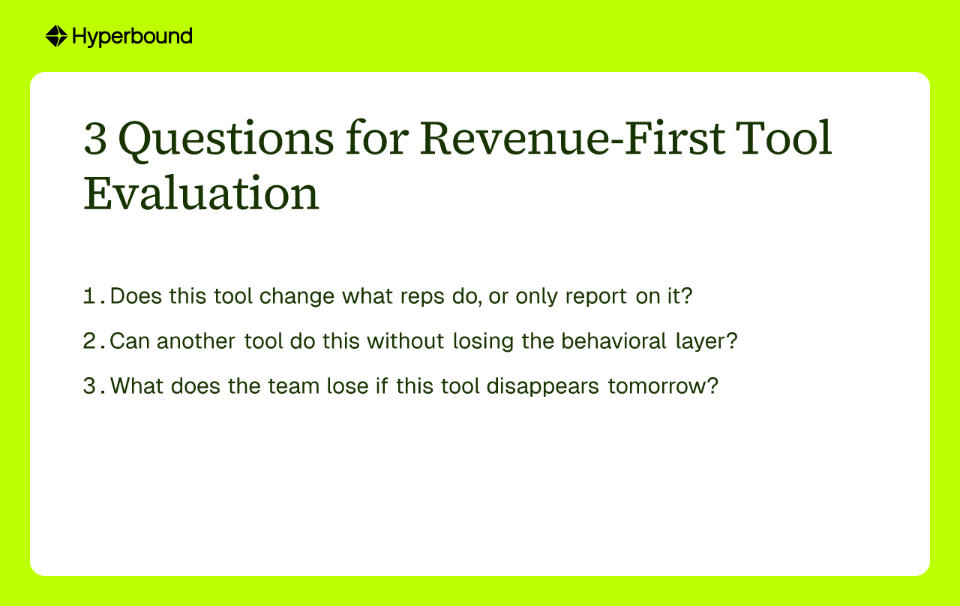
Before you cut anything, run every tool through these three questions. This framework, informed by RevOps best practices and sales tech consolidation research, shifts the evaluation from feature counting to revenue protection.
This is the most important distinction in your stack. Every tool is either a system of insight or a system of action.
Systems of insight tell you what happened. Dashboards, BI tools, and most analytics platforms live here. They are critical for visibility. But they do not change seller behavior on their own.
Systems of action directly influence what reps do. They drive practice, prompt the right follow-up, guide sellers through a process, or automate a step that would otherwise be skipped. They change behavior.
The goal is not to cut insight tools. It is to make sure you are not accidentally cutting the action layer that produces the results your reports show.
This is a more precise version of the redundancy question. It is not asking whether another tool has the same feature. It is asking whether outcome parity exists.
If you consolidate Tool A into Tool B, will reps still perform the specific, revenue-driving behaviors that Tool A enabled? Feature presence is not the same as behavioral continuity. A CRM might technically log calls. A sales engagement platform might actively prompt and guide the right follow-up sequence. Consolidating to just the CRM removes the behavioral trigger, even if "call logging" still appears on the feature checklist.
Work backwards from removal. Map the dependencies. Does Tool A feed data that makes Tool B more effective? Does Tool A trigger a workflow that Tool B relies on? Removing a tool mid-stack can quietly break things downstream.
Also factor in the hidden costs: retraining time, broken workflows, and the operational chaos of disrupting routines that are actually working. One RevOps team described hitting a breaking point when they tried to consolidate without losing functionality. This question is how you avoid that scenario.
Here is a consolidation scenario that comes up often. A RevOps leader sees that Gong analyzes sales calls. They also see that Hyperbound analyzes sales calls. Both appear in the "conversation intelligence" row of the spreadsheet. One gets flagged for removal.
This is exactly where the wrong framework leads to the wrong decision.
Run it through the three questions.
Does each tool change what reps do, or only report on it?
Gong is a system of insight. It captures the reality of customer conversations, surfaces deal risks, and gives managers visibility into what is happening across the pipeline. It answers: what is actually occurring in your deals?
Hyperbound is a system of action. It uses those insights to drive behavior change through AI-powered practice and targeted coaching. It answers: now that you know what is happening, how do you get reps to do it differently? The core principle is straightforward: data alone does not change behavior. Deliberate practice does.
These are not the same function. They sit at different points in the same loop.
Can another tool do this without losing the behavioral layer?
No. Gong provides the signal. It does not provide the practice environment. Managers using Gong can typically review only 2 to 5 percent of calls at scale, which means most insights never translate into coaching. Hyperbound scores 100 percent of calls and surfaces targeted roleplay recommendations tied directly to those findings. That behavioral bridge does not exist inside Gong.
What does the team lose if each disappears?
Without Gong, you lose the source of truth. Coaching and strategy decisions get made without data. You are flying blind.
Without Hyperbound, you have the data and no scalable way to act on it. The insight-to-action loop breaks. You know what your top reps do. You have no efficient mechanism to get everyone else doing it.
The proof is in the outcomes. Vanta used Hyperbound alongside their conversation intelligence tool and cut new hire ramp time from 210 days to 72 days. Nivoda achieved a 50 percent ramp reduction and doubled revenue year-over-year. These are not redundancy numbers. These are compounding returns from connecting insight to action.
Hyperbound is not a replacement for Gong. It is what makes Gong's data actionable at scale.

A consolidated stack is not the shortest possible list of tools. It is a set of deeply integrated tools, each with a clear purpose, that cover the full revenue workflow without gaps.
Think in terms of capability layers, not vendor count:
CRM (Salesforce): The system of record. All customer data lives here. Every other tool should feed into it or pull from it.
Revenue Activation (Hyperbound): The system of reality and action. It starts by capturing the unfiltered voice of the customer (like traditional CI tools such as Gong or Chorus) and then uniquely closes the loop by turning those insights into rep skills through practice and AI-coaching. Deal intelligence is one of the highest-signal inputs a RevOps team can work with, and activating that intelligence is how you change outcomes. Hyperbound's Practice, Perform, and Kota modules cover this full execution layer, from knowing to doing.
LMS and Sales Content Platforms: The system of knowledge. Playbooks, onboarding content, and customer-facing materials are managed here, with SCORM-tracked completion feeding back into your unified learning record.
Each layer has a distinct job. No layer duplicates another. And every layer connects to the others, which is what makes the whole greater than the sum of its parts.
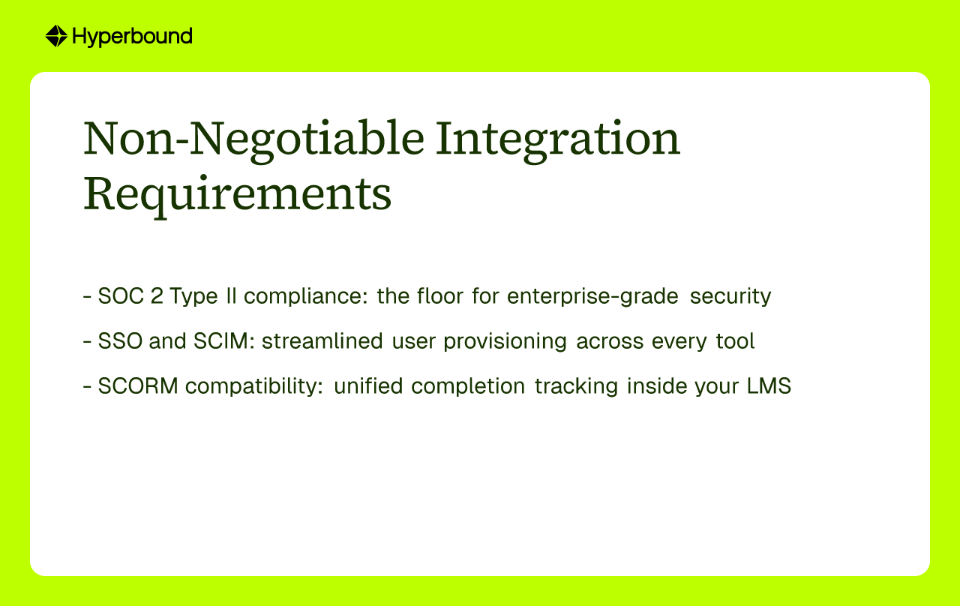
As you evaluate tools against this framework, there are three non-negotiable technical requirements. Skipping these creates compounding admin burden and security risk down the road.
SOC 2 Type II compliance. This is the floor for enterprise-grade data security. Any tool handling customer conversation data, rep performance data, or pipeline information needs to meet this standard. Non-compliance creates legal exposure and blocks procurement approval in most enterprise environments.
SSO and SCIM. Single Sign-On and System for Cross-domain Identity Management streamline user provisioning and de-provisioning. When a rep leaves, you need one place to revoke access across every integrated tool. Without SCIM, that becomes a manual operation with security gaps.
SCORM compatibility. If a tool generates coaching content or training modules, SCORM compliance ensures that content can be tracked inside your primary LMS. Without it, you lose completion records, create a fragmented learning history, and force reps to navigate multiple systems to find the same content.
These are not aspirational requirements. They are the table stakes for a stack that scales without creating new operational debt.
The right outcome of sales tech stack consolidation is not a lower tool count. It is a tighter connection between insight and action across your entire GTM motion.
A rationalized stack creates a feedback loop. Conversation intelligence captures what is happening in deals. Revenue activation tools turn those signals into rep behavior change. Better-prepared reps generate better data back in the CRM. The loop compounds over time.
Cutting tools without this framework breaks the loop. You save budget on paper and lose it in pipeline. The complexity tax gets paid one way or another. The question is whether you pay it in subscriptions or in revenue.
Use the three questions. Protect the behavioral layer. And build a stack where every tool earns its place by moving deals, not just reporting on them.
The best way to consolidate a sales tech stack is to evaluate each tool based on its direct impact on revenue outcomes and seller behavior, not just its cost or feature overlap. Use a framework that asks three key questions for every tool: 1) Does it change what reps do, or just report on it? 2) Can another tool replicate its function without losing the behavioral change layer? 3) What would the team lose if the tool disappeared tomorrow? This revenue-first approach ensures you cut what's safe to cut while protecting the tools that actively drive deals.
Consolidating tools based on feature overlap is a mistake because it creates false equivalencies and ignores the unique behavioral impact each tool may have. Two tools might both have a feature like "call analysis," but they can be fundamentally different in how they analyze calls, what actions they prompt, and how they influence a seller's workflow. Cutting a tool based on a surface-level feature match can inadvertently remove a critical system of action, leading to gaps in your revenue motion that only appear when pipeline starts to slip.
A system of insight tells you what happened in your sales process, while a system of action directly influences what your sellers do to change future outcomes. Systems of insight include dashboards, BI tools, and analytics platforms that provide visibility and reporting. Systems of action are tools that drive practice, prompt specific follow-ups, or guide reps through a process. A rationalized tech stack needs both; insight tools to identify problems and action tools to solve them at scale.
No, conversation intelligence tools like Gong and revenue activation platforms like Hyperbound are not redundant; they serve complementary functions. Gong acts as a system of insight, capturing the reality of customer conversations to tell you what is happening. Hyperbound acts as a system of action, using those insights to change rep behavior through AI-powered practice and coaching, telling you how to improve. Hyperbound makes the data from tools like Gong actionable at scale, connecting insight to execution.
A rationalized sales tech stack is not about having the fewest tools, but about having a set of deeply integrated tools organized into distinct capability layers with no functional gaps. A well-structured stack typically includes: 1) A CRM as the central system of record (e.g., Salesforce). 2) A Revenue Activation platform for practice and performance (e.g., Hyperbound). 3) An LMS or Sales Content Platform for knowledge management. Each layer has a clear job and integrates seamlessly with the others.
The most critical technical requirements for any new sales tool are SOC 2 Type II compliance for security, SSO and SCIM for user management, and SCORM compatibility for unified training tracking. These are non-negotiable for building a scalable and secure tech stack. SOC 2 ensures enterprise-grade data security. SSO/SCIM streamlines user provisioning and de-provisioning. SCORM allows training content from various tools to be tracked within your primary Learning Management System (LMS), preventing a fragmented learning experience.











Use Cases
Legal