
You've just hired a promising new sales rep, but the relief is quickly replaced by a familiar dread: onboarding. The process often feels chaotic, and you're left wondering if you've done enough to set them up for success. You're not alone—many sales managers describe onboarding as "cumbersome and challenging," with significant consequences for getting it wrong.
Consider this: Companies with structured onboarding see new reps achieve quota 50% faster than those without. Effective onboarding can increase quota attainment rates by up to 73%. Yet B2B sales reps forget 70% of what they learn within a week of training if it's not reinforced.
The difference between a struggling rep and a high performer often comes down to how they were onboarded. This comprehensive checklist transforms the chaotic scramble of bringing on new team members into a strategic advantage for your sales organization.
"You'd honestly be surprised how many companies hire people without training them thoroughly about the product," one sales professional on Reddit noted. This lack of preparation leads to a painful cycle: poor performance, lost deals, and eventually, turnover.
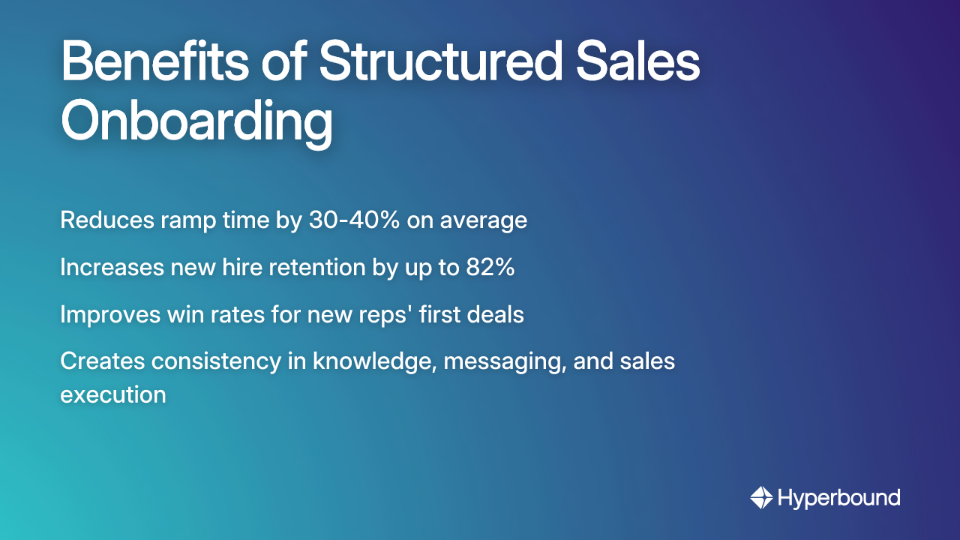
The stakes are simply too high to wing it. Beyond the direct impact on quota attainment, a structured sales team onboarding process:
Let's break this down into four actionable phases that transform a new hire into a confident, quota-crushing team member.
Goal: Ensure a seamless Day 1 by handling all logistics in advance, making the new hire feel welcome and prepared.
Checklist:
Goal: Immerse the new rep in the company culture, the "why" behind the product, and the profile of the ideal customer.
Checklist:
Goal: Bridge the gap between theoretical knowledge and practical application in a safe, controlled environment.
Checklist:

Goal: Transition the rep to independent execution while establishing a strong, continuous coaching and feedback rhythm.
Checklist:
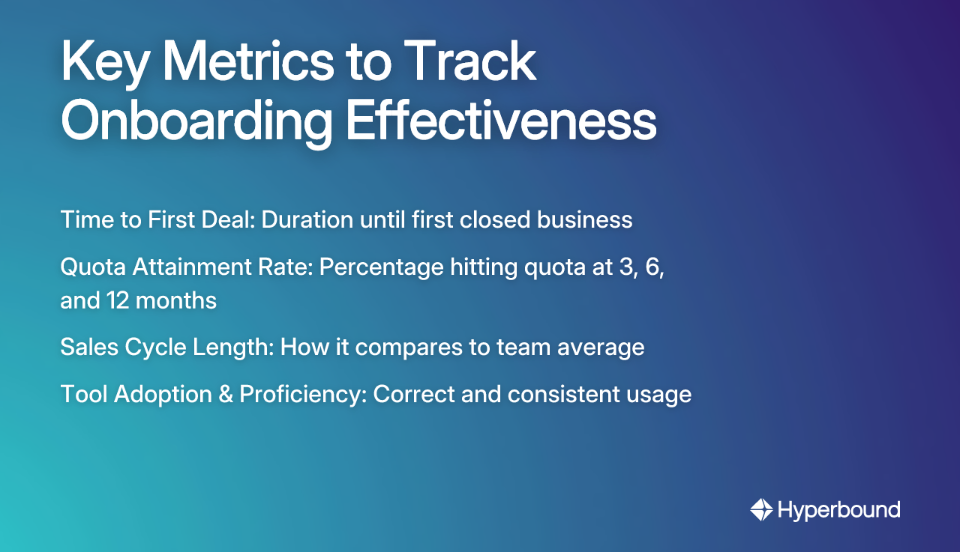
Onboarding isn't a "set it and forget it" program. It must be measured and refined. Track these key metrics to gauge effectiveness:
At the 30, 60, and 90-day marks, schedule time to explicitly ask new hires for feedback on the onboarding process:
This addresses the challenge of "inflexibility in adapting to new ideas" and creates a culture of continuous improvement. As one Reddit user suggested, "After 2 months of immersing this person into your day to day, let them start suggesting changes to make to the program and a/b test."
Traditional onboarding methods have inherent limitations: manager bandwidth constraints, inconsistent messaging, and the inability to provide immediate feedback at scale. Modern AI-powered tools can overcome these challenges.

A great sales rep can fail with poor onboarding, while a good rep can become great with a world-class program. This checklist serves as your roadmap to transform the chaotic scramble of onboarding into a strategic advantage.
By implementing a structured, repeatable, and tech-enabled sales team onboarding process, you're making the single most impactful investment a sales manager can make in building a consistently high-performing team.
Remember: Onboarding isn't just about getting a new hire up to speed—it's about setting the foundation for their entire career at your company. When done right, it creates a virtuous cycle of confidence, competence, and quota attainment that benefits everyone involved.
A sales onboarding checklist is a structured document that outlines all the steps, tasks, and resources required to successfully integrate a new sales representative into your team. It covers everything from pre-boarding logistics and first-week immersion to detailed product training, process practice, and performance expectations, ensuring a consistent and effective ramp-up period for every new hire.
A structured onboarding process is crucial because it directly impacts revenue, rep performance, and retention. Companies with effective onboarding see new reps achieve quota 50% faster, increase quota attainment rates by up to 73%, and improve new hire retention. It eliminates guesswork, ensures consistency in messaging, and sets a clear path for new reps to become productive, confident members of the team.
The active, structured part of sales onboarding typically lasts 90 days, but continuous development should be ongoing. This 90-day period is often broken down into phases: the first week focuses on foundation and culture, the first month on process and practice, and the first quarter on execution and refinement. While a rep may start closing deals within this timeframe, true ramp-up to full productivity can take six months or more, depending on the complexity of the product and sales cycle.
The most common mistakes in sales onboarding are information overload, a lack of hands-on practice, and unclear performance expectations. Many companies overwhelm new hires with product features instead of focusing on problem-solving, fail to provide safe environments for role-playing, and don't set clear 30-60-90 day goals. Another major pitfall is treating onboarding as a one-time event rather than a continuous process with a feedback loop.
AI significantly improves sales onboarding by providing scalable, personalized, and objective training opportunities. AI-powered tools like role-play simulators allow new reps to practice critical conversations risk-free and receive instant feedback. AI can also analyze real sales calls to flag coachable moments, ensuring consistent feedback at a scale that is impossible for managers to achieve manually, ultimately cutting ramp time and boosting rep confidence.
Sales onboarding is the holistic process of integrating a new hire into the company, while sales training is a specific component of that process. Onboarding covers company culture, systems access, team introductions, and setting expectations. Sales training focuses specifically on developing skills and knowledge, such as product details, sales methodology, and CRM usage. Effective onboarding provides the context and structure for ongoing training to be successful.
The success of a sales onboarding program is measured by tracking key performance indicators (KPIs) that demonstrate a new hire's progress toward full productivity. The most critical metrics include Time to First Deal, Quota Attainment Rate (at 3, 6, and 12 months), and Sales Cycle Length compared to the team average. Additionally, tracking tool adoption rates and gathering qualitative feedback from new hires is crucial for refining the program.










Use Cases
Legal