
You've read "Fanatical Prospecting," watched hours of YouTube videos, and listened to countless podcasts. But when it's time to actually pick up the phone, you freeze. You're told the "best way to learn is to do," but also that "if you just prospect... with no real training, you will fail." This frustrating paradox is where most sales careers stall before they even begin.

The global sales training market is a massive $4.6 billion industry. Yet, the results are often dismal. 70% of B2B sales reps forget the information they learned within a week of training. If not reinforced, 77% of learning is forgotten within 6 days. This isn't just a training problem; it's an application and development problem.
This article will dissect why this gap exists and provide a practical framework for turning theoretical knowledge into tangible sales results.
Sales training is intended to improve seller capabilities, drive behavior change, and maximize sales success. It should be treated as a change management initiative, not a one-time event.
Yet many organizations fall into the trap of "check-box training"—one-off sessions designed to tick a box rather than facilitate genuine, long-term change. As one sales professional put it, these trainings are "absolutely useless unless you actually do the selling."
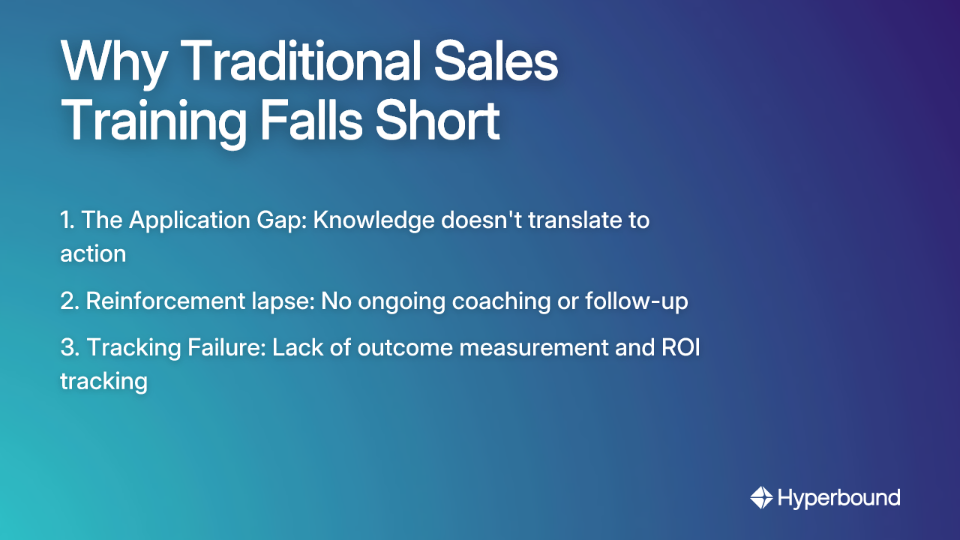
The most common failures of traditional sales training include:
To understand why most sales training fails, we need to clarify an essential distinction:
Training = Knowledge Transfer This is about providing skills and information. Examples include learning a new prospecting script or the steps of the Challenger Sale methodology.
Development = Competency Transfer This is about nurturing a salesperson's overall capabilities and wisdom over time. It's about building business acumen, strategic thinking, and adaptability.
Sales training excels at knowledge transfer but often fails at competency transfer. True competency requires practice, experience, and reflection.
According to Gartner, leaders must shift from "sales training" to "sales learning," emphasizing a continuous environment over traditional, event-based methods. They also recommend "Just-in-Time Learning" to provide sellers with information exactly when they need it.
This shift addresses the common pain of "knowing a lot of theory but not applying practical skills" that many salespeople experience.
Feeling overwhelmed by the sheer number of skills you need to excel in sales? You're not alone. 72% of sellers feel overwhelmed by the number of skills they need for excellence.
Let's break it down into manageable categories:
.png)
This is not just about learning; it's about creating a system for growth that bridges the gap between knowledge and application.
Based on the skills outlined above, honestly assess where you (or your team) stand. Use Gartner's four-step framework:
Books or podcasts may be helpful to extract an idea or two, but they're not magic bullets. Frame these resources as supplements to your development framework, not standalone solutions.
To truly bridge the gap between knowing and doing, reps need a place to practice safely and get immediate feedback.
Don't overlook what's right in front of you. As one sales professional advised, "I personally mostly use the library of resource my company has. I would recommend asking to see if your company has one."
Frame books and podcasts as tools for generating ideas to test within your development framework, not as rigid instruction manuals. Choose wisely and apply immediately.
True sales mastery isn't achieved in a two-day workshop. It's forged in the continuous, disciplined cycle of learning, applying skills in the real world, reflecting on successes and failures, and receiving targeted coaching.
The fear of failure keeps many salespeople stuck in perpetual preparation mode. But as one Reddit user bluntly put it, "Get out there and screw up a lot." Reframe failure as the most valuable data source for development. The goal isn't to be perfect from day one; it's to be better than you were yesterday.
Stop searching for the single "best" training course and start building your own personal system for continuous skill development. The gap between knowing and doing narrows with each deliberate practice session, each coaching conversation, and each reflection on real-world application.
Your success in sales doesn't depend on what you know—it depends on what you consistently do with what you know.

The main problem with traditional sales training is the "application gap"—a significant disconnect between learning theoretical knowledge and applying it effectively in real-world sales scenarios. Most training is treated as a one-time event with little to no follow-up. As a result, sellers forget as much as 70-77% of what they learn within a week, meaning the investment rarely translates to improved performance.
Sales training often fails because it focuses on knowledge transfer rather than competency development. It provides information but doesn't offer a structured way for reps to practice, receive feedback, and reinforce new skills until they become second nature. Without a system for deliberate practice and continuous coaching, the initial knowledge gained from a training session is quickly lost.
Sales training focuses on knowledge transfer, which is about providing specific skills and information like a new script or methodology. Sales development, on the other hand, is about competency transfer—nurturing a salesperson's overall capabilities, business acumen, and adaptability over time through continuous practice and experience. Development is an ongoing process, while training is often a one-time event.
You can practice sales skills in a risk-free environment using AI-powered role-playing platforms. Tools like Hyperbound's AI Sales Roleplays allow you to practice any sales scenario with realistic AI buyer personas. This provides a safe, on-demand space to build muscle memory through repetition, receive instant feedback, and refine your approach without the pressure of a live customer call.
The most important sales skills can be grouped into four key categories: foundational communication (active listening, delivery), strategic sales skills (prospecting, objection handling), advanced competencies (business acumen, resilience), and technical proficiency (CRM, pipeline management). Mastering a blend of these skills is crucial for top performance.
You can bridge the gap by implementing a personal development framework. First, assess your skills to identify gaps. Second, engage in deliberate practice using tools like AI role-playing. Third, ensure consistent reinforcement through coaching and follow-up. Finally, measure your progress with relevant metrics and feedback loops. This transforms learning from a passive activity into an active, results-oriented system.










Use Cases
Legal