
You've invested in call recording. You have a CRM full of pipeline data. Your managers are sitting through rep reviews every week. But win rates are still flat, ramp times are still long, and you still can't pinpoint exactly which skills are costing you deals.
You're not alone. According to Salesforce's State of Sales, reps spend only 28% of their week actually selling — and the coaching that's supposed to sharpen the other 72% isn't sticking. Research consistently shows that 80% of sales training is forgotten within 30 days. Meanwhile, frontline managers spend just 5–8% of their time coaching and listen to less than 1% of recorded conversations, meaning most skill gaps go undetected until they show up in a lost deal.
The result? High turnover rates, stagnant win rates, and an uncomfortable truth: you have plenty of data, but no clear line from that data to what a rep should do differently tomorrow.
That's the gap that sales rep skill gap analysis is designed to close. Done right, it moves your enablement program from "we ran a training session" to "we identified a specific behavior, fixed it through targeted practice, and saw conversion rates go up." But the tool you use to run that analysis matters enormously — because most tools stop halfway.
This buyer's guide evaluates the 6 best sales skills assessment tools for gap analysis in B2B teams, structured around four criteria that matter most to sales leaders:
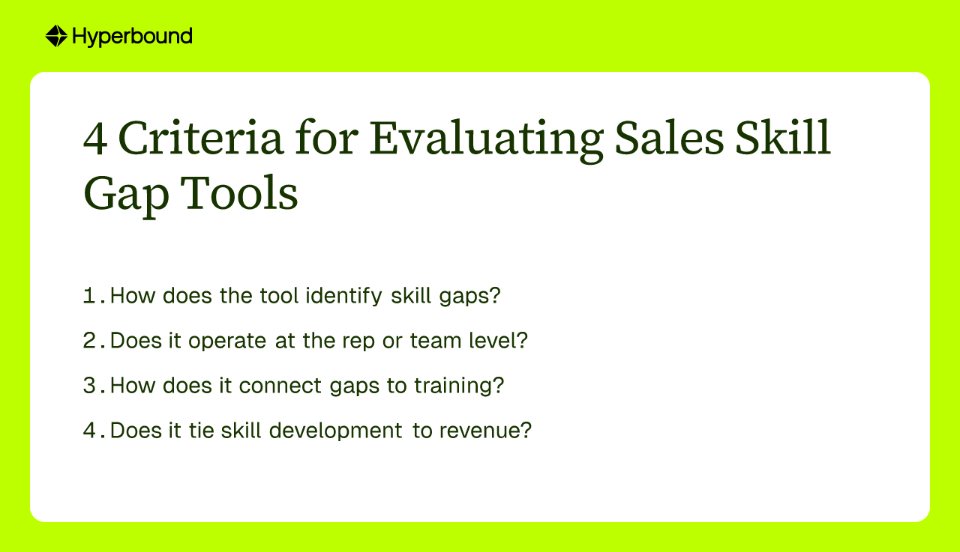
We'll cover tools across three categories: manual survey platforms (Culture Amp, Qualtrics), conversation intelligence tools (Gong, Chorus), and AI roleplay and coaching platforms — starting with the only platform that completes the full loop.
Best for: B2B sales teams that want to close the loop from gap identification to revenue impact
Most tools tell you what the problem is. Hyperbound tells you what the problem is, assigns targeted practice to fix it, and then measures whether it worked — all in one continuous cycle.
Hyperbound coined the "Revenue Activation" category to describe exactly this: moving beyond call data and analytics into actually changing outcomes. The platform is built around a Practice → Perform → Activate model, where each layer feeds the next.
How it identifies gaps: Hyperbound Perform deploys AI Scorecards on real sales conversations, analyzing them against your winning methodologies. Critically, it doesn't just score individual calls in isolation — it rolls up insights across all calls, emails, and touchpoints in a deal to surface deal-level patterns. This means you're catching skill gaps in context: not "this rep stumbled on a pricing objection once," but "this rep consistently loses momentum at the economic buyer stage across six deals."
Rep or team level: Both. At the rep level, Perform surfaces deal-specific coaching with granular behavioral analysis. At the team level, Kota Activate — Hyperbound's AI orchestration layer — runs a full pipeline review across all deals simultaneously, surfacing cross-deal objection trends and benchmarking reps against top performer behaviors. Managers get a real pulse on team-wide skill gaps without listening to a single extra call.
How it connects gaps to training: This is where Hyperbound separates itself from every other tool on this list. When Perform identifies a gap (say, weak discovery questions in enterprise deals), Kota automatically orchestrates a personalized coaching intervention — creating and assigning a targeted Bite-Sized Roleplay in Hyperbound Practice. The AI buyer personas used in practice are built from analysis of 2M+ hours of real B2B sales conversations, not generic scripts, so reps are practicing scenarios that mirror their actual deals. Features like LinkedIn profile bots, Screen Comprehension for demo practice, and SCORM integration with leading sales enablement platforms make it easy to embed practice directly in existing workflows.
Ties to revenue outcomes: Hard proof, not theory. Vanta achieved a 60% ramp reduction — cutting time-to-productivity from 210 days to 72 — and grew their BDR team 4x in the process. Nivoda saw a 150% increase in their DM-to-demo conversion rate alongside a 50% ramp reduction. These aren't engagement metrics. They're revenue outcomes driven by a closed-loop system that connects skill gaps directly to the behaviors that win deals.
Bottom line: If you want a complete sales rep skill gap analysis program — not just data, not just practice, but a system that continuously improves execution and measures the impact — Hyperbound is the only platform built to do it end-to-end.
Best for: Teams that want deep call-level data and are willing to do the coaching work manually
Gong is the most widely used conversation intelligence platform in B2B sales, and for good reason — it captures and analyzes more of what happens on calls than almost any other tool. But when it comes to closing the loop on skill gap analysis, it stops at the insight stage.
How it identifies gaps: Gong records, transcribes, and analyzes sales calls to surface patterns: talk-to-listen ratios, competitor mentions, sentiment shifts, and deal risk signals. It's excellent at identifying what is happening in conversations and correlating those behaviors with win/loss outcomes. If your reps are talking 70% of the time or never asking about budget, Gong will surface it.
Rep or team level: Both, with strong team-level dashboards. Managers can filter performance data by rep, by deal stage, by topic, or by custom methodology trackers. Team-level trend analysis is one of Gong's strongest features.
How it connects gaps to training: Here's the limitation: the connection is manual. Gong gives you a library of call clips, analytics, and coaching notes. It's up to the manager to watch the call, identify the coachable moment, schedule a 1:1, and then hope the rep internalizes the feedback. There's no native mechanism to turn a flagged skill gap into a structured practice opportunity. Gong is, as often described internally by sales leaders, "a giant library of data" — enormously valuable, but requiring significant human effort to translate into behavior change.
Ties to revenue outcomes: Gong does correlate conversation behaviors with win rates and can help teams understand what top performers do differently. What it can't do is create more of those behaviors through systematic practice, or measure whether a coaching intervention on Monday actually changed how a rep performed on Thursday's call.
Best for: Teams already embedded in the ZoomInfo ecosystem looking for call intelligence with CRM context
Chorus.ai, now part of ZoomInfo, offers call recording and analysis capabilities similar to Gong, with tighter integration into ZoomInfo's contact and account intelligence data. For teams already using ZoomInfo for prospecting, the workflow consolidation is a genuine advantage.
How it identifies gaps: Chorus analyzes call recordings to flag key moments — objection handling patterns, filler word frequency, talk-time balance, and adherence to sales methodologies. Its AI identifies specific skills needing improvement at the call level and surfaces them for manager review.
Rep or team level: Primarily individual-rep focused, with manager dashboards available for team-level oversight. Managers can build "playlists" of best-practice call clips for the team to review.
How it connects gaps to training: Like Gong, the path from insight to improvement is manual. Chorus provides the evidence a manager needs to coach, but the actual coaching loop — scheduling it, conducting it, and verifying whether the skill improved — happens outside the platform. Call clip libraries are useful for illustrating what good looks like, but they're passive learning, not deliberate practice.
Ties to revenue outcomes: The ZoomInfo integration adds useful deal context (e.g., company growth signals, stakeholder org charts), but the link from a skill gap identified on a call to a specific revenue outcome remains correlational. There's no mechanism to assign targeted practice and then measure whether that practice changed a deal's trajectory.
Best for: Organizations wanting baseline qualitative data on team morale, engagement, and self-reported skill confidence
Culture Amp is a leading employee experience platform built for HR and people teams. It's not a dedicated sales assessment tool, but sales leaders sometimes use it to gather directional data on how their teams perceive their own skill levels and where confidence gaps exist.
How it identifies gaps: Through surveys, pulse checks, and manager feedback cycles. Culture Amp surfaces self-reported and perception-based data — a rep might indicate they feel underprepared for enterprise deals, or a manager might score their team low on competitive positioning. The data is qualitative and based on perceived experience, not observed behavior.
Rep or team level: Primarily team and organizational level. Culture Amp is designed for aggregate trend analysis, not granular individual coaching.
How it connects gaps to training: Reporting from Culture Amp can inform strategic training decisions — if 60% of your team reports low confidence in objection handling, that's a signal to build a training program. But the platform doesn't build that program, deliver it, or measure whether it worked at the skill level. The connection is directional at best.
Ties to revenue outcomes: The link is highly indirect. The hypothesis is that improved engagement and morale drive better performance and lower turnover, which positively impacts revenue over time. Culture Amp itself would not claim to measure the impact of a sales skill on a won deal.
Best for: Large organizations that want structured, benchmark-driven competency assessments at scale
Qualtrics is an enterprise-grade experience management (XM) platform that can be configured to run 360-degree reviews, competency assessments, and manager-feedback surveys. It's a powerful data collection and analysis engine when set up correctly.
How it identifies gaps: Qualtrics uses structured employee feedback surveys to measure skills against predefined competency frameworks and industry benchmarks. You can run 360-degree assessments where reps, peers, and managers all contribute data on specific skill areas — discovery, negotiation, product knowledge, and so on.
Rep or team level: Both. Qualtrics can generate personalized reports for individual reps showing their skill scores against benchmarks, as well as team-level dashboards for leadership. Configuration flexibility is one of its core strengths.
How it connects gaps to training: Qualtrics tells you what to train on with a high degree of specificity and statistical rigor. Where it stops is the how. The platform surfaces skill gaps clearly but does not deliver training, assign practice, or create coaching interventions. It hands the baton to a separate L&D system or manager and hopes the handoff happens smoothly.
Ties to revenue outcomes: By enabling data-informed training investments, Qualtrics can indirectly contribute to performance improvement. But the platform itself doesn't draw a line from a specific competency score to a change in pipeline conversion rate or win rate. You'll need additional tools and manual effort to close that loop.
Best for: Teams that want a dedicated practice environment for structured sales simulations
Second Nature is an AI sales simulation platform that lets reps practice conversations with AI avatars in scenario-based environments. It sits in the same category as Hyperbound Practice, though with key differences in how simulations are built and how gaps connect to real-world performance.
How it identifies gaps: Second Nature identifies gaps within the simulation itself. As a rep works through a scenario — say, a product demo or an objection-handling drill — the AI evaluates their responses and scores them on predefined criteria. Gaps surface through performance on the practice itself, not from analysis of real sales calls.
Rep or team level: Primarily individual-focused. Reps practice specific scenarios at their own pace, with feedback generated after each session. Manager-level reporting is available but tends to focus on simulation completion and scores rather than behavioral patterns across live deals.
How it connects gaps to training: The platform is the training. When a rep mishandles a pricing challenge in a simulation, they get immediate feedback and can retry. This is the clearest strength of Second Nature — the feedback loop is fast and built into the practice experience.
The limitation is the source of the scenarios. Because simulations are typically built from generic templates or manually scripted by enablement teams, they may not reflect the specific objections, buyer personas, or deal dynamics that a rep is facing in their actual pipeline. Contrast this with Hyperbound's approach, where practice scenarios are derived from analysis of your team's own real call data — meaning reps practice the conversations they're actually losing.
Ties to revenue outcomes: The connection between simulation performance and revenue outcomes is inferred — better practice should lead to better live performance. But without a mechanism to score real calls, identify deal-level gaps, and then assign targeted practice based on what's happening in active deals, the revenue impact is harder to quantify.
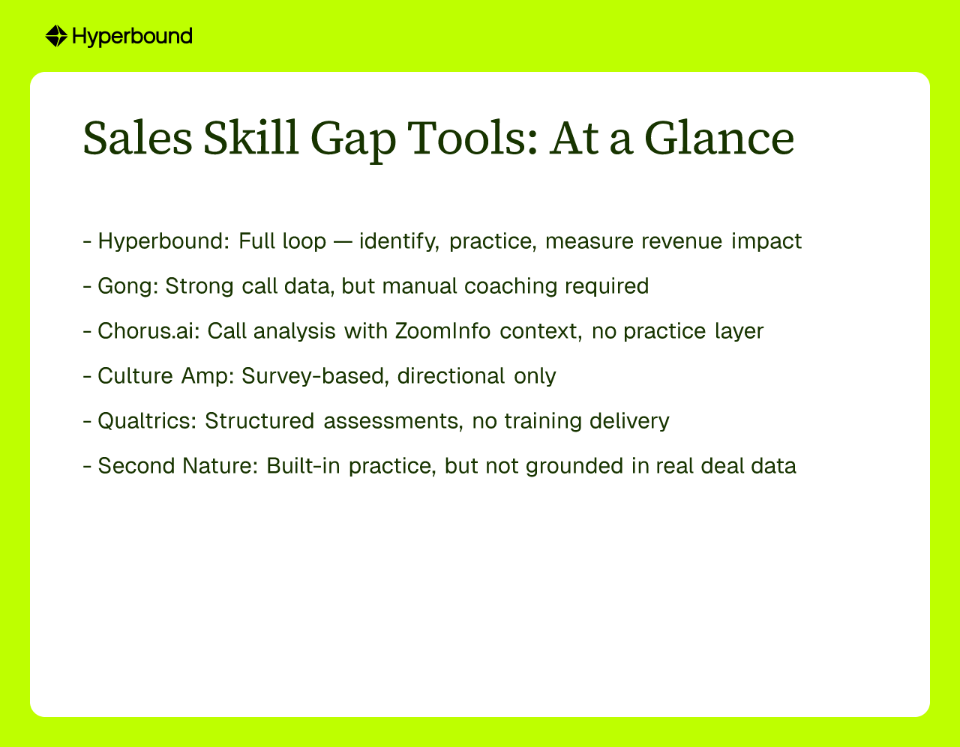
Here's a quick summary of where each tool excels and where it falls short for B2B sales rep skill gap analysis:
.png)
Survey tools like Culture Amp and Qualtrics are useful for building a baseline picture of where your team thinks skill gaps exist. They're a starting point, not a system.
Conversation intelligence tools like Gong and Chorus are excellent at capturing what's actually happening in the field. They surface the evidence. But they don't close the loop — getting from a flagged call clip to a rep who performs differently on the next call requires manual manager intervention that most sales orgs simply don't have the bandwidth to execute consistently.
AI roleplay platforms like Second Nature provide the practice environment, but if the scenarios aren't grounded in your real deal data, the transfer to live performance is weaker than it needs to be.
Only Hyperbound connects all three stages: scoring real calls → identifying and assigning targeted practice → measuring whether performance changed. That's the complete Revenue Activation loop — and it's why customers like Vanta and Nivoda are measuring outcomes like 60% ramp reduction and 150% demo rate increases, not just engagement metrics.
If you're building a serious sales rep skill gap analysis program for a B2B team and want every training dollar to trace back to pipeline performance, Hyperbound is the only platform purpose-built to deliver that connection.

Ready to close the loop? See how Hyperbound's Practice → Perform → Activate model works for your team.
Sales rep skill gap analysis is the process of identifying the specific skills, behaviors, and knowledge your sales representatives lack that are preventing them from hitting their performance targets. This goes beyond just looking at lagging indicators like win rates. It involves analyzing real-world sales activities—such as calls, emails, and demos—to pinpoint coachable moments. The goal is to move from guessing what's wrong to knowing exactly what to fix.
Closing sales skill gaps is crucial because it directly impacts key revenue metrics like win rates, deal velocity, and customer lifetime value, while also reducing costly ramp times and rep turnover. Research shows that 80% of sales training is forgotten within a month. Without a system to continuously identify and close skill gaps, that ineffective training leads to stagnant performance and missed revenue goals.
You can identify sales skill gaps using several methods, including qualitative surveys, manager observations, analysis of conversation intelligence data, and automated AI scoring of real sales conversations. While surveys provide directional feedback, they rely on self-reporting. The most advanced approach, used by platforms like Hyperbound, involves using AI to score every interaction against your winning methodology to identify patterns that are directly tied to outcomes.
The key difference is that conversation intelligence tools identify what is happening in sales calls, while a full skill gap analysis platform identifies the gap, provides the tools to fix it, and measures the impact. A conversation intelligence tool is like a library of game tapes to review manually. A complete platform like Hyperbound automates the entire loop: it analyzes performance, assigns personalized practice to fix weaknesses, and then measures whether deal outcomes actually improved.
AI improves sales coaching by automating the analysis of performance data at scale, personalizing training to individual needs, and providing a safe, repeatable environment for reps to practice new skills. Instead of managers listening to less than 1% of calls, AI can score 100% of them to surface coachable moments. It can then automatically assign a targeted AI roleplay simulation, allowing reps to practice handling a specific objection or scenario until they master it.
You can measure the success of a sales skill development program by tracking improvements in both leading behavioral indicators and lagging revenue outcomes. Leading indicators are improvements in specific skills (e.g., talk-to-listen ratio, objection handling scores). Lagging indicators are the business results that follow, such as reduced ramp time, increased conversion rates at specific deal stages, and higher win rates. The most effective tools connect these dots, showing how improving a skill directly led to a measurable impact on revenue.










Use Cases
Legal