
You've rehearsed your pitch until it's airtight. You know your ICP cold, your discovery questions flow naturally, and your value proposition lands with clarity. Then the prospect says it:
"We're already working with someone else.""We don't have budget right now.""There's too much going on right now."
And you freeze.
That's the moment deals are actually won or lost — not during the polished pitch, but in the five seconds after the pushback. Yet most sales training programs, and most sales simulator tools, are almost entirely optimized for the first part. They drill the pitch to perfection and treat objections as a footnote. The result? Reps who sound great up until the moment they don't.
This is a well-documented problem. Research surfaces the 15 most common objections reps face — pricing, budget, timing, competitor allegiance, lack of authority — and what's striking is how predictable they are. These aren't surprise curveballs. They're the same objections, in the same industries, across thousands of sales conversations. And yet, research shows that when reps successfully navigate them, they achieve a 64% success rate.
That gap isn't a knowledge problem. It's a practice problem.
This article breaks down 5 sales simulator tools — evaluated specifically on how well they handle objection training, not just pitch rehearsal. We're looking at five critical objection types: pricing, timing, competitor, stakeholder access, and status quo. Let's get into it.
If you want to train objection handling specifically, Hyperbound Practice is the most purpose-built sales simulator for the job. The key differentiator isn't just that it uses AI — it's what that AI was trained on.
Hyperbound's buyer personas are built from 2M+ hours of real B2B sales conversations. That means when the AI says "It's too expensive," it doesn't stop there. It follows up the way a real skeptical CFO would, adjusting tone and pressure based on how the rep responds — because that's what actually happens on real calls.
Here's how it maps to specific objection types:
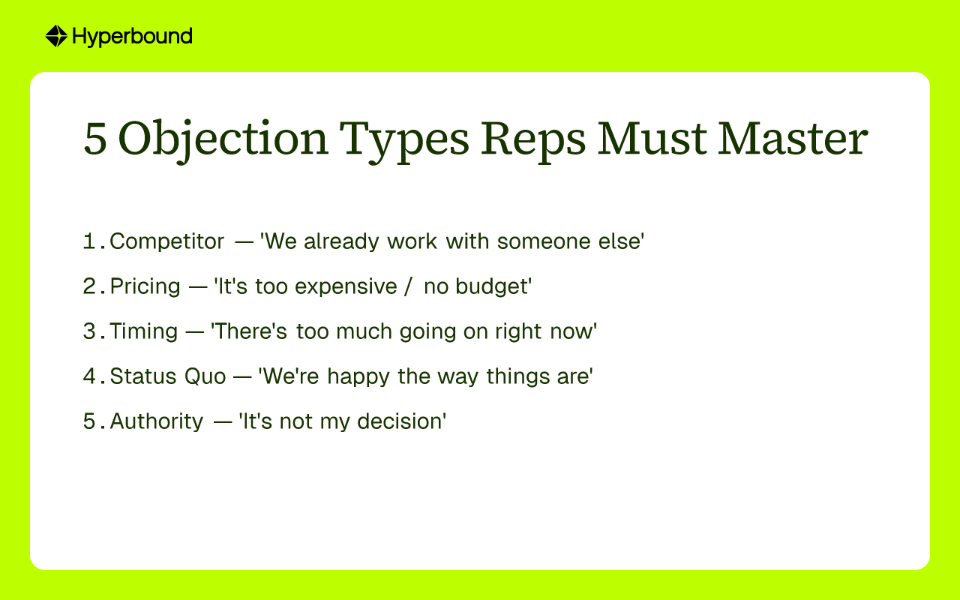
Competitor objections ("We're already working with someone else"): Hyperbound personas can be configured to simulate a satisfied — or subtly dissatisfied — customer of a specific competitor. Reps practice the Onion Method: peeling back layers with probing questions to surface hidden frustration. Most simulators script the objection and accept a canned response. Hyperbound's AI pushes back dynamically.
Pricing & budget objections ("It's too expensive," "I don't have budget"): The AI can be configured with different emotional states — price-sensitive, skeptical, or simply resistant — so reps can't just memorize a reframe. They have to earn the conversation back by demonstrating ROI. The research is clear here: shifting from price to value is the core skill — but it only becomes habitual through repetitions that feel real.
Timing & status quo objections ("There's too much going on," "We're happy the way things are"): Reps practice the Boomerang technique — turning the objection into the reason to act now. Hyperbound's auto-scorecard system immediately flags if a rep accepts a brush-off too easily, fails to create urgency, or skips the follow-up question that would have kept the conversation alive.
Stakeholder & authority objections ("It's not my decision"): This is where Hyperbound's Multiparty Roleplays feature becomes invaluable. Reps can simultaneously practice against a champion persona and a skeptical economic buyer — the same multi-threaded complexity they'll face in real enterprise deals.
Bitesized Roleplays make this practical for tenured reps too. Instead of forcing a 30-minute generic simulation, a senior AE can drill one objection type in under five minutes — before a specific call, embedded directly in their workflow through Slack, calendar, or CRM.
The results speak for themselves: Vanta cut ramp time from 210 to 72 days (a 60% reduction), and Nivoda saw a 150% increase in demo conversion rates — directly tied to reps being better prepared for the moments that matter.
Conversation intelligence platforms like Gong are widely used in sales teams. They automatically track keywords like "budget," "competitor," and "contract" across thousands of calls, giving revenue leaders a bird's-eye view of which objections are surfacing most often in the pipeline.
Managers can build playlists — curated clips of top reps handling a competitor objection beautifully, or a price conversation that turned into a close. It's useful for analyzing recorded calls to identify patterns and create contextual learning moments.
Where it falls short for objection training: These platforms are a film room, not a practice field. A rep can watch ten examples of a senior AE handling "we already use a competitor" and still freeze when it's their turn on a live call. Watching isn't the same as doing. They surface the what — the behaviors, the language, the pivots that work — but they don't give reps the at-bats to internalize those behaviors until they become instinct.
For teams already on Gong, it's worth noting that Hyperbound integrates directly with Gong — so you can pull real objection data from live calls and feed it into targeted practice scenarios. The two tools complement rather than compete.
Best for: Identifying which objections are costing your team deals; building a library of best practices from top performers. Gap: No proactive, safe-to-fail environment for building objection-handling muscle memory.
Other call analysis tools, like Chorus.ai (now part of ZoomInfo), offer similar conversation intelligence capabilities, with strong theme detection and transcript analysis that makes them useful for surfacing recurring objections across your team's calls.
Where these tools can add value is in their ability to identify patterns across reps — not just individual conversations. If five different reps are all stumbling on the same stakeholder access objection, a manager can catch that trend and address it in coaching.
Where it falls short for objection training: Like other conversation intelligence platforms, these tools are fundamentally retrospective. They help you study what happened after the fact, not rehearse what's about to happen. They're excellent at helping you understand the test — but they don't let you take practice exams. The gap between analyzing a great objection response and actually delivering one under pressure remains wide.
Best for: Post-call review, pattern analysis across teams, identifying high-value coaching moments. Gap: No simulation layer for building skills proactively; analysis stays at the call level, not the deal level.
Some AI sales simulators, like PitchMonster, are designed to provide objection-specific roleplay scenarios and feedback. They are legitimate practice tools, particularly effective at analyzing delivery mechanics — tone, pacing, filler words, and vocabulary choices.
For early-stage reps who need to smooth out their communication style, this kind of feedback is valuable. Knowing that you said "um" eleven times in a two-minute response, or that your pace slowed noticeably when challenged on pricing, is actionable data.
Where it falls short for objection training: The primary limitation is the substance of the simulation rather than the style. When the AI's training data doesn't reflect the actual texture of real B2B objection conversations — the layered follow-ups, the emotional undercurrents, the buyer reasoning — reps can rehearse responses that land cleanly in simulation but fall flat in real conversations.
The difference is the gap between practicing lines for a play vs. doing improv with an experienced actor. One teaches you what to say; the other trains you to think in the moment.
Best for: Working on communication delivery, confidence-building for newer reps, basic objection scripting. Gap: Simulation fidelity may not match the dynamic, contextual nature of real B2B objections.
Before any technology, there were two reps in a conference room with one playing a skeptical prospect and one trying to close. Internal peer review sessions remain one of the most accessible and organizationally bonding forms of objection practice.
Done well — structured, regular, with specific objection scenarios assigned in advance — peer sessions generate shared team vocabulary around objection handling, surface what's actually working in real conversations, and build the kind of camaraderie that makes feedback easier to receive.
Where they fall short: The constraints are real. Peers know the "right" answers and rarely push back with the sustained skepticism of a true economic buyer. Feedback is subjective and varies dramatically by manager. At scale — across a 50-rep team, a distributed workforce, or multiple time zones — consistency collapses entirely. And there's no objective scorecard to track whether a rep is actually improving their objection responses over time.
Peer review is a complement to technology-driven practice, not a substitute. It reinforces what great looks like through shared experience; it can't replace the volume and objectivity that a sales simulator provides.
Best for: Reinforcing culture, sharing recent objection wins, light preparation before important calls. Gap: Lacks scalability, scoring objectivity, and the sustained realism needed to build durable skills.
Here's the problem with even the best sales simulator: it's only as good as the scenarios it trains on. If your reps are drilling generic competitor objections but your pipeline is being stalled by a highly specific "we already built something in-house" objection that emerged last quarter, the training isn't reaching the right place.
This is the gap that Hyperbound Perform is built to close.
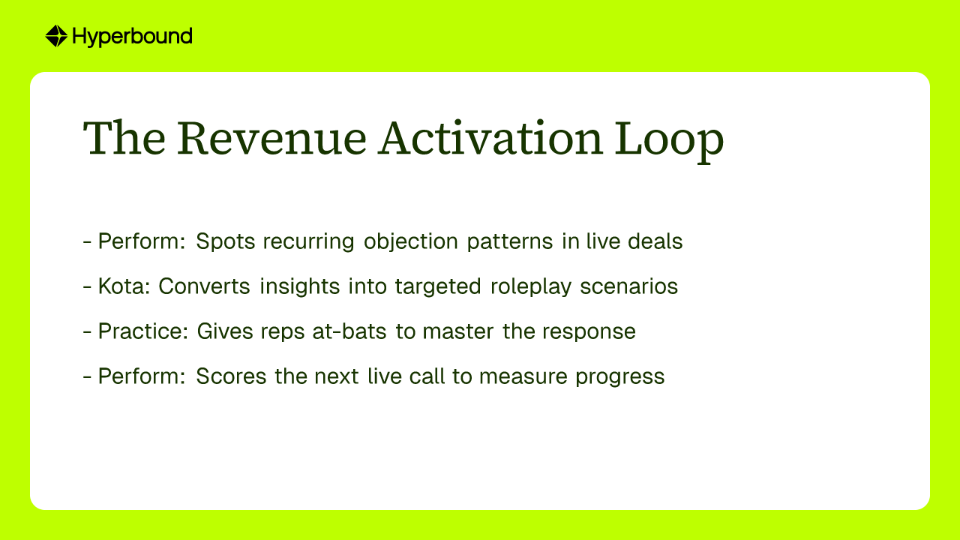
Rather than analyzing single calls in isolation, Perform looks across all the touchpoints in an active deal — every discovery call, follow-up, stakeholder conversation — and surfaces what's actually stalling your pipeline right now. If "competitor X" is appearing in 40% of stalled deals this month, that's not an individual coaching issue. That's a team-wide skill gap that needs immediate, targeted practice.
From there, Kota Activate — Hyperbound's AI assistant — takes that live deal intelligence and converts it into action. It can automatically create and assign Bite-Sized Roleplays in Hyperbound Practice for the specific objection pattern your team is struggling with right now, not the one they struggled with six months ago when the last training curriculum was built.
The loop looks like this:
This is what separates a training event from a continuous improvement system — and it directly addresses one of the most persistent pain points for Sales Enablement leaders: the months-long lag between a problem emerging in the field and a training program catching up to it.
Great objection handling isn't a natural talent. It's a skill that's built through deliberate, realistic repetitions — the kind where the AI pushes back when you accept a brush-off too quickly, where the scorecard flags that you never asked the follow-up question that would have kept the deal alive, where you practice the same pricing objection with three different emotional states until your response becomes automatic.
Conversation intelligence tools like Gong and Chorus are valuable — they help you understand what's happening in your pipeline and what your best reps do differently. Peer review builds culture and shared language. But neither creates the deliberate, objective, high-volume practice environment that turns objection handling from a weakness into a competitive advantage.
If you want your team to stop freezing and start closing, that requires a sales simulator built on real conversations — and a feedback loop that connects practice directly to live deal outcomes.
A sales simulator is a software tool that allows sales representatives to practice real-world sales scenarios, like handling customer objections, in a safe, AI-enabled environment. Unlike traditional training methods, these platforms provide realistic, interactive roleplays with AI buyer personas. This gives reps the opportunity to build muscle memory, receive objective feedback on their performance, and master their responses to tough questions before they're on a live call with a real prospect.
Specific training for sales objections is crucial because handling pushback is often the moment a deal is won or lost, and research shows that reps who navigate them successfully have a 64% higher success rate. Most sales training focuses on perfecting the pitch, but objections related to pricing, timing, and competitors are predictable and frequent. Without dedicated practice, even seasoned reps can freeze under pressure. Deliberate practice on these specific moments turns a potential weakness into a significant competitive advantage.
The most effective AI sales simulators use AI trained on millions of hours of real B2B sales conversations, enabling them to provide realistic, dynamic, and unscripted pushback. Key features to look for include AI personas that can adopt different emotional states (e.g., skeptical, price-sensitive), the ability to practice against multiple stakeholders at once (multiparty roleplays), and dynamic AI that adjusts its response based on the rep's approach, rather than following a simple script. This level of realism is what bridges the gap between practice and real-world performance.
Sales simulators are a "practice field" for proactively building skills, while conversation intelligence tools are a "film room" for retrospectively analyzing past performance. Tools like Gong and Chorus are excellent for reviewing recorded calls to identify what works and what doesn't. However, they don't provide a safe-to-fail environment for reps to actively practice and internalize those learnings. A sales simulator allows reps to take the insights from the "film room" and turn them into instinct through repeated practice.
Yes, experienced sales reps benefit significantly from sales simulators, particularly through features like "bitesized roleplays" that allow them to drill specific, high-stakes objections in minutes. Instead of sitting through generic training, a senior rep can use a simulator to run a five-minute practice session on a competitor objection right before a crucial call. This targeted, just-in-time practice helps even top performers stay sharp, test new approaches, and prepare for unique challenges they'll face in complex deals.
The impact of objection handling training can be measured through key sales metrics such as reduced ramp time for new hires, increased demo conversion rates, and shorter sales cycles. Leading platforms connect practice to performance. For example, by analyzing live deal data, you can identify a common objection that is stalling your pipeline, assign targeted practice on that objection, and then measure whether reps handle that objection more effectively on subsequent calls. Companies have seen results like a 60% reduction in ramp time and a 150% increase in demo conversions after implementing this kind of targeted practice.
The most common sales objections typically fall into five categories: pricing, timing, competitor, stakeholder access, and status quo. These predictable objections include statements like "It's too expensive" (pricing), "There's too much going on right now" (timing), "We're already working with someone else" (competitor), "It's not my decision" (authority/stakeholder), and "We're happy the way things are" (status quo). Effective sales training should prepare reps to handle all five of these common pushbacks.
Ready to turn your team's most common objection moments into their strongest skills? See how Hyperbound Practice works →










Use Cases
Legal