
Scorecards are often treated as a solved problem. A manager builds one, grades a few calls, and the team begins receiving feedback. Inconsistency emerges weeks or months later, when a second team builds its scorecard differently, a third adds a criterion the others dropped, and no one flags the divergence because each scorecard still appears functional in isolation.
Rubric drift accumulates until the grading signal across the organization becomes noise; by then, the coaching program has already lost its foundation.
The starting point is a fork. One team builds a scorecard, and another team takes a different path because its sales motion differs. Highspot's analysis of sales scorecards identifies this early fragmentation as the structural cause of later inconsistency: once teams maintain separate documents, divergence is the default outcome rather than the exception.
From there, edits accumulate in isolation. A manager notices that "consultative questioning" is being scored too generously, so they tighten the language in their version. Another manager, seeing low scores on objection handling, softens the criterion to reduce friction in their one-on-ones. Both changes occur without coordination and remain invisible to the other team.
Criteria come and go without coordination as well. A top-of-funnel team strips out late-stage criteria to keep their scorecard lean. An enterprise team adds three new items to cover complex deal dynamics. The result is that reps across the floor are no longer being evaluated against the same core competencies, even when their role titles are identical.
The absence of a single source of truth makes these inconsistencies permanent rather than correctable. Without a protected master scorecard that governs what every version must contain, there is no mechanism for detecting drift and no authority for resolving it. As Revenue.io notes in its review of sales call scorecard tools, the lack of centralized scorecard governance makes grading subjective by default, which defeats the purpose of having a scorecard at all.
One manager's "strong discovery" becomes another manager's "needs development" because the labels are identical while the behaviors they describe differ.
The first cost is that coaching quality becomes manager-dependent. When scorecards differ, the feedback a rep receives reflects their manager's version of the rubric, not an organizational standard. Two reps with identical call behavior receive different scores, different feedback, and different development priorities. There is no way to compare coaching effectiveness across teams because the measurement tools are not measuring the same things.
Reps absorb this as mixed signals. A behavior that earns a high score on one team goes unremarked on another, and a behavior that triggers a coaching conversation for one manager is invisible to the next. Sales enablement practitioners recognize the pattern: inconsistent criteria across teams create confusion for reps about what good performance requires.
Benchmarks become unreliable. If Team A's average discovery score is 3.8 and Team B's is 3.2, the comparison carries no information when the two teams score against different criteria. Leadership cannot determine whether Team B needs more coaching or whether the manager grades harder. The numeric score is not meaningful.
The deepest cost falls on enablement leaders. Their dashboards and reports are populated by grading data, and when that grading data reflects divergent rubrics, every downstream analysis is unreliable. Skill gap identification, program effectiveness measurement, and resource allocation decisions all rest on the assumption that the underlying scores are comparable. When they are not, enablement leaders are making decisions on data they cannot trust.
The business case for fixing this is substantial. Korn Ferry's research on sales coaching effectiveness finds that organizations with structured coaching processes achieve 14% higher quota attainment, 15% higher win rates, and nearly 20% lower voluntary turnover. Those results depend on coaching that is consistent and comparable. Rubric drift erodes the structural condition those outcomes require.
Sales scorecard consistency across teams cannot be achieved by asking managers to align more often. Calibration sessions provide marginal improvement but do not solve the structural problem. The structural problem is that multiple versions of the scorecard exist and can be edited independently.
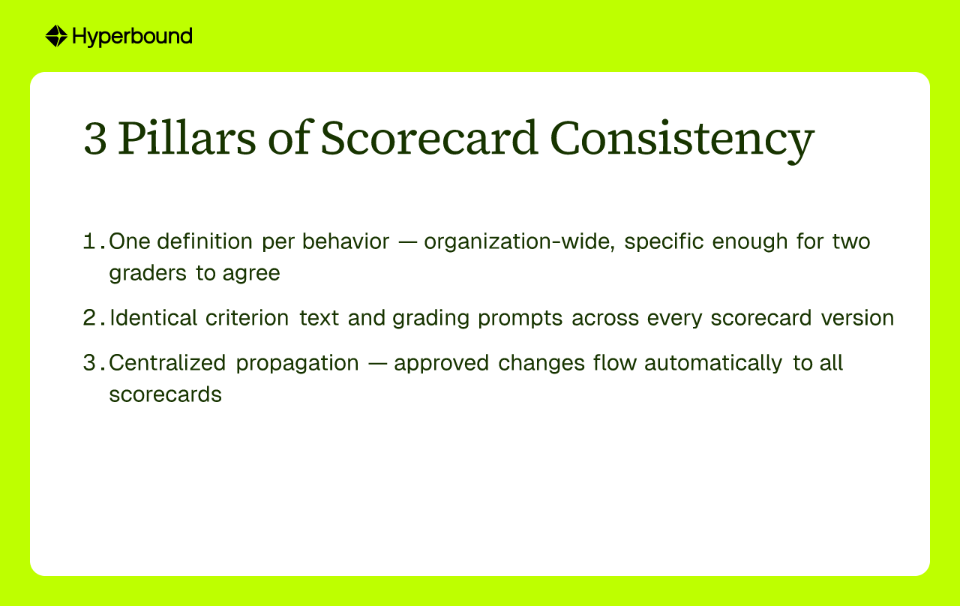
Consistency requires three things held together.
One definition per behavior. Every criterion must have a single, organization-wide definition. "Consultative selling," "effective discovery," and "handling objections" need written definitions that are specific enough to produce the same score from two different graders watching the same call. Vague labels delegate interpretation to each manager, which is the first step toward drift. Ed McCarthy's framework for sales coaching rubrics identifies this definitional precision as the prerequisite for any cross-team comparison: without it, the rubric measures manager judgment rather than rep behavior.
Identical criterion text and grading prompts across every scorecard. The wording that appears on the scorecard and the instructions given to the grader must be character-for-character identical across all versions. Any paraphrase introduces a new interpretation. The requirement is operational rather than stylistic. An observed pattern in grading consistency discussions is that even small changes to prompt structure produce meaningfully different scoring outputs, which means that variation in wording produces variation in results regardless of intent.
Centralized propagation of every change. This is the operational requirement that the other two depend on. If a criterion can be updated in one location and that update flows automatically to every scorecard in the organization, drift cannot accumulate. If updates have to be made manually in each team's version, they will not be made consistently, and the scorecards will diverge again within weeks.
The propagation requirement also changes scorecard governance. The governance question shifts from who approves changes to which system ensures that approved changes land everywhere immediately.
Consider a common enablement initiative: leadership wants every rep graded on feature dumping. The behavior is defined as leading with product capabilities before establishing the customer's problem. The initiative is sound; the rollout determines whether rubric drift undermines it.
Without a centralized system, each manager adds their own version of the criterion. One writes "avoids listing features before confirming pain." Another writes "leads with customer need, not product." A third keeps their existing "product knowledge" criterion and considers it close enough. Within two weeks of launch, the organization is running three different measurements of the same behavior. The aggregate data is uninterpretable from day one.
With centralized propagation, the criterion is written once: a single behavioral definition, a single grading prompt, a single scoring anchor for each level. That criterion is then pushed to every scorecard in the organization simultaneously. Every call graded from that point forward applies the same standard.
This is where Hyperbound's AI Scorecards become operationally relevant. The platform uses concept-based scoring and scorecard routing so the same behavioral standards can be applied across call types without each manager maintaining a separate local version. That centralized propagation is exactly what Kota Actions makes possible at scale: make changes across your entire instance at once, so one criterion change lands on every scorecard in a single pass. Without that alignment, even a well-designed criterion degrades into a set of local variations before the first week of grading is complete.
The result is cleaner data and coaching quality that no longer depends on which manager reviews a call. A rep on the enterprise team and a rep on the SMB team are evaluated against the same feature-dumping criterion, scored on the same scale, and receive feedback grounded in the same standard. The initiative produces data that reflects rep behavior rather than the idiosyncrasies of each team's scorecard.

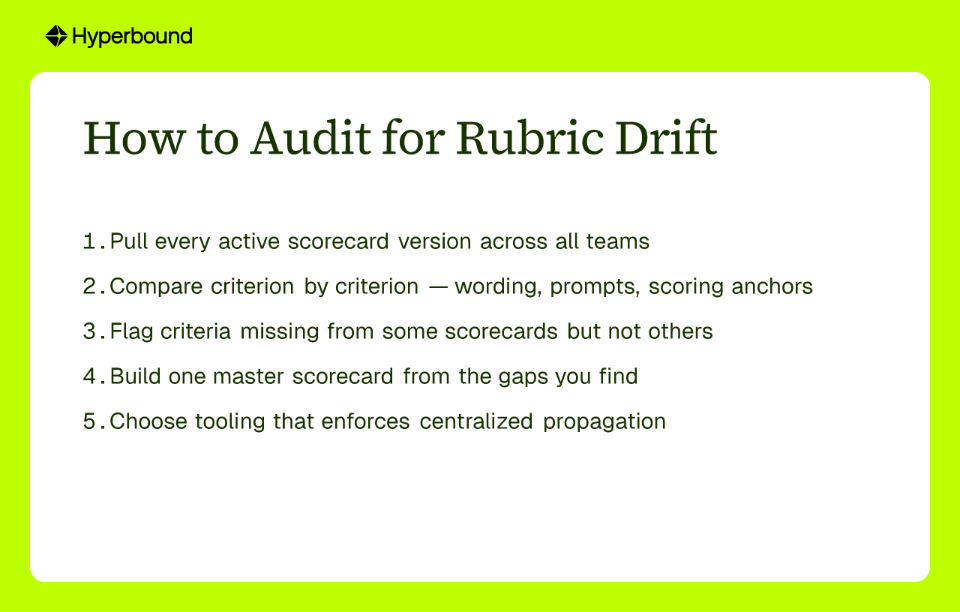
RevOps and enablement teams that want to eliminate rubric drift should begin with an audit rather than a rebuild. Pull every active scorecard version across all teams and compare them criterion by criterion. The gaps that surface will be specific: criteria that appear on some scorecards and not others, definitions that have drifted in wording, grading prompts that have been revised independently.
That audit produces the inventory needed to build the master version: one scorecard that defines every criterion, fixes the grading language, and becomes the single source from which all team versions are derived. Writing criteria that can actually be scored consistently is the prerequisite, and our guide on writing sales call scorecard criteria that hold up under different graders walks through the trigger-and-action pattern that makes two graders land on the same score.
From that point, the governance question is whether the tooling supports centralized propagation. If managers can edit their local versions without affecting the master, drift will return. The architecture must enforce the hierarchy rather than rely on managers to maintain it voluntarily.
Watch for the moment when the next behavior change needs to roll out. That moment is the operational test. If the update lands identically on every scorecard without requiring manual coordination across teams, the system is working. If it requires a round of emails, a calibration session, and follow-up checks three weeks later, the structural problem has not been solved.
Consistent grading is an infrastructure outcome rather than a training outcome. Build the infrastructure first.

Rubric drift is the gradual, uncoordinated divergence of sales scorecard criteria, wording, or scoring prompts across teams and versions. It typically begins when one team builds a scorecard fork, then local managers make isolated edits, add or remove criteria, and no single source of truth governs the master benchmark. Because each scorecard still looks functional on its own, drift often goes unnoticed until grading data stops being comparable across the organization.
Sales scorecards become inconsistent when multiple teams maintain separate scorecard versions and edit them independently. A manager may tighten one criterion to correct generous grading while another manager softens a different criterion to reduce friction. Without a protected master scorecard and centralized propagation, these local changes accumulate and the same role is evaluated against different core competencies.
Inconsistent scorecards make coaching quality manager-dependent, confuse reps with mixed signals, break cross-team benchmarks, and corrupt enablement analytics. When two teams score the same behavior differently, average score comparisons carry no information and skill-gap analysis becomes unreliable. Organizations with structured, consistent coaching achieve higher quota attainment, win rates, and retention, but those outcomes depend on comparable scorecard data.
You prevent sales scorecard drift by combining one organization-wide definition for each behavior, identical criterion text and grading prompts across every scorecard, and centralized propagation of every change. Start with an audit of all active scorecards, build a single master version, and then use tooling that automatically pushes approved updates to every team. Governance must be architectural rather than dependent on managers voluntarily staying aligned.
Centralized scorecard governance is an operating model in which one master scorecard is the single source of truth and all approved changes flow automatically to every team version. It answers the question, "What system ensures that approved changes land everywhere, immediately?" Without that propagation mechanism, local edits return within weeks and drift accumulates again.
To audit for rubric drift, pull every active scorecard version across all teams and compare them criterion by criterion. Flag criteria that appear on some scorecards but not others, differences in wording, grading prompts, and scoring anchors. Use the gaps to build one master scorecard, then verify that future behavior updates land identically on every scorecard without manual coordination.
Identical scorecard wording is important because any paraphrase introduces a new interpretation. Even small changes to prompt structure can produce meaningfully different scoring outputs. When the criterion text and grading instructions are character-for-character identical across all versions, scores reflect rep behavior rather than variation in how each manager reads the rubric.
Concept-based scoring evaluates whether a rep demonstrated a defined behavior or concept, such as consultative questioning or avoiding feature dumping, rather than matching keywords or a manager's personal interpretation. By applying the same behavioral standard across call types and teams, concept-based scoring helps prevent the local drift that makes scorecard data unreliable.
RevOps and enablement teams should look for scorecard tooling that enforces a locked master rubric, supports identical grading prompts, automatically routes the right scorecard to the right call type, and propagates approved changes to all versions at once. If managers can edit local scorecards without affecting the master, drift will return, and the structural problem will remain unsolved.









Use Cases
Legal