
You pull up your sales dashboard and see the numbers staring back at you. Fifty calls made this week. Average talk time: four minutes. Conversion rate: 12%. You share it in the team meeting, nod along, and then everyone goes back to their desks. Nothing changes.
Sound familiar? This is the trap that most sales teams fall into, and it is not a data problem. You have plenty of data. The problem is the kind of data you have is descriptive, not prescriptive. It tells you what already happened, but it gives you zero direction on what to actually fix.
As one sales manager put it on Reddit: "the biggest challenge as a sales manager is scaling quality training without burning yourself out." When your only coaching input is a conversion rate, you are stuck guessing which rep needs help, on which skill, and what kind of practice would actually move the needle. That guesswork burns time and produces inconsistent results.
A modern sales roleplay analytics platform changes this completely. Instead of reporting on history, it tells you exactly what to fix, who needs to fix it, and whether the practice they are doing is actually working on real calls. This article breaks down how that shift works and what it means for your team.
Descriptive analytics are the foundation of most sales reporting. Call volume, talk time, win rates, pipeline velocity, and average deal size all fall into this category. According to MTD Sales Training, descriptive analytics summarize what has already occurred. They are useful for tracking trends and reporting to leadership, but they are not built for coaching.
Here is the core problem: descriptive analytics identify symptoms, not root causes. A 12% conversion rate on discovery calls is a symptom. But why is it 12%? Is it because reps are talking too much and not listening? Are they failing to ask enough open-ended questions? Are they losing the prospect with a long, unfocused monologue in the first three minutes? The number alone does not tell you.
This gap between data and action is exactly why training adoption dies. As one revenue operations professional noted in a Reddit discussion on sales training software: "most of the 'all-in-one' training platforms looked great in a demo but then just became another tab my reps ignored." When data does not point to a clear next action, reps and managers alike disengage. The platform becomes noise.
The solution is not more data. It is smarter data that coaches.
Prescriptive analytics do not just report a number. They diagnose a specific skill gap and point to a precise remedy. The difference in practice looks like this:
This is the core of what Hyperbound's sales roleplay analytics platform is built to deliver. The platform tracks a set of granular, objective metrics across both practice sessions and live calls. Each one maps to a specific, coachable behavior:
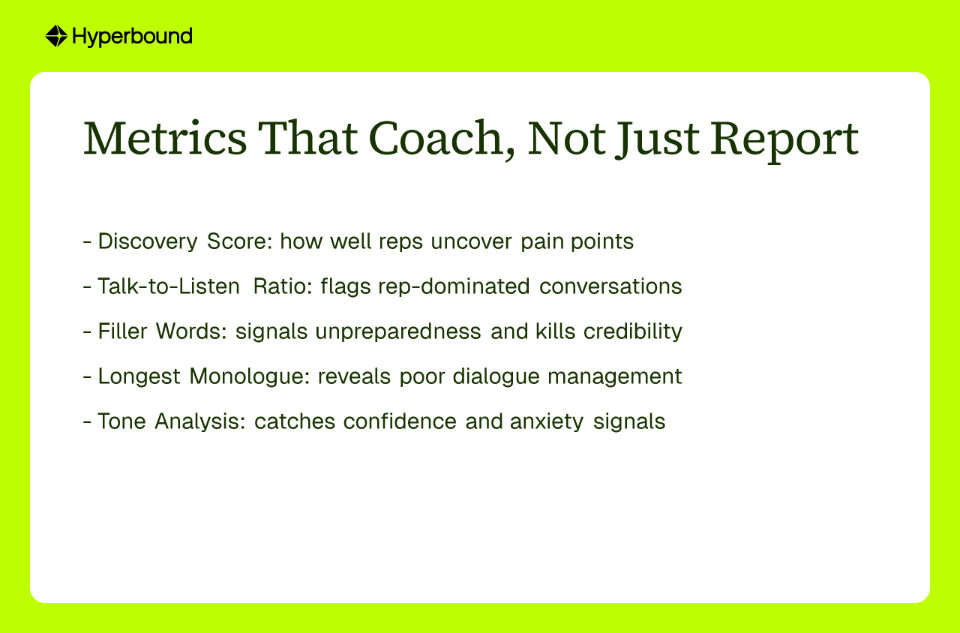
What makes this data powerful is not just what it measures, it is that it replaces subjective manager opinions with a consistent, objective standard. Gone is the coaching session where the manager says "I think Sarah is doing fine." The data either supports that or it does not. Every rep is evaluated on the same criteria, every time, whether they are doing a mock call in practice mode or handling a live prospect.
This shift toward objective call scoring is a core value of modern coaching platforms: software that automatically scores calls based on established sales methodologies ensures detailed feedback rather than sporadic manager evaluations. The result is fairer, more consistent development across your entire team.
Tracking practice scores is useful. But the real value of a sales roleplay analytics platform comes from connecting those practice scores to what happens on actual calls with real prospects. This is the Practice → Perform loop, and it is what separates a training tool from a performance system.
Here is how it works in Hyperbound: reps complete roleplay scenarios in the Practice module. Their scores across discovery, talk ratios, filler words, and tone are logged and tracked over time. These scores are not just a record of how they did in a sandbox. They function as leading indicators, predicting where a rep is likely to struggle when the pressure of a real call is applied.
When a rep moves to live calls in the Perform module, Scorecard Auto-Routing kicks in. Real call data is automatically scored and fed back into the analytics engine. This continuous feedback loop answers questions that no traditional CRM report ever could:
This last question is especially valuable for Sales Operations and RevOps teams building coaching programs at scale. Instead of assuming that more practice is always better, you can actually measure return on practice, identifying which specific scenarios drive the highest performance gains on real calls.
The results of structured practice loops like this are significant. Research on sales leaders shows that teams using structured practice platforms practice up to 15 times per week compared to just twice per week with traditional methods. That increased volume, combined with targeted feedback, drives real outcomes: 94% quota attainment among teams that practice consistently. Hyperbound customer Vanta, for example, used this connected system to reduce sales ramp time by 60% and increase their pipeline 5x.
The reason these numbers move is not that reps are practicing more. It is that they are practicing the right things, and the platform is continuously verifying whether the practice is working.

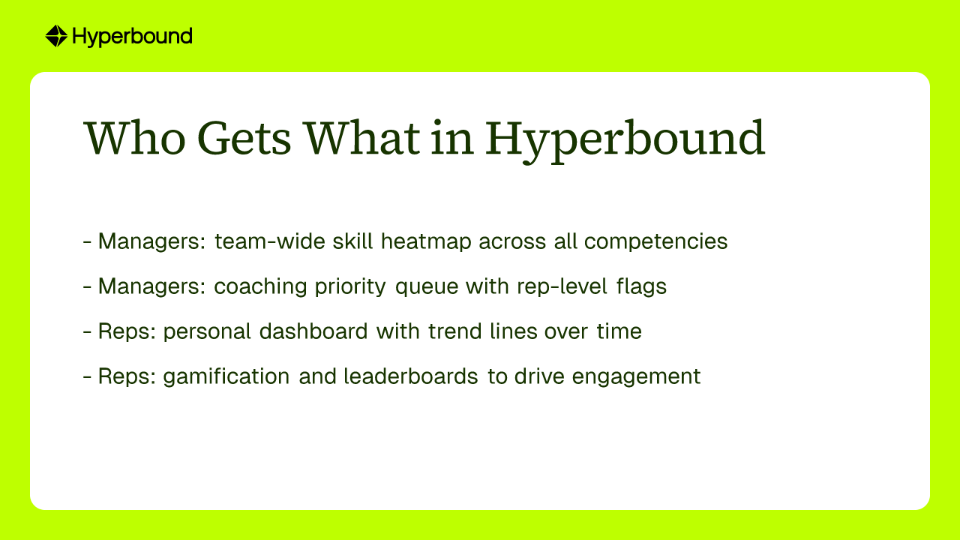
Good analytics are only useful if they surface the right information to the right person at the right time. Hyperbound solves this with two distinct views: one built for the manager, one built for the rep.
Sales managers do not need another dashboard full of numbers. They need to know, at a glance, which reps need coaching and on exactly which skill. The team-wide skill heatmap in Hyperbound delivers exactly this. It maps every rep across every tracked competency, including discovery, talk-to-listen ratio, objection handling, and tone, so managers can immediately see where the team has collective strength and where there are shared weak spots.
Paired with this is the Coaching Priority Queue, a feature that automatically surfaces which reps need the most urgent coaching attention and flags the specific skill areas driving their underperformance. Instead of spending hours reviewing call recordings across the team, a manager can open the queue and know exactly who to meet with, what to focus on, and which roleplay scenario to assign before the meeting.
This kind of focused, data-driven coaching can save managers 3 to 8 hours per week on call reviews and coaching prep alone. That time compounds fast across a quarter. More importantly, it shifts the 1:1 coaching session from a vague performance conversation to a specific, targeted skill-building session backed by data.
For reps, the personal improvement dashboard gives them something that most training platforms fail to provide: ownership over their own development. Rather than waiting for a manager to tell them what went wrong on a call, reps can log in and see their own trend lines across every tracked metric. Their discovery score this week versus last. Their filler word frequency over the past month. Whether their talk-to-listen ratio has improved since they started practicing a specific scenario.
This transparency drives behavior change in two ways. First, it makes progress visible. When reps can see their own scores moving in the right direction, they stay motivated to keep going. This is the opposite of the "another tab my reps ignored" problem that plagues most training platforms. When the tool shows measurable improvement, reps stick with it.
Second, it builds call confidence. One sales ops professional noted in this Reddit thread that tools helping reps "stay confident on calls" are the ones worth keeping. A rep who can see that their discovery score has improved from 58 to 74 over six weeks walks into their next call with a very different mindset than one who has only ever been told "keep working on your discovery."
Layered on top of the personal dashboard, gamification elements like leaderboards and practice challenges give reps a reason to compete and engage beyond their individual goals. This kind of structured engagement is a key driver of sustained platform adoption, preventing the drop-off that kills most training initiatives after the first two weeks.
Most sales teams are still running on analytics built for a different era. They review what happened last quarter, spot a trend in conversion rates, and then rely on gut instinct and intuition to figure out what coaching to deliver. The problem is gut instinct does not scale. It burns managers out, produces inconsistent development across reps, and leaves the most important question unanswered: is what we are doing in practice actually working?
A sales roleplay analytics platform built around prescriptive data changes that equation. Instead of reviewing recordings after a deal is already lost, you identify the skill gap in a practice session before the rep ever picks up the phone. Instead of telling Sarah you think she is doing fine, you show her the data. Instead of running the same generic objection handling workshop for the whole team, you assign the exact scenario to the exact rep who needs it most.
The shift from descriptive to prescriptive analytics is not just a product feature. It is a fundamentally different philosophy about how sales development should work. One that treats coaching as a continuous, data-driven process rather than a quarterly event.
If your current analytics are only telling you what happened, it is worth asking: what would change if they told you what to fix?
The primary difference is that descriptive analytics tell you what has already happened, while prescriptive analytics tell you what to do next. Descriptive data includes metrics like call volume and conversion rates, which are useful for reporting but not coaching. Prescriptive analytics diagnose specific skill gaps—like a poor talk-to-listen ratio or low discovery score—and recommend a clear action to fix them.
Traditional sales metrics like win rates are symptoms, not root causes. A low win rate tells you there's a problem, but it doesn't explain why it's happening. This forces managers to guess which skills a rep needs to improve, leading to generic, inconsistent coaching that often fails to produce results.
AI-powered platforms measure abstract skills by analyzing specific, objective behaviors within a conversation. For example, a "Discovery Score" is calculated by tracking how many pain points a rep uncovers. "Tone Analysis" is assessed by analyzing vocal cues for signals of confidence or anxiety. This replaces subjective manager feedback with consistent, data-driven evaluation for every rep on every call.
Roleplay practice improves real call performance by creating a feedback loop between a controlled practice environment and live calls. Platforms like Hyperbound track metrics in practice sessions, identifying likely weak points before a rep talks to a real prospect. Then, by scoring live calls with the same criteria, the system verifies whether those skills have successfully transferred, creating a continuous cycle of targeted practice and measurable improvement.
Teams that use prescriptive analytics platforms for structured practice can expect significant improvements in key sales outcomes. Because the coaching is targeted and data-driven, common results include faster ramp times for new hires, higher quota attainment, and a stronger sales pipeline. For example, Hyperbound customer Vanta reduced ramp time by 60% and increased their pipeline 5x.
No, a sales analytics platform is valuable for reps at every experience level. For new hires, it accelerates onboarding by building foundational skills. For veteran reps, it helps identify and eliminate bad habits, refine advanced techniques like objection handling, and adapt to new sales methodologies. The objective data provides targeted insights for continuous improvement, regardless of tenure.










Use Cases
Legal