
Your new hire just aced their onboarding quiz. Scored 100% on the product knowledge assessment. Finished every module. Checked every box.
Then they got on their first live discovery call — and froze.
If you've led a sales team for more than a quarter, you know this story. The knowing-doing gap is one of the most expensive problems in B2B sales. Traditional certification tests whether your reps remember something, not whether they can do it under pressure. And when the average sales ramp time sits at 5.7 months, costing up to 3x a rep's base salary in lost productivity, the stakes of getting certification wrong are very real.
It gets worse. As sales leaders on Reddit have put it, "most of the 'all-in-one' training platforms looked great in a demo but then just became another tab my reps ignored." One team spent significant budget rolling out a major platform only to end up with 15% of reps actually logging in. New hires show up "pumped, full of energy" — but when you hand them a 40-page onboarding doc or training videos, their enthusiasm is gone.
This is what static certification produces: reps who passed a test, but can't execute on a live call.
The modern approach to sales rep certification software flips the model entirely. Instead of asking "did this rep answer the question correctly?", it asks "did this rep demonstrate the skill?" That means passing a certification on objection handling requires a rep to actually handle objections — in a realistic, scored AI simulation — not just recall the framework.
This is behavioral certification, and it's the foundation of effective onboarding and ramp programs.
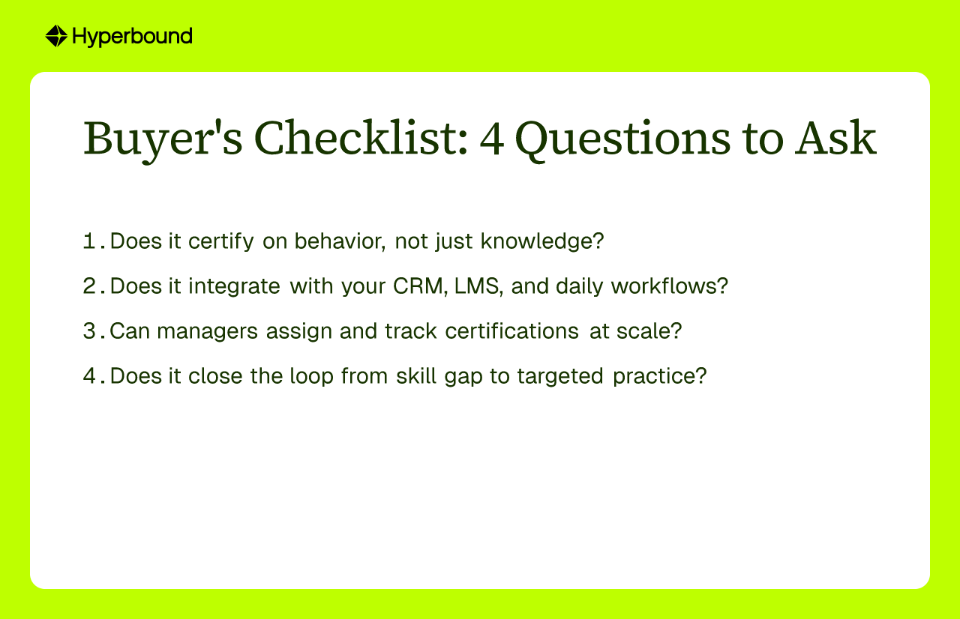
Before evaluating any tool, run it through this buyer's checklist:
With that framework in hand, here are three of the top sales rep certification software tools on the market today.
Hyperbound Practice is the flagship product from Hyperbound, the Revenue Activation Platform built to close the gap between data and outcomes. It's purpose-built to certify reps on their ability to execute in real-world selling scenarios — cold calls, discovery, demos, objection handling, renewals, and upsells — using AI buyer personas trained on 2M+ hours of real B2B sales conversations.
Does it certify on behavior? Yes — this is the core of the product. Certification in Hyperbound Practice isn't a quiz. It's a scored simulation. Reps must demonstrate the skill — handle the objection, run the discovery, nail the pitch — before they earn the cert. AI Scorecards deliver instant, objective feedback on methodology adherence, talk ratios, and key selling moments. There's no way to "memorize the right answer." You either show the skill or you don't.
For leaders who've tried other AI roleplay tools and found them "unrealistic for B2B sales role-playing" — or worse, tools that "just agree and tell me why I'm right" — Hyperbound's AI personas are built differently. They push back. They take the conversation in unexpected directions. They behave like real buyers because they're trained on real buyer conversations.
Does it integrate with workflows? This is where tools either become sticky or get abandoned. Hyperbound Practice embeds directly into the tools your team already uses: SCORM compatibility for Seismic, Highspot, and Showpad; CRM integrations with Salesforce and HubSpot; and availability in Slack and Microsoft Teams via Kota. As Reddit users consistently point out, "the tools that last are the ones that plug right into daily workflows." Hyperbound is built around that principle.
Can managers track at scale? Managers can assign certification paths for onboarding cohorts, new product launches, or messaging rollouts — then track rep progress, skill development, and team-wide readiness from a single dashboard. No more guessing who's "ready."
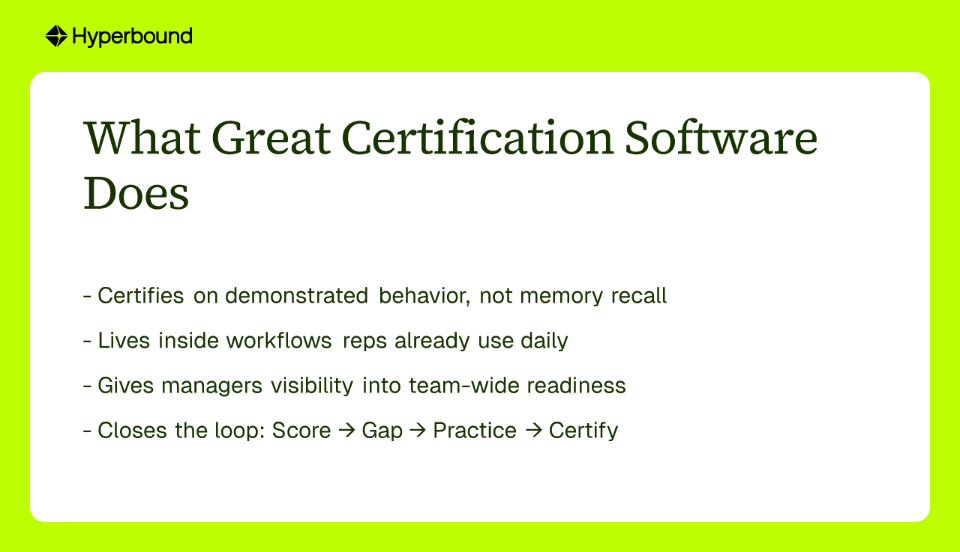
Does it close the loop? This is Hyperbound's defining operational advantage. The full loop looks like this: Score Real Calls → Identify Skill Gaps → Practice Roleplays → Re-Certify. Insights from real calls (via Hyperbound Perform) flow into recommended practice simulations, and Kota Activate orchestrates the coaching interventions. The result is a continuous improvement cycle where training is always calibrated to what's happening in the field — not a quarterly refresh.
The proof is in the outcomes:
One more thing worth noting for tenured reps skeptical of generic certification: Bitesized Roleplays let experienced reps practice specific in-deal scenarios in 5–10 minute sessions focused on exactly the skill they need to sharpen. No one has to sit through a 90-minute generic module to stay certified.
Gong is a well-known standard for conversation intelligence. It captures and analyzes every real customer interaction, giving managers the data they need to coach with precision and evaluate performance across the team.
Does it certify on behavior? Yes — but reactively. Gong's strength is post-call. Managers can build coaching playlists and scorecards to evaluate reps on actual calls and certify them once they demonstrate mastery in live interactions. This is genuinely powerful for identifying top rep behaviors and coaching toward them. The caveat: first calls on real deals are where reps learn. That's an expensive classroom.
Does it integrate with workflows? Absolutely. Gong sits at the center of most enterprise sales tech stacks, with deep CRM integrations and compatibility with the tools teams already use daily.
Can managers track at scale? Yes. Performance dashboards and team analytics allow leaders to track coaching progress, measure win rate correlations with rep behaviors, and identify skill gaps across the organization.
Does it close the loop? Partially. Gong excels at the "Score" and "Identify Gaps" stages of the certification loop, and creates libraries of best moments from call recordings for reps to review. Where it falls short is the practice side — there's no dedicated, AI-driven environment for reps to rehearse and build muscle memory before their next high-stakes conversation. Gong tells you what happened and what needs to improve. Getting reps to actually practice that improvement still requires another tool — making it a useful part of the stack, but not the complete picture.
Highspot is a sales enablement platform built around organizing content, delivering structured training, and certifying that reps have absorbed the foundational knowledge they need to succeed. If your primary challenge is ensuring consistent messaging across a distributed team, Highspot is worth evaluating.
Does it certify on behavior? It includes AI practice for role-play scenarios, but its primary strength is knowledge certification — ensuring reps have mastered playbooks, product messaging, and competitive positioning through structured learning modules and assessments.
Does it integrate with workflows? Highspot offers over 100 integrations, including deep Salesforce connectivity, embedding training and content delivery "just-in-time" within the sales process where reps need it.
Can managers track at scale? Yes. Adaptive learning paths adjust to each rep's skill gaps, and analytics link training engagement to sales performance metrics — giving enablement leaders visibility into ROI on their programs.
Does it close the loop? Highspot effectively closes the loop between training engagement and knowledge outcomes. It excels at the structured learning (LMS) layer of the onboarding stack and surfaces which content is driving revenue. For deep behavioral practice and simulation-based certification, teams typically need to complement it with a dedicated AI roleplay tool.
.png)
The goal of modern sales onboarding isn't to produce reps who can pass a test — it's to produce reps who can execute on a live call on day one. That requires a fundamental shift in how we think about certification: away from knowledge recall, and toward demonstrated skill in realistic, scored simulations.
The best sales rep certification software tools in your stack should answer "yes" to all four questions on the buyer's checklist. They need to certify on behavior, not just content completion. They need to live inside the workflows your reps already use, or they'll be abandoned by week three. They need to give managers the visibility to track readiness at scale. And critically, they need to close the loop — turning every skill gap identified in the field into a targeted practice opportunity, not a note in a forgotten coaching doc.
Platforms like Hyperbound Practice represent what that full loop looks like in practice. When reps don't just study the playbook but certify by running it — in a realistic AI simulation that pushes back, challenges their messaging, and scores their execution — they build the muscle memory that actually transfers to live calls. That's how you get outcomes like 50% faster ramp, a 60% reduction in time-to-productivity at Vanta, and a 150% jump in demo conversion rates at Nivoda.
The tools that stick, as the people actually using them have figured out, are the ones that make practice feel like real selling — and plug seamlessly into the way your team already works.
If you're ready to see what behavioral certification looks like in action, explore Hyperbound Practice or book a demo to see the full Revenue Activation loop for yourself.
Sales rep certification software is a tool designed to train, assess, and validate the skills and knowledge of a sales team. Unlike traditional learning management systems (LMS), modern certification platforms focus on verifying that reps can not only recall information but also apply it effectively in real-world selling scenarios. The best tools use methods like AI roleplay simulations to certify reps on their actual behaviors, such as handling objections or running a discovery call, rather than just passing a quiz.
Traditional sales certification is often ineffective because it tests a representative's ability to remember information, not their ability to perform under pressure. This creates a "knowing-doing gap" where a rep can score 100% on a product quiz but freeze on a live call. Static methods like multiple-choice tests or watching videos don't build the muscle memory required for dynamic sales conversations. This leads to longer ramp times and inconsistent performance.
Behavioral certification is an approach that assesses a sales rep's ability to demonstrate a specific skill in a realistic scenario, rather than just answering a question about it. For example, to get certified on objection handling, a rep wouldn't take a quiz on the "best" responses. Instead, they would enter an AI simulation where they have to actively listen to and overcome objections from a realistic AI buyer. This method ensures reps are certified on what they can do, not just what they know.
AI roleplay provides a safe, scalable, and consistent environment for sales reps to practice and be certified on their conversational skills before they interact with real buyers. AI buyer personas can simulate a wide range of scenarios, from cold calls to competitive takedowns, and provide immediate, objective feedback via AI scorecards. This allows managers to certify reps at scale, ensuring every team member has mastered the necessary skills and messaging in a controlled, low-risk setting.
When evaluating a sales certification tool, you should look for four key capabilities: the ability to certify on behavior, seamless integration with your existing workflows (CRM, LMS), scalable tracking for managers, and a system that closes the loop from identifying a skill gap to providing targeted practice. A tool that only tests knowledge or doesn't fit into a rep's daily routine is likely to be ignored. The most effective platforms connect real-world performance data to targeted AI practice sessions, creating a continuous improvement cycle for the entire team.
You can measure the ROI of sales certification software by tracking key business metrics like reduced ramp time for new hires, increased demo-to-close conversion rates, and higher quota attainment across the team. For example, Vanta used behavioral certification to cut their sales ramp time by 60% (from 210 to 72 days) and drive 5x more pipeline. By linking certification activities to performance outcomes in your CRM, you can draw a clear line between your investment in training and tangible revenue growth.
Yes, the best sales certification software is designed for continuous development, not just for new hire onboarding. Tenured reps can use it to prepare for specific deals, practice handling new objections, or get certified on new product messaging. Features like bitesized, 5-10 minute AI roleplays allow experienced sellers to sharpen specific skills without having to sit through a generic training module, ensuring the entire team stays at the top of their game.










Use Cases
Legal