
You've invested in an LMS. You've built out a content library. You've run onboarding bootcamps. And yet, when your reps get on a live call, they still freeze on objections, stumble through discovery, and burn through pipeline while learning on the job.
Sound familiar? You're not alone. One sales enablement leader on Reddit put it bluntly: "Reps hated it, managers hated it, and nobody could find what they needed without 10 clicks and a bunch of swearing."
That's the core problem with most sales tech today — it's content delivery, not sales readiness.
Here's a distinction worth making before you evaluate any platform:
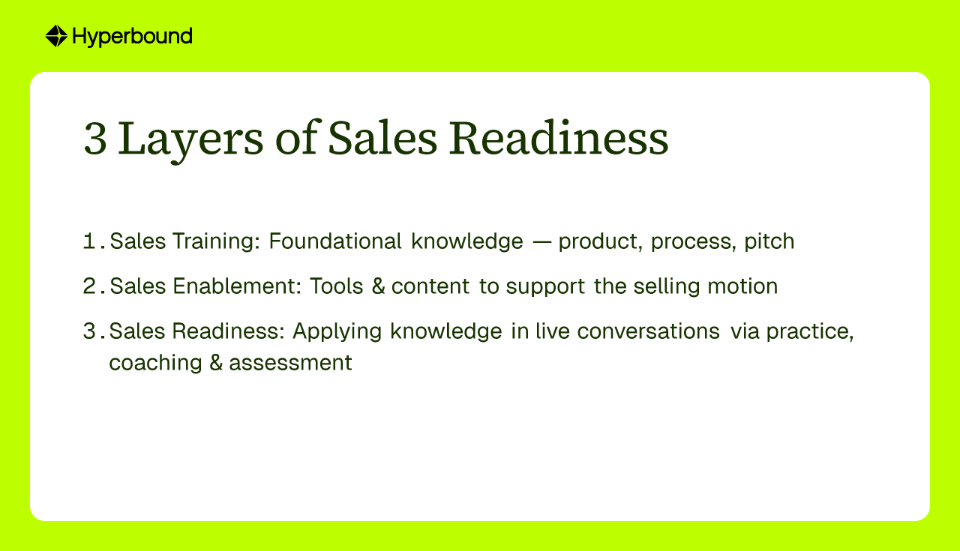
As Seismic defines it, sales readiness "equips salespeople with the necessary knowledge and skills for effective conversations throughout the buyer's journey."
The gap most organizations miss? Research from Harvard Business Review shows that learners forget up to 75% of newly learned information within six days if it isn't applied. A content library doesn't fix that. Repetition, practice, and feedback do.
That's the lens through which this list is built. These nine platforms are organized by the specific use case they solve best — so you can cut to what your team actually needs right now.
Best for: Closing the gap between knowing and doing with hyper-realistic AI roleplays tied to real buyer behavior.
If your reps need more at-bats without burning real pipeline to get them, Hyperbound Practice is the most purpose-built solution on this list. While conversation intelligence tools like Gong tell you what happened on a call, Hyperbound lets reps change what happens next by practicing before the call ever takes place.
The AI buyer personas aren't built from generic scripts — they're trained on analysis of 2M+ hours of real B2B sales conversations to replicate how actual decision-makers push back, deflect, and engage. This directly addresses the frustration many teams voice: "That's great… but my team needs to know how to actually apply the knowledge to real-life sales calls."
Key features:
Validated proof points:
Hyperbound's approach fits squarely into what revenue leaders need: a continuous improvement loop where real call data informs what reps practice, and practice improves what happens on real calls.
Best for: Organizations that want a single platform for skills assessments, content, coaching, and conversation intelligence.
Mindtickle is one of the most feature-rich platforms in the sales readiness software category. It combines guided coaching programs, interactive roleplay, content delivery, and performance analytics — making it a strong choice for enterprise teams running structured onboarding programs at scale.
Users on G2 highlight the dashboards for tracking rep progress and the use of gamification to drive completion rates. It's a capable all-in-one, though some teams find it comes with meaningful administrative overhead to configure and maintain.
Best for: All-in-one GTM enablement across sales, support, and partner teams.
WorkRamp stands out for its clean, user-friendly interface on both the admin and learner sides. It combines onboarding, continuous training, and performance insights in a platform that reps actually want to use — a non-trivial factor given how often adoption kills ROI on enablement tools.
It's well-suited for growing teams that need structured onboarding paths without a steep implementation curve.
Best for: Role-based practice and coaching embedded inside a market-leading content enablement platform.
Seismic Learning (formerly Lessonly) leverages Seismic's powerful content management layer to deliver training and coaching in context. If your team is already running Seismic for content delivery, adding Seismic Learning creates a tight loop between the material reps study and the scenarios they practice. Users consistently rate it highly for ease of use and support for blended learning formats.
Best for: Teams that want to build a coaching culture through asynchronous video feedback and peer learning.
Allego specializes in video-based practice and review — reps record themselves pitching, and managers or peers respond with feedback on their own time. This makes it especially effective for distributed or remote sales teams where synchronous coaching sessions are hard to schedule.
The platform supports formal coaching workflows alongside more informal peer sharing, which helps surface best practices organically. If your team needs a container that tracks what reps have completed and lets them revisit key learning moments, Allego handles that well.
Best for: Scaling onboarding and continuous learning through structured peer coaching.
SalesHood is built on the principle that reps learn best from each other. Structured cohort-based learning, video feedback loops, and enablement templates make it a strong choice for teams that want to formalize how institutional knowledge gets passed down — especially during rapid hiring phases.
Best for: Scoring 100% of real calls against your methodology and providing deal-level coaching to improve win rates.
Conversation intelligence tools tell you what happened on a sales call. Hyperbound Perform tells you what to do next. It moves beyond simple transcription and analysis to provide actionable, deal-level coaching across the full sales cycle.
Perform scores every real conversation against your custom scorecards — tracking methodology adherence, identifying deal risks, and highlighting coachable moments automatically. Instead of managers spending hours manually reviewing calls, they get data-driven recommendations on where to focus their coaching efforts. This directly solves the challenge of needing "tools that help analyze patterns across multiple calls for effective coaching."
One important framing: Hyperbound closes the loop. While it can integrate with CI platforms, Perform connects insights to action. It can automatically trigger targeted roleplay assignments in Hyperbound Practice, ensuring that the gaps identified in real calls are closed through practice.
Best for: Just-in-time, in-the-workflow learning embedded where reps work.
Spekit takes a fundamentally different approach to sales readiness software: instead of pulling reps out of their workflow to train, it embeds contextual knowledge directly inside their tools — Salesforce, Slack, Chrome, wherever they already work.
This directly addresses the rep experience problem of "7-20 clicks just to find info." Spekit surfaces the right answer at the moment of need, reducing the cognitive load on reps who are already juggling CRM tasks, emails, and live calls simultaneously. It's less of a practice platform and more of a real-time support layer — but for teams dealing with information sprawl, it fills a meaningful gap.
Best for: Customer Success and Account Management teams that need to practice the conversations that protect and expand revenue.
Most sales readiness tools are built for pre-sales. Renewals, upsells, QBRs, and de-escalation calls get left out — which is exactly where retention revenue is won or lost.
Hyperbound's AI Post-Sales Roleplays is the only purpose-built option on this list for CSMs and AMs. It lets post-sales teams practice with AI customer personas that simulate a frustrated churning customer, a happy expansion candidate, or a skeptical executive in a QBR — before those conversations happen live.
Key features:
For Heads of Customer Success who need to standardize how the team handles high-stakes moments — and measure whether reps are actually improving — this fills a gap that no other platform on this list addresses.
Before signing any contract, run every platform through these four criteria:
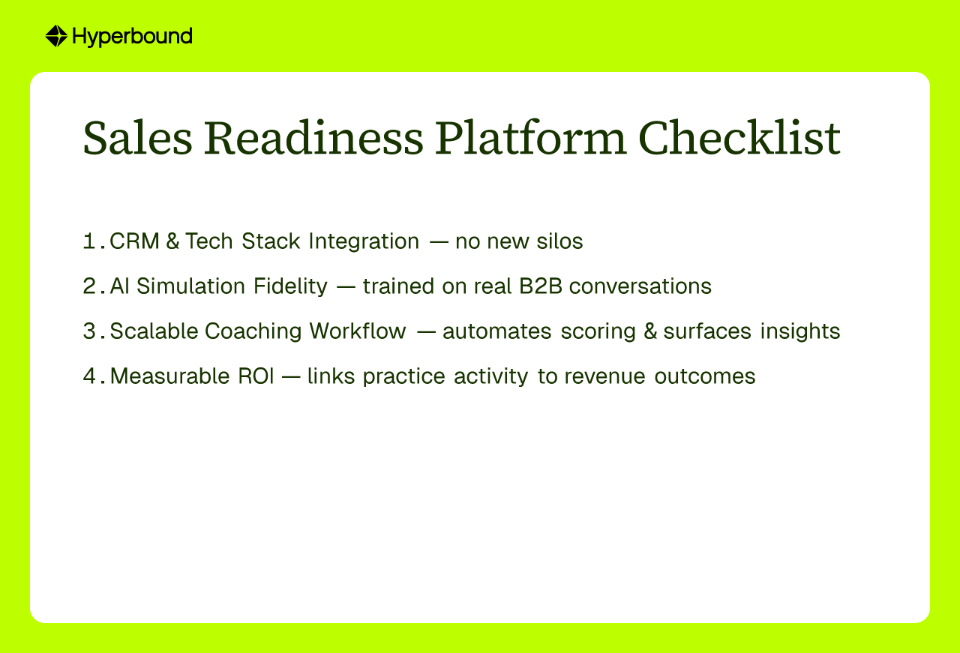
1. CRM & Tech Stack Integration Does it plug into your existing workflow without creating another silo? The best sales readiness software integrates with your CRM (Salesforce, HubSpot), conversation intelligence tools, and your LMS. If it doesn't, you're adding to the tool sprawl problem rather than solving it.
2. AI Simulation Fidelity Is the practice actually realistic? There's a significant difference between an AI that follows a decision tree and one trained on real B2B sales conversations. The latter prepares reps for how buyers actually behave — the former trains them for interactions that don't exist in the field.
3. Scalable Coaching Workflow Does it make managers more effective or just busier? The platform should automate objective scoring and surface specific coachable moments — especially given that most frontline managers spend only 5-8% of their time on coaching. A tool that requires manual review of every call to generate insight won't scale.
4. Measurable ROI Can you connect training activity to revenue outcomes? Quantifying "the softer stuff like engagement" is one of the hardest parts of building an internal business case for a new tool. The right platform provides analytics that link practice and skill development directly to ramp time, conversion rates, and win rates — numbers that actually get budget approved.
Sales enablement provides reps with the tools and content they need to sell, while sales readiness ensures they can actually apply that knowledge and those skills in live buyer conversations. Sales readiness focuses on the practical application of skills through practice, coaching, and assessment, closing the gap between knowing what to do and actually doing it effectively under pressure.
A traditional Learning Management System (LMS) is ineffective for sales teams because it primarily focuses on content delivery and knowledge retention, not skill application. Sales is a performance-based skill, and research shows reps forget up to 75% of new information within a week if it's not applied. Platforms built for sales readiness solve this by providing a safe environment for reps to practice, receive feedback, and master conversations before engaging with real prospects.
AI roleplay helps sales reps improve by providing a scalable, consistent, and safe environment to practice real-world sales scenarios without risking live deals. Unlike practicing with a manager, an AI buyer is available 24/7 and provides instant, objective feedback on performance, scoring reps on everything from talk ratios to adherence to sales methodologies. This allows reps to get the "at-bats" they need to master objection handling, discovery, and pitching.
A conversation intelligence (CI) tool like Gong records and analyzes past calls to tell you what happened, while a sales readiness platform tells you what to do next and helps reps improve before the next call. While CI tools are powerful for review, readiness platforms are proactive. For example, they can use insights from real calls to create targeted AI roleplay exercises, closing the loop between identifying a skill gap and actively fixing it through practice.
You can measure the ROI of sales readiness software by tracking key business metrics that are directly impacted by rep performance. The most effective platforms link practice and coaching activities to tangible outcomes like reduced ramp time for new hires, increased conversion rates from demo-to-meeting, faster time to a rep's first won deal, and higher overall win rates. Look for a platform that provides clear analytics connecting skill development to revenue outcomes.
No, sales readiness is for the entire revenue team, not just new hires. While it's critical for reducing ramp time, it's also essential for continuous improvement among tenured reps. Markets change, products evolve, and new competitors emerge. A readiness platform allows experienced reps to practice new messaging, refine skills on specific objections, and adapt their approach, ensuring the entire team is consistently performing at its peak.
True sales readiness isn't about giving reps more content to read before their next call. It's about giving them a safe environment to build real skills — and a feedback system that keeps improving those skills as the market changes.
The platforms on this list each solve a piece of that problem. But the most complete answer to the buyer's checklist above is a system that connects practice to performance to business outcomes in a continuous loop.
That's the model Hyperbound calls Revenue Activation:
The operational loop runs continuously: score real calls → identify skill gaps → assign targeted practice → score real calls again. Every cycle, reps get sharper. Every cycle, managers get more leverage. And the connection between training investment and revenue outcomes becomes something you can actually measure and report on.
That's the difference between a training cost center and a revenue driver.
If your team is still showing up to deals underprepared — or if your current platform is high on content and low on practice — it's worth seeing what a tighter loop looks like in action. Explore Hyperbound's Revenue Activation Platform and find out why teams at Vanta, LinkedIn, Nivoda, and Monday.com have made it their foundation for sales readiness.










Use Cases
Legal