You're reviewing your CRM, your heart racing with anxiety. That big deal you've been working on for months - the one that would put you over quota - is still stuck in "Proposal Sent" status. You've sent three follow-up emails and left two voicemails this week. Your sales manager keeps asking for updates, and you can feel that dreaded "commission breath" creeping into your interactions with the prospect.
Sound familiar?
Many sales professionals struggle with the emotional rollercoaster of sales. One moment you're riding high on a closed deal, the next you're questioning your entire career path after a string of rejections. The standard advice? "Just detach from the outcome."
It's easier said than done.
After doing 40-60 dials a day for months on end, constantly facing rejection while trying to meet aggressive sales goals, burnout is real. And let's be honest - telling a sales rep to "not care about the outcome" is like telling a fish not to care about water.
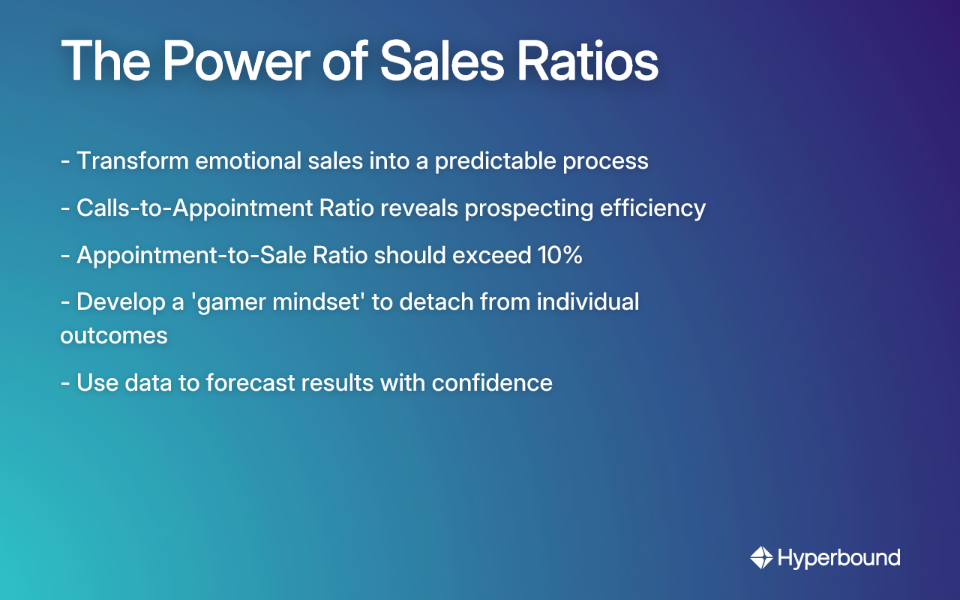
But here's the reality: true detachment isn't about not caring. It's about shifting your focus from individual outcomes to a predictable, mathematical process. The secret weapon? Tracking specific sales ratios that transform your approach from emotional to analytical.
Most reps know their win rate (deals closed divided by total opportunities), but this is a lagging indicator that only tells you what already happened. To truly improve your performance and achieve emotional detachment, you need to master the leading indicators that drive success.
This ratio measures how many calls it takes to secure a qualified appointment. It answers the fundamental question: "How much activity does it take to get my foot in the door?"
Formula: Total Calls ÷ Total Appointments Booked
For example, if you make 100 calls and book 5 appointments, your ratio is 20:1.
Why it matters: A high ratio indicates inefficiency in your outreach strategy. Your messaging, targeting, or call approach may need refinement. A lower, healthier ratio means your prospecting efforts are working effectively.
This is arguably the most important metric for an individual rep. It measures how effectively you convert qualified conversations into closed business.
Formula: Total Appointments Held ÷ Total Sales Closed
For example, if you conduct 10 qualified appointments and close 2 deals, your ratio is 5:1.
The critical benchmark: According to sales performance data, this ratio should never drop below 10%. If you're closing fewer than 1 in 10 appointments, there's a significant issue in your sales process, value communication, or qualification approach.
What counts as an appointment? For accurate tracking, define a qualified appointment as a meeting that:
This ensures you're measuring the conversion of genuinely qualified prospects rather than casual conversations.
Once you know your personal ratios (e.g., it takes 50 calls to get 5 appointments, and 5 appointments to get 1 sale), everything changes. Each individual call no longer carries the weight of potential failure - it becomes just one action in a predictable numbers game.
Think of it like adopting a "gamer mindset" for sales. In video games, you don't expect to win every battle. You expect to gain experience points, learn the mechanics, and gradually level up. Similarly, in sales:
When a prospect doesn't commit, it no longer ruins your day - it's simply an expected part of your ratio. You know exactly how many more calls you need to make to hit your targets.
This data-driven approach eliminates "mind deals" (those opportunities you irrationally pin your hopes on) and builds unshakable confidence. When your sales manager asks about your pipeline, you can say: "I made 200 calls this month, resulting in 20 appointments. Based on my 10% appointment-to-sale ratio, I expect to close 2 deals from this activity."
No more emotional attachment to individual outcomes. Just mathematical certainty.
Once you've mastered the foundational ratios, it's time to understand pipeline velocity - a comprehensive "health score" for your entire sales funnel that measures how quickly you're generating revenue.
Formula: Pipeline Velocity = (Number of Opportunities × Average Deal Size × Win Rate) ÷ Length of Sales Cycle
Let's break down each component:
For example, if you have:
Your pipeline velocity would be: (10 × $5,000 × 0.25) ÷ 30 = $416.67 per day
This formula reveals the four critical levers you can pull to increase revenue:
The beauty of this metric is that it helps you make strategic decisions about where to focus your improvement efforts.

To calculate your ratios accurately, you need clean, consistent data. Focus on tracking these critical leading indicators:
Industry benchmarks can provide valuable perspective:
For effective tracking and improvement, consider these tools:

Here's a simple weekly tracking template you can implement immediately:
Week ofTotal CallsEmails SentAppointments SetAppointments HeldSales ClosedCalls-to-Appointment RatioAppointment-to-Sale RatioNotes & InsightsMay 11257586115.66.0New script improved appointment rateMay 81106065118.35.0Focused more on friends-of-a-friend referrals
Instructions:
By tracking these ratios, you transform from an emotional, outcome-focused rep to a strategic, process-driven "sales scientist." This approach doesn't just improve your numbers - it fundamentally changes your experience of the job:
Remember that detachment isn't about not caring about results - it's about trusting the process. When you approach sales as a mathematical equation rather than an emotional endeavor, you'll find that paradoxically, your results improve precisely because you're less attached to them.
Start today by picking one ratio - like Calls-to-Appointment - and tracking it for two weeks. The clarity you gain will be the first step toward transforming your entire sales approach from an anxiety-producing guessing game to a predictable, data-driven process.
Your quota doesn't care about your feelings; it only cares about your numbers. So focus on the numbers, and let the feelings take care of themselves.
The two most important foundational sales ratios for an individual rep are the Calls-to-Appointment Ratio and the Appointment-to-Sale Ratio. The first measures your prospecting efficiency (how many calls it takes to get a meeting), while the second measures your closing effectiveness (how many meetings it takes to get a sale). Mastering these provides a clear, mathematical view of your performance.
Tracking sales ratios helps combat burnout by reframing rejection from a personal failure into a predictable part of a process. Instead of feeling defeated by a "no," you see it as a necessary data point on the path to your next "yes." This shifts your focus from uncontrollable outcomes to controllable activities (like making calls), which reduces stress and provides a sense of agency.
A healthy Appointment-to-Sale ratio should never be below 10%, meaning you close at least one deal for every ten qualified appointments you hold. If your ratio is lower than this, it signals a significant opportunity for improvement in your sales process, from qualification and value communication to closing techniques.
The easiest way to start is by using a simple spreadsheet, like the template provided in the article. For one month, commit to tracking a few key activities daily or weekly: total calls made, appointments set, appointments held, and sales closed. Then, calculate your ratios. This will give you a personal baseline to work from and improve upon.
A "qualified appointment" is a meeting that meets specific criteria, ensuring you're measuring meaningful sales conversations. A good definition is a meeting that: lasts at least 15 minutes, includes a discussion about pricing or budget, and involves a decision-maker. Using a consistent definition is crucial for accurate and reliable ratio tracking.
Focusing only on win rate is like looking in the rearview mirror; it's a lagging indicator that tells you what has already happened. In contrast, ratios like Calls-to-Appointment are leading indicators. They measure the activities that drive future success, giving you real-time feedback and control over your pipeline and final results.
The "gamer mindset" for sales is an approach where you treat your sales activities like a video game. Instead of viewing each call as a high-stakes, make-or-break event, you see it as an action that contributes to a larger, predictable numbers game. Each "no" is not a failure but simply data, and each activity helps you "level up" by moving you statistically closer to your next appointment and sale.











Use Cases
Legal