Knowing why a prospect needs your product is the easy part. The real challenge is conveying that need in a way that truly connects. If you've ever delivered what you thought was a flawless pitch only to be met with indifference, you're not alone.
The modern sales landscape has fundamentally changed. Today, 96% of prospects research companies before ever engaging with a sales rep, according to HubSpot's sales statistics. Yet despite this shift, 73% of sales reps still fail to fully understand their client's business needs, as revealed in a Forrester study.
This disconnect creates a critical opportunity: the sales professional who can bridge that gap with a perfect pitch will consistently outperform the competition. But here's the crucial mindset shift that must come first: sales isn't something you do to someone, but what you do for and with them. The perfect pitch isn't a monologue—it's a conversation.
In this article, we'll deconstruct the essential components of a pitch that resonates, provide actionable best practices to build genuine connections, and share proven examples to help you move from a one-sided presentation to a collaborative dialogue that closes deals.
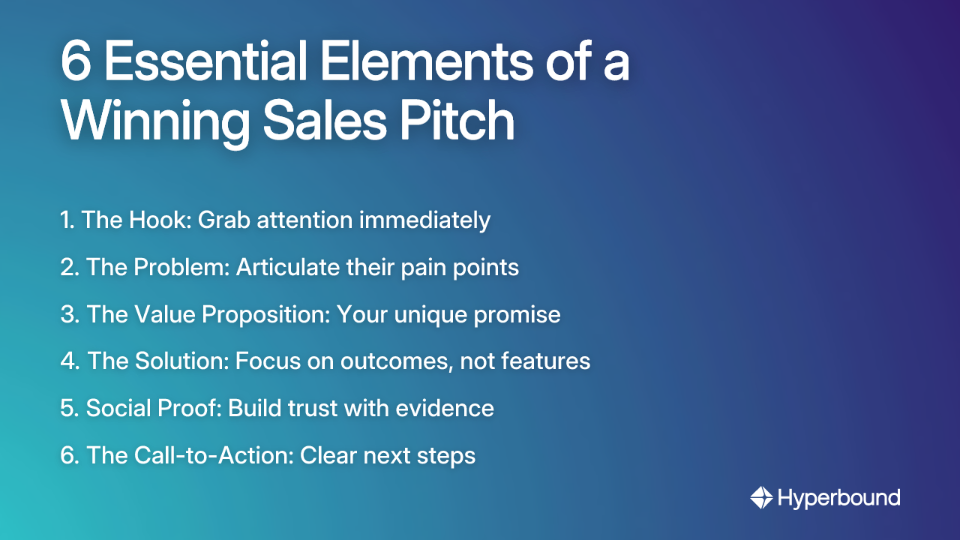
Every successful sales pitch, regardless of format, contains these critical building blocks:
Your opening must earn you the right to continue. Start with a provocative question, a surprising statistic, or an intriguing fact relevant to the prospect. Avoid weak openings like "I know you're busy" that signal low confidence. Instead, lead with something that creates immediate curiosity and demonstrates you've done your homework.
Before talking about your solution, demonstrate a deep understanding of their problem. This is the cornerstone of the "no pain, no sale" principle. Reference their industry challenges, a recent company announcement, or common frustrations for their role. When prospects feel truly understood, they're more open to solutions.
Clearly and concisely state how you create value. This addresses the common challenge of making your company stand out in a competitive landscape.
A simple, effective formula for crystallizing your value proposition is:[Your Company Name] helps [Your Target Audience] with [Your Services] so you can [The Primary Benefit].
Remember this crucial insight from sales professionals: "Nobody cares about the amazing features your product/service has". What they care about is what it does for them.
Connect every feature to a tangible benefit or outcome. As one sales expert puts it, "Don't sell what you do, sell what you cause!" This shift in perspective transforms your pitch from a product description to a vision of transformation.
End with a clear, low-friction next step. Don't leave the prospect wondering what happens next. This addresses the urgency principle that "Time kills all deals". Examples include:
.png)
Now let's move from theory to practice with concrete tips for crafting and delivering a compelling pitch:
If you go in explaining why they need you, they'll immediately get defensive. Instead, start with open-ended questions to understand their world. Practice active listening—listen to understand, not just to respond. This creates a collaborative atmosphere rather than a one-sided pitch.
People buy emotionally and justify intellectually. Research from Stanford shows stories are remembered up to 22 times more than facts alone. Share a customer success story that mirrors the prospect's situation or the origin story of your company to create an emotional connection.
A common mistake is trying to cover everything in one pitch. Instead, focus on the single most compelling thing. If that sticks, it will open the door to discuss more. Your goal is to spark interest, not overwhelm.
Your offering can't just be "nice to have." You must create sufficient value where the prospect feels that continuing without your service would be irresponsible for their business. This shifts the conversation from "Should we buy this?" to "Can we afford not to?"
Avoid generic, one-size-fits-all scripts. Mention something specific about their company, their role, or a recent post they shared on LinkedIn. This shows you've invested time in them and immediately differentiates you from the mass of salespeople sending templated messages.
40% of people respond better to visual information than plain text. Use a clean, simple sales deck as a visual aid for your conversation, not a script to be read from. Remember, your visuals should complement your words, not replace them.

Your delivery matters as much as your words. Aim for a confident, friendly, and professional tone. Speak at a conversational pace of about 120-150 words per minute to keep the audience engaged. While recording yourself is a good start, using an AI roleplay tool can provide a more realistic practice environment and objective feedback on your delivery.
Anticipate common concerns about price, urgency, need, or trust. Prepare thoughtful responses so you can address them confidently when they arise. This preparation shows you understand their perspective and have thought through potential roadblocks.
One of the most powerful pieces of sales advice: "When they say yes, STOP SELLING". Once you have commitment, confirm the next steps and conclude the conversation. Overselling after securing a "yes" can introduce doubt and derail your progress.
Maintain momentum after the pitch with timely follow-ups. Send a curated package of relevant content—like case studies or a link to a recorded demo—that your prospect can explore at their own pace.
Let's examine specific pitch templates for different communication channels:
Goal: Spark interest and open the door for a longer conversation.
Structure: Problem + Solution + Differentiator + Question
Example: "Did you know most marketing teams spend 10 hours a week just manually compiling reports? We built a platform that automates that process in minutes, freeing up your team for creative work. Unlike other solutions, ours integrates with all your existing tools. Are you facing similar challenges with reporting?"
Goal: Qualify interest and book a formal meeting.
Structure:
Goal: Get a response and start a conversation.
Subject Line: Make it catchy and personalized. e.g., "Idea for [Prospect's Company]" or "Question about your process"
Body: Keep it concise.
A perfect sales pitch isn't a flawless monologue; it's a well-researched, empathetic, and collaborative conversation. It's built on a foundation of understanding the prospect's pain, telling a compelling story, and providing undeniable proof.
Remember the most crucial mindset shift: "Sales isn't something you do to somebody, it's something you do for and with somebody". By focusing on genuine connection and delivering tangible value, you transform your sales pitches from a source of anxiety into your most powerful tool for building lasting customer relationships.
The best pitches don't feel like sales pitches at all—they feel like the beginning of a partnership where both sides win. Master this approach, and you'll not only close more deals but also build a reputation as a trusted advisor rather than just another salesperson.

The most important part of a sales pitch is demonstrating a deep understanding of the prospect's problem. Before you can effectively sell a solution, the prospect must feel that you truly understand their specific challenges and pain points. This "no pain, no sale" principle builds trust and makes the prospect more receptive to hearing about your solution.
The ideal length of a sales pitch depends on the context. An elevator pitch should be a concise 30-60 seconds to spark interest. A phone pitch might last a few minutes, aiming to book a longer meeting. A formal presentation could be 15-30 minutes, but it should always be a conversation, not a monologue. The key is to be as long as necessary to convey value but as short as possible to maintain engagement.
Storytelling is effective because it creates an emotional connection and makes your message more memorable. People often buy on emotion and justify with logic. A well-told customer success story helps the prospect visualize themselves benefiting from your solution. Research shows stories are up to 22 times more memorable than facts alone, ensuring your pitch stands out.
To make your pitch sound natural, focus on personalization and treat it as a conversation guide rather than a rigid script. Personalize every interaction by referencing details about the prospect's company or role. Lead with open-ended questions to encourage dialogue and practice your key talking points so they flow naturally.
A value proposition is your unique promise of the value you deliver, while the solution explains how you deliver that value by connecting product features to tangible outcomes. The value proposition is a concise, high-level statement (e.g., "We help sales teams cut admin time in half"). The solution section dives deeper, explaining the specific features that achieve this result.
Start your sales pitch with a strong, personalized "hook" that immediately grabs the prospect's attention. Avoid weak openings like "I know you're busy." Instead, use a provocative question, a surprising industry statistic, or a direct reference to a recent company event. This demonstrates that you've done your research and value their time.
If a prospect says "no," the first step is to seek understanding. Politely ask clarifying questions to uncover the root of the objection—is it about timing, budget, authority, or need? This feedback is invaluable. Depending on their answer, you can either address the specific concern or, if it's a firm "no," thank them for their time and ask if you can check back in the future.










Use Cases
Legal