
You've crafted a product or service that should be flying off the shelves. Your offering is solid. Your pricing is competitive. Yet when it comes time to pitch, something falls flat. The conversion rate isn't where it should be, and you're left wondering what went wrong in those crucial moments of communication.
"I'm at a smaller company with limited resources, so basically I'm on an island by myself when it comes to selling," laments one salesperson on Reddit. If this sounds familiar, you're not alone.
The truth is, the gap between having a quality offering and conveying its value effectively is where fortunes are lost daily. And for many sales professionals, especially those without robust team support, this gap can feel impossible to bridge.
The problem isn't your effort—it's the lack of a structured, repeatable process. Without a framework, every pitch becomes a gamble rather than a strategic conversation.
This is why we've developed the 5-Step Sales Pitch Training Framework—what I call "The Five D's" for dominating your pitch. This isn't just another list of sales tips; it's a comprehensive process for consistent preparation, personalization, and delivery that turns pitches into conversations and prospects into partners.
.png)
A winning pitch begins long before you speak to the prospect. This critical first phase is about deep research and crafting a compelling core narrative.
Go beyond surface-level data. SalesFocusInc advises that you must "Know their pain points" at a deep level. Research their:
Remember, your goal isn't just to know their business card information—it's to understand their world as intimately as they do.
Don't assume you know what they need. Ask insightful questions to uncover the core issue. As Sales Odyssey highlights, remember Theodore Levitt's famous quote:
"People don't need a quarter-inch drill bit. They want a quarter-inch hole."
Your job is to find out what "hole" your prospect is trying to create—what business outcome they're truly seeking beyond the immediate solution.
Before you can communicate value, you must define it precisely for this specific prospect. Ask yourself the question from Badger Mapping's guide: "What's in it for them?"
How does your solution make their life, or their business, measurably better? Quantify this value whenever possible with metrics like:
A pitch shouldn't be a list of features. SalesFocusInc suggests crafting the pitch like a story with a clear narrative arc:
This storytelling approach engages the prospect emotionally and logically, making your pitch more memorable and persuasive.
Generic pitches fail. This step is about tailoring your message so the prospect feels you're speaking directly to them and their unique situation.
Use your research from Step 1 to personalize every aspect of your presentation. Instead of broad claims like "our software increases productivity," speak to their specific challenges: "Based on what you shared about your team's current process taking 8 hours per week, our automation would free up nearly a full workday for your staff."
Ask targeted questions that demonstrate your understanding: "You mentioned struggling with customer retention in Q2—has that continued to be a challenge?" This shows you've done your homework and care about their specific situation.
How does this person, and this company, make buying decisions? Sales Odyssey recommends using the SONCAS method to understand their primary motivators:
This insight helps you frame your arguments effectively for maximum impact.
The Center for Sales Strategy's "Discover" phase recommends leading with an insight to uncover desired business results.
For example: "I saw that your industry is facing increasing compliance costs, and many leaders are focused on automating documentation to reduce liability. Is that a priority for you as well?"
This approach positions you as a knowledgeable partner rather than just another vendor asking the same questions.
Your prospect is likely evaluating competitors. Here, you must clearly and convincingly demonstrate why your solution is the best choice.
Don't just make claims; back them up with evidence:
Use Hard Data: As highlighted by Badger Mapping, statistics make your value tangible. For example: "Our software allows teams like yours to drive 20% less, freeing up 8 hours of busywork weekly."
Share Success Stories: Use relevant case studies and testimonials. SalesFocusInc stresses the importance of providing success stories from the prospect's specific industry. A financial services company wants to hear about other financial services companies, not manufacturing examples.
Avoid overwhelming your prospect with a feature dump. Sales Odyssey advises presenting just 2 or 3 of the most impactful sales arguments tailored to the prospect's profile.
This maintains focus and prevents them from being overwhelmed. Remember, in sales, less is often more—quality arguments trump quantity every time.
Build immense credibility by addressing potential shortcomings before the prospect does. SalesFocusInc calls this "Know your shortcomings."
For example: "We may not be the cheapest option, and that's because we invest heavily in 24/7 customer support, which delivers 98% client satisfaction for our customers."
This honest approach builds trust and defuses objections before they arise.

This is the performance. Confidence, engagement, and a clear plan for what comes next are critical for success.
Your goal is to be fluent, not robotic. Badger Mapping suggests practicing to maintain a conversational pace of 120-150 words per minute.
As one sales professional advises on Reddit, "One great way to critique yourself is to video record yourself doing it... you will be amazed how many things you will see yourself doing that you can improve upon." This self-review process is a great start, but it can be time-consuming and lacks objective feedback.
To scale effective practice, leading sales teams now use AI-powered platforms like Hyperbound's AI Sales Roleplays. These tools allow reps to practice critical conversations against realistic AI buyer personas, receive instant, data-driven feedback on their performance, and master their pitch in a safe environment.
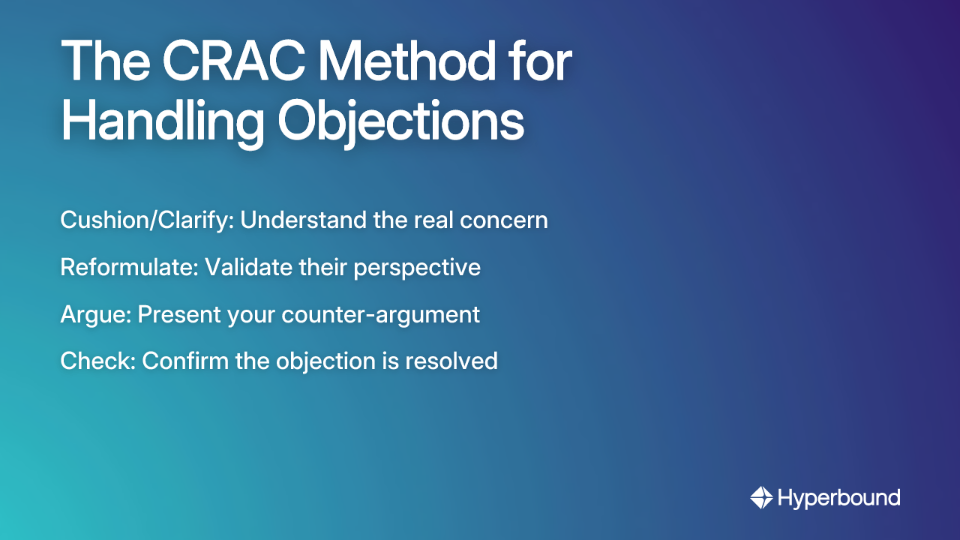
Objections are a sign of engagement, not rejection. Use a structured method like the CRAC method from Sales Odyssey:
End every pitch with a clear, mutually agreed-upon plan. This addresses the common fear of "being scared to ask the question," as mentioned by salespeople on Reddit.
Instead of a hard close, propose a logical next step: "Based on our conversation, the logical next step would be a detailed demo with your technical team. Are you and Sarah available next Tuesday?"
A framework is useless without practice and refinement. The best salespeople are in a constant state of learning.
While manually recording your practice sessions is a valuable first step, technology offers a more powerful and scalable path to improvement. AI coaching platforms like Hyperbound analyze your team's best calls to identify winning behaviors and then build hyper-realistic roleplay scenarios. This allows reps to get consistent, objective feedback and practice their pitch until it's perfect.

You don't have to do it alone. In addition to practice platforms, consider resources like:
Apply what you've learned in mock pitches, role-playing with colleagues, or even in low-stakes real-world scenarios. As one Reddit user said, the only training that matters is "actually doing the job." This framework gives you the structure to make that "doing" more effective.
True sales success isn't about having the slickest lines; it's about having a robust process. By mastering the Five D's—Development, Details, Differentiation, Decision-Makers, and Delivery—you move from hoping for a sale to architecting one.
Stop feeling isolated and relying on trial and error. Start implementing this structured framework to build confidence, articulate value with precision, and achieve the consistent wins you're aiming for. Your next great pitch is not a matter of luck, but of preparation.
The 5 steps of a winning sales pitch are Development, Details, Differentiation, Decision-Makers, and Delivery. This framework, also known as "The Five D's," provides a structured process for success. It starts with Development (researching the prospect), moves to Details (personalizing your message), then Differentiation (proving your unique value), Decision-Makers (navigating the organization), and finally, Delivery (executing the pitch with confidence).
To make your pitch more personal, you must connect your solution directly to the prospect's specific pain points and business challenges. This involves deep research (Step 1: Development) to understand their industry, company, and individual motivators. Instead of listing generic features, use their language and address their specific problems. For example, quantify how your solution will save them time or money based on the information they've shared, demonstrating that you've done your homework and genuinely understand their needs.
The best way to practice a sales pitch is through consistent, realistic role-playing that provides objective feedback. While recording yourself is a good start, modern AI-powered platforms like Hyperbound offer a more scalable solution. These tools allow you to practice against realistic AI buyer personas, receive instant, data-driven feedback on your performance, and master handling objections in a safe, repeatable environment before you engage with a real prospect.
Storytelling is crucial because it makes your pitch more memorable and emotionally engaging than a simple list of facts and features. A well-crafted story creates a narrative arc where the prospect is the hero facing a challenge. You can set the scene (their current problem), introduce the conflict (the cost of not solving it), and present your solution as the resolution. This logical and emotional connection helps prospects visualize success and makes your value proposition stick long after the meeting ends.
You should handle objections using a structured framework like the CRAC method, which involves Cushioning/Clarifying, Reformulating, Arguing, and Checking. This four-step process helps you manage objections professionally without being defensive. First, Clarify to understand the root cause of the concern. Then, Reformulate their point to show you're listening. Next, Argue by providing a tailored counter-point or solution. Finally, Check to confirm that you have fully addressed their concern before moving on.
You can prove your product's value by providing concrete proof and focusing on just two or three key arguments that matter most to the prospect. Avoid overwhelming them with a list of every feature. Instead, use hard data, statistics, and relevant success stories to make your value tangible. Share case studies from their specific industry to build credibility. It's also effective to proactively address potential shortcomings (e.g., higher price) and frame them as a strength (e.g., investment in superior support), which builds trust and differentiates you.










Use Cases
Legal