
Your sales forecast says Q3 is looking strong. Your gut says something's off. And by the time you figure out which one is right, two of your biggest deals have quietly gone cold.
This is the reality for most revenue teams today. According to Gartner, 69% of sales operations leaders report increased forecasting difficulties due to deal slippage — not because they lack data, but because the data they have doesn't tell them what's actually happening inside their deals.
The real culprits? Missed forecast calls caused by over-optimistic reps sandbagging their numbers. Stalled deals that sit in "late stage" for weeks with zero meaningful buyer activity. And rep accountability gaps that only surface after a quarter ends badly. The traditional answer — more CRM fields, more pipeline reviews, more spreadsheets — hasn't fixed the problem. If anything, it's made it worse. As one sales rep put it bluntly on Reddit: "Salesforce is f**ing scary,"* and that fear has a cost. When reps don't trust or understand their tools, data quality tanks, pipeline visibility evaporates, and managers are left flying blind.
Modern sales pipeline visibility software needs to do more than display a Kanban board of deal stages. The best tools in this category now deliver:
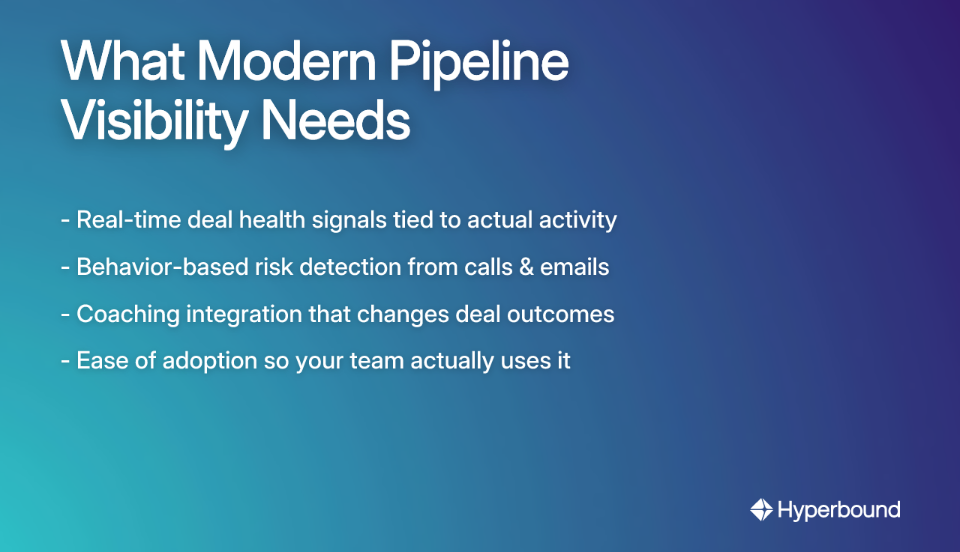
Here are the 8 best sales pipeline visibility software tools built for modern revenue teams, evaluated against exactly those criteria.
Most pipeline tools show you what is in your funnel. Hyperbound Perform shows you why deals are winning or stalling — and what to do about it before it's too late.
Unlike tools that rely on CRM hygiene (fields being updated, stages being moved), Hyperbound Perform surfaces deal risk from actual buyer conversations. It automatically scores 100% of real customer calls against your custom methodology scorecards and rolls those insights up across every touchpoint in a deal — from first cold call to closing conversation — to expose where momentum is building and where it's breaking down.
Key features:
The core insight behind Perform is what sets Hyperbound apart: deals don't die from CRM neglect — they die from behavioral breakdowns in conversations. A champion who stops responding, a discovery call where pain was never fully uncovered, a demo where the economic buyer's objections went unaddressed. Perform catches these signals while deals are still winnable.
This is also how Hyperbound defines the "Revenue Activation" category — the gap between analyzing call data and actually changing outcomes. Perform doesn't just report what happened; it tells your reps and managers what to do next.
Ideal for: Mid-market to enterprise sales teams who want to connect rep behavior to deal outcomes and act on what they see — not just document it.
Gong is one of the most widely adopted call intelligence platforms in B2B sales. It captures and analyzes customer interactions — calls, emails, and web conferences — to give revenue teams a clearer view of deal status and risk signals.
Key features:
Gong is genuinely strong at surfacing what is being said across your pipeline. Where it has a natural ceiling is the practice layer — Gong can tell a manager that a rep is struggling with objection handling, but it doesn't give that rep a place to practice those specific objections against a realistic buyer before the next call. That's the gap Hyperbound Perform is built to close.
Ideal for: Teams that want deep conversation analytics and call-level coaching integrated into their pipeline reviews.
Clari is a purpose-built revenue operations platform that brings rigor to pipeline management and forecast accuracy. It aggregates data from your CRM, email, calendar, and calls to give leadership a single source of truth on deal health.
Key features:
Clari excels at giving CROs and RevOps leaders a defensible forecast with documented risk signals. It's less focused on the rep-level coaching actions that would actually fix the deals it flags.
Ideal for: Large enterprise teams that need reliable, data-driven forecasting and structured pipeline governance.
Salesforce Sales Cloud is the industry-standard CRM, and for good reason — its configurability is unmatched. But that power comes with real trade-offs that sales teams rarely talk about honestly.
Key features:
Here's the honest reality though: one Reddit user captured it perfectly — "Salesforce is highly customizable; each company will have different fields/objects. Salesforce developers only are in charge of tailoring it to their sales process." That's not a knock on Salesforce — it's genuinely powerful — but it means your pipeline visibility is only as good as your implementation. Teams that invest in the setup get a lot out of it. Teams that don't often end up with a system reps avoid updating, which defeats the purpose entirely.
Ideal for: Enterprise teams with dedicated admin resources who need a deeply integrated, custom-built sales process.
If Salesforce is the enterprise tank, Pipedrive is the sports car — built for speed, clarity, and ease of use. Its visual drag-and-drop pipeline is intentionally simple, which is exactly what smaller teams need.
Key features:
For sales professionals who find spreadsheet-based tracking overwhelming or enterprise CRMs intimidating, Pipedrive is a welcome relief. As one Reddit commenter put it: "Pipedrive looks awesome — I like Pipedrive better." The tradeoff is depth: Pipedrive won't give you behavior-based deal risk signals or coaching integration, but for teams in early stages who just need reliable pipeline visibility without the complexity tax, it's hard to beat.
Ideal for: Small to mid-sized teams in early growth stages who want clean, visual pipeline management without the overhead.
HubSpot Sales Hub sits at the intersection of CRM, pipeline management, and marketing automation — all under one roof. Its strength is tight integration across the entire customer journey, from first marketing touch to closed deal.
Key features:
As one Reddit user said: "We used HubSpot with a team of 10 people. It was great." That sentiment sums up HubSpot's sweet spot: teams that want a unified platform where sales and marketing share the same data, without the IT overhead of an enterprise tool.
Ideal for: SMBs and scaling teams that want sales pipeline visibility tightly integrated with their marketing and customer success workflows.
Close is a CRM built from the ground up for inside sales teams that live and die by their outreach volume. Rather than bolting communication tools onto a traditional CRM, Close bakes them in natively — calls, emails, and SMS all live inside the same workflow.
Key features:
Close removes the friction of switching between your dialer, inbox, and CRM — everything happens in one place, which means more activity data gets captured automatically. Pipeline visibility here is activity-driven: you see what outreach is happening, what's getting responses, and what's going cold.
Ideal for: Inside sales teams running high-volume outbound who need speed, communication tools, and pipeline tracking in one place.
Zoho CRM punches well above its price point. It offers a rich feature set — advanced workflow automation, visual pipeline views, detailed reporting, and AI-powered insights via Zia — at a fraction of the cost of enterprise alternatives.
Key features:
Zoho's value proposition is straightforward: if you need a fully functional, customizable CRM with solid pipeline visibility and don't want to pay enterprise prices, Zoho delivers. It lacks the depth of conversation intelligence you'd get from Gong or Hyperbound Perform, but for teams that need reliable pipeline tracking and process automation on a budget, it covers the fundamentals well.
Ideal for: Budget-conscious teams at any size who need a versatile, feature-rich CRM without a significant financial commitment.
.png)
Not every team has the same gap. Use this matrix to find your fit:
.png)
.png)
The key differentiator when choosing between these tools comes down to one question: Do you need to see what's in your pipeline, or do you need to change what happens to it?
Tools like Clari and Gong are excellent at the former — they give you visibility, signal, and context. But for sales teams who want to use pipeline intelligence to actually change deal outcomes — by identifying behavioral gaps, coaching reps in the moment, and closing the loop between insight and execution — Hyperbound Perform occupies a distinct category.
Pipeline visibility has never been the problem. Most teams have more dashboards, more data, and more reporting than they know what to do with. The problem is the gap between seeing a deal at risk and actually doing something about it while there's still time.
The best sales pipeline visibility software doesn't just illuminate your funnel — it tells you why deals are healthy or at risk based on what's actually happening in buyer conversations, and it gives your team a clear path to act on those insights.
Whether you're a small team looking for a simple visual pipeline or an enterprise revenue team trying to connect rep behaviors to deal outcomes at scale, there's a tool on this list built for your situation. Start with your biggest gap — visibility, forecasting, coaching, or adoption — and pick the tool that closes it.
If that gap is between what your pipeline tells you and what your team actually does about it, Hyperbound Perform is worth a closer look.
Sales pipeline visibility software is a tool that helps sales teams track, manage, and analyze their sales opportunities from initial contact to a closed deal. Unlike traditional CRMs that rely on manually entered data, modern tools automate data capture from calls, emails, and meetings to provide a real-time, accurate view of deal health and forecast reliability.
Your CRM is often not enough because it relies on manual data entry from reps, which can be inconsistent, outdated, or overly optimistic. This leads to an inaccurate pipeline view based on self-reporting rather than actual buyer activity. Modern visibility tools integrate with your CRM but add a layer of automated analysis from real conversations, providing objective signals about which deals are truly progressing and which are at risk.
Conversation intelligence improves pipeline visibility by automatically analyzing customer calls and emails to identify risks and opportunities that manual CRM data entry would miss. It can detect things like a lack of follow-up questions from a rep, unaddressed buyer objections, or a champion going silent. This provides a more accurate, behavior-based understanding of deal health beyond just the deal stage.
Pipeline visibility is about seeing what is happening in your deals, while revenue activation is about changing the outcome of those deals based on what you see. Visibility tools like Clari or Gong are excellent at flagging risks. Revenue activation platforms like Hyperbound Perform take the next step by providing integrated coaching and practice tools to help reps fix the behavioral issues that put the deal at risk in the first place.
Everyone on the revenue team benefits, but in different ways. Sales reps get clearer next steps, managers get better coaching insights, and leaders get more accurate forecasts. Reps can focus on winnable deals, managers can conduct more effective pipeline reviews based on objective data, and leaders can trust their forecast and make better strategic decisions.
To choose the right software, first identify your primary pain point: is it inaccurate forecasting, a lack of deal-level insight, poor CRM adoption, or a gap in sales skills? If your main problem is forecasting, a tool like Clari is a strong choice. If you need to understand what's being said in calls, look at Gong. If your goal is to directly connect rep behavior to deal outcomes and actively coach your team to win more, a revenue activation platform like Hyperbound Perform is designed for that specific challenge.










Use Cases
Legal