
Imagine this: It's 5:30 PM. Every rep on your team — regardless of their attainment, regardless of whether their pipeline is healthy — gets blocked on the calendar for a mandatory, hour-long pipeline review with executive leadership. No exceptions.
One sales rep who lived this reality posted about it on Reddit, asking simply: "How quickly would this make you quit?" The top reply: "Daily? For an hour? Run, don't walk. That is asinine."
This is the dysfunction no one talks about enough in sales pipeline coaching conversations. The pipeline review — one of the most critical rituals in sales management — has been reduced to a glorified CRM status update. Managers tolerate it. Reps dread it. And at the end of it, zero behavior changes on either side.
The meeting asks "what happened?" when it should be asking "what will we do differently to win?" It interrogates deals instead of developing the people running them. And the data it relies on is rep-reported, subjective, and disconnected from what buyers are actually saying on calls.
The result, as one commenter put it bluntly: "Micromanagement means they do not trust their salespeople. It will get worse."
But here's the thing — the problem isn't that pipeline reviews exist. The problem is how they're structured. A well-run, 30-minute pipeline review can be the highest-leverage coaching conversation a frontline manager has all week. It can move deals forward, accelerate rep development, and build a culture of trust instead of fear.
Here's exactly how to do it.
Before fixing the meeting, it's worth understanding why it breaks down in the first place.
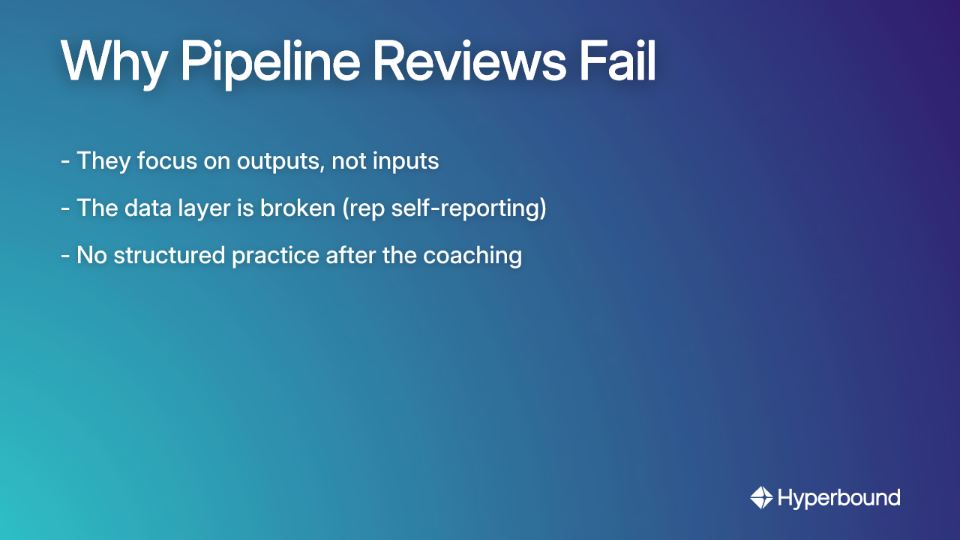
They focus on outputs, not inputs. Most pipeline reviews are laser-focused on the forecast number — where deals are in the stage, what the close date is, what the rep "thinks" the probability is. But none of that tells you why a deal is where it is, or what behavior needs to change to move it forward. You're looking at a lagging indicator and calling it a coaching session.
The data layer is broken. Without real signal from buyer conversations, managers are forced to rely entirely on what reps tell them — which is often optimistic, incomplete, or shaped by what the rep thinks the manager wants to hear. There's no ground truth. There's no visibility into whether the rep is actually uncovering budget, engaging the economic buyer, or addressing the competitor objection that keeps coming up.
There's no practice on the back end. Even when a manager identifies a skill gap in a pipeline review, there's typically no structured way to turn that insight into improvement before the rep's next live call. The coaching conversation ends, the rep nods, and nothing changes.
The good news: all three of these failure modes are fixable with the right structure and the right data.
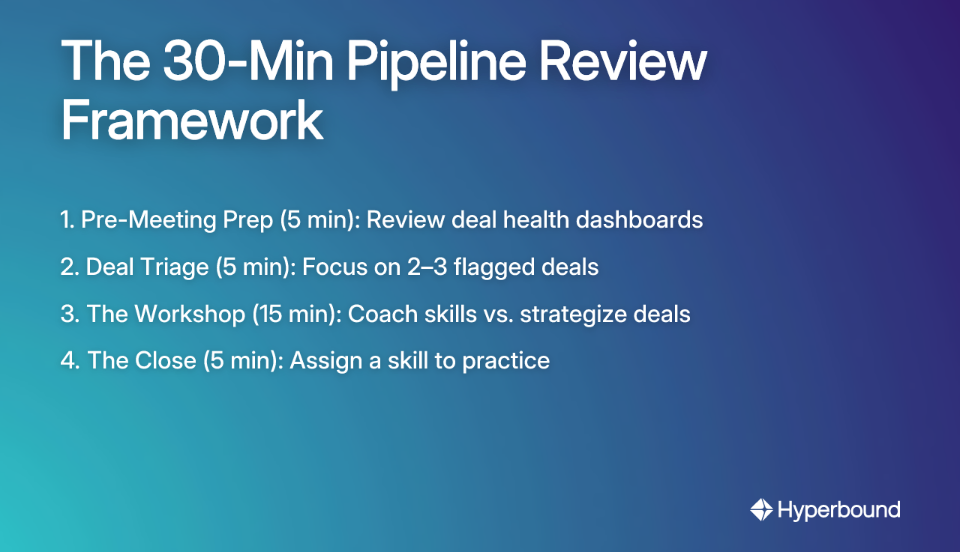
This framework breaks the meeting into four distinct, time-boxed segments. Every minute is intentional. Every segment has a specific output.
The biggest hidden cost of pipeline reviews isn't the meeting itself — it's the 45 minutes of prep that precedes it. Digging through CRM records, hunting for the most recent call notes, trying to remember which deals the rep mentioned last week. By the time the meeting starts, you're exhausted and you haven't coached anyone yet.
This is where Hyperbound Perform's deal health dashboards change the game. Instead of manually reconstructing a picture of each deal from fragmented sources, you get an at-a-glance view of pipeline health grounded in real buyer conversations — not rep-reported CRM fields. Perform automatically scores 100% of customer calls and rolls those insights up to the deal level, surfacing execution risks before you even open the meeting.
Sitting above that is Kota, Hyperbound's AI Revenue Analyst. Before you walk into the pipeline review, Kota has already flagged which deals are showing early risk signals and which reps are struggling with specific skill gaps — things like failing to engage the economic buyer, losing ground on competitor objections, or letting deals stall without a confirmed next step. You don't have to go looking for the problems. Kota surfaces them.
Pre-meeting prep goes from 45 minutes of detective work to 5 minutes of focused review.
This is where most managers go wrong: they try to cover the entire pipeline. Every deal gets a status update. Every deal gets two minutes. No deal gets real attention.
The right approach is depth over breadth. Pick 2–3 deals for a focused inspection. Here's how to select them:
Announce these deals at the top of the meeting. Don't let the rep drive the agenda by defaulting to their best stories. The deals you inspect should be chosen by signal, not by narrative convenience.
This is the heart of the pipeline review. And the most important skill a manager can develop here is learning to distinguish between two fundamentally different types of deal problems:
A skill gap → a coaching conversation A situational challenge → a strategic conversation
Conflating the two is how reps get bad feedback ("you just need to be more confident") and how good deals get mismanaged ("let's just send another follow-up email").
Signals that indicate a coaching conversation:
These come directly from Hyperbound Perform's real call scoring. If the AI scorecard shows the rep consistently has a poor talk-to-listen ratio, fails to confirm next steps, or routinely skips discovery questions around budget or decision criteria — that's a skill gap. The deal's health is a symptom; the rep's behavior is the cause.
The coaching question here isn't "what's the update?" It's: "I see on the last three calls in this deal, we haven't identified the economic buyer. What discovery questions are you using to get at their approval process? Let's talk through a different angle."
Signals that indicate a strategic conversation:
These show up in the deal-level dashboard — your single-threaded champion has gone dark, no new meetings have been booked in three weeks, or a competitor was mentioned on the last call but never addressed.
The strategic question here isn't about the rep's skill. It's: "This deal is at risk because we're single-threaded. Your champion may not have the internal influence to push this across the line alone. Who else in their organization can we map out and create an engagement strategy around?"
Great pipeline reviews also use pointed probing questions to surface blind spots:
These questions work because they force both the manager and the rep to reason from evidence, not assumption — especially when that evidence is grounded in what buyers are actually saying on recorded calls.
.png)
Here's what separates a coaching-first pipeline review from every other kind: it ends with a specific skill the rep will practice before their next critical call. Not a task. Not a follow-up item. A skill.
"Follow up with the prospect" is a task. "Practice handling the CFO-level pricing objection using a realistic simulation before Thursday's call" is a skill assignment.
This final five minutes closes the loop between deal inspection and rep development. Based on what the real call scoring revealed during the workshop, the manager assigns a targeted practice session in Hyperbound Practice. The rep goes into the AI roleplay environment — built from analysis of 2M+ hours of real B2B sales conversations — and practices the exact scenario where they're struggling. They get an AI scorecard back immediately, with objective feedback on what they did well and where they still need to sharpen up.
A concrete example of how this sounds in practice:
"Based on what we talked about with the budget conversation in the Acme deal, I want you to go into Hyperbound Practice and run the 'CFO Pricing Objection' roleplay twice before your call on Thursday. I'll pull up your scorecard with you tomorrow morning and we'll debrief together."
This is the operational loop that makes sales pipeline coaching compound over time: Score Real Calls → Identify Skill Gaps → Practice Roleplays → Score Real Calls Again. Each cycle, the rep gets sharper. Each cycle, the deal data gets richer. And the manager spends their time developing people instead of interrogating spreadsheets.
The reason most pipeline reviews don't change anything is that they never bridge insight to action. A manager might correctly diagnose a problem on a call — "your discovery isn't deep enough" — but without a structured path from that observation to actual skill practice, the diagnosis dies in the meeting room.
This framework changes that by treating the pipeline review as the beginning of a learning loop, not the end of an inspection. Every piece of deal data feeds a coaching conversation. Every coaching conversation feeds a targeted practice session. Every practice session feeds better performance on the next live call.
This is what Hyperbound describes as Revenue Activation — the gap between having data and using it to change outcomes. Teams that adopt this behavioral coaching model see measurable results: Vanta, for example, achieved a 60% reduction in ramp time — cutting time from 210 days down to 72 — by focusing their coaching on the specific behaviors that drive closed-won deals.
The other thing this framework does is rebuild trust. When reps understand that the pipeline review exists to make them better — not to catch them failing — the entire energy of the meeting shifts. It goes from interrogation to collaboration. From dread to value. That's not a soft outcome. That's a retention strategy.
The pipeline review doesn't have to be the meeting everyone dreads. It can be the meeting your reps actually look forward to — because they leave it sharper, clearer on what to do next, and more confident going into their most important calls.
The structure is simple: five minutes of smart prep, five minutes of focused triage, fifteen minutes of coaching versus strategy, and five minutes of actionable practice. Thirty minutes. One specific skill to build. Zero wasted time on lagging CRM data.
The prerequisite is having a real data layer — one grounded in actual buyer conversations, not rep self-reporting. That's what makes the difference between a manager who guesses at what a rep needs and a manager who knows.
Ready to turn your pipeline reviews from dreaded status updates into high-impact coaching sessions? See how Hyperbound Perform and Kota Activate give you the deal-level intelligence to coach, not just inspect.
A sales pipeline review is a recurring meeting between a sales manager and a sales representative to assess the health of the rep's sales deals and identify actions needed to move them forward. Traditionally, these meetings focus on status updates and forecasting. However, the most effective pipeline reviews are structured as coaching sessions designed to develop a rep's skills and strategically advance key deals, rather than simply interrogating CRM data.
Most pipeline reviews fail because they focus on lagging indicators (outputs) instead of the behaviors that drive them (inputs), rely on subjective self-reported data from reps, and lack a structured way to practice and implement coaching feedback. This turns the meeting into a dreaded status update that feels like micromanagement. Without objective data from actual buyer conversations, managers are coaching blind, and without a clear action plan for skill development, the same issues reappear week after week.
You can make pipeline reviews more effective by structuring them as 30-minute, coaching-first sessions focused on a few key deals, using data from real buyer conversations to identify skill gaps, and ending with a specific practice assignment for the rep. The article outlines a four-step framework: 5 minutes of pre-meeting prep using AI-driven insights, 5 minutes of deal triage to select 2-3 deals, 15 minutes of workshop time to coach skills or strategize, and 5 minutes to assign a targeted skill to practice.
An effective pipeline review should be a focused, 30-minute meeting. This is enough time to have a deep, meaningful coaching conversation about 2-3 critical deals without trying to cover the entire pipeline. The 30-minute structure ensures every minute is intentional, breaking down into pre-meeting prep, deal triage, a coaching workshop, and assigning a practice-based next step.
A coaching conversation addresses a gap in a sales rep's skills, while a strategic conversation addresses a situational challenge within a specific deal. For example, if a rep consistently fails to identify the economic buyer across multiple deals, that's a skill gap requiring coaching. If a deal is stalled because the rep's champion has left the company, that's a situational challenge requiring a new strategy. Knowing the difference is crucial for providing the right kind of support.
Instead of covering every deal, you should select 2-3 deals for in-depth review based on specific signals like AI-flagged risks, stalled progress, or a lack of confirmed next steps. A good approach is to choose one deal from each phase of the pipeline (Create, Advance, Close) to ensure you're coaching across the entire sales cycle. This depth-over-breadth method allows for a meaningful conversation rather than a superficial status update on the entire pipeline.
AI can dramatically improve pipeline reviews by automatically analyzing 100% of customer calls to provide objective data on deal health and rep performance, eliminating reliance on subjective, self-reported information. AI tools like Hyperbound Perform and Kota can surface at-risk deals, identify specific skill gaps (like poor talk-to-listen ratios or missed discovery questions), and flag risks before they derail the pipeline. This allows managers to spend their prep time analyzing insights rather than digging for information, leading to more targeted and effective coaching.










Use Cases
Legal