
You've just wrapped another pipeline review. Ninety minutes of your week gone — and what do you actually know that you didn't know before? A handful of rep-delivered status updates: "it's moving forward," "they're evaluating a few options," "I think we're in a good spot." No deal behavior. No signal. Just optimism with a slide deck.
This isn't a people problem. It's a tooling one. Traditional CRMs were supposed to fix this, but as sales practitioners in the trenches have pointed out, "most CRMs end up with better notes… but not better qualification." They capture text, not context. And conversation intelligence platforms? Invaluable for visibility — but they create a "giant library of data" and leave overburdened managers (who spend only 5–8% of their time coaching) to connect the dots themselves.
The result: even with a full tech stack, the gap between insight and rep behavior change stays wide open.
That's where sales pipeline AI assistants come in — a new class of tools designed not just to record and report, but to analyze deal behavior, automate CRM hygiene, surface early risk signals, and trigger coaching interventions at the right moment. Companies using AI sales coaching report a 20% higher likelihood of achieving better revenue outcomes — and the tools below represent the sharpest edges of that shift.
Here are the 7 best sales pipeline AI assistants for B2B sales teams — organized around the specific buyer need each one addresses best.
Best for: Closing the loop from live deal behavior to coaching interventions and CRM hygiene
Most tools in this list show you what's wrong. Hyperbound does something different — it fixes it. The company coined the Revenue Activation category to describe what happens when teams stop just analyzing call data and start using it to change outcomes.
At the core of this is a continuous operational loop: Score Real Calls → Identify Skill Gaps → Practice Roleplays → Score Real Calls again. Two products power this loop for pipeline management:
Hyperbound Perform is the deal intelligence layer. Unlike tools that analyze individual calls in isolation, Perform rolls up insights across all calls, emails, and stakeholder interactions within a deal. It surfaces deal momentum, flags early risk signals, and recommends deal-winning actions while there's still time to act. For CRM hygiene, its Auto-CRM Fill automatically captures and updates deal data from real conversations (currently HubSpot, Salesforce coming soon) — directly solving the "manual data entry struggle" that sales reps frequently cite as a major productivity drain. Reps can review data before it's pushed, keeping them in control.
Kota Activate sits above Perform as an orchestration layer — an AI assistant that analyzes all deals simultaneously, references historical closed-won/lost patterns, and delivers actionable coaching recommendations directly in Slack or Teams. The differentiator: Kota doesn't just report insights. It acts on them. If Perform detects a rep struggling with pricing objections across multiple live deals, Kota can automatically assign a targeted, deal-specific Bite-Sized Roleplay in Hyperbound Practice — trained on 2M+ hours of real B2B sales conversations, not generic scripts.
Pros:
Cons:
Best for: Deep conversation intelligence and team-wide call analytics
Gong is the market leader in recording, transcribing, and analyzing sales conversations. It's excellent at helping revenue leaders understand what top performers say and do on calls, identify market trends, and ensure message adherence across the team.
Pros:
Cons:
Best for: Conversation intelligence within the ZoomInfo ecosystem
Chorus.ai records and analyzes sales calls with AI, pinpointing key moments, tracking topics, and generating rep scorecards. If your team is already invested in the ZoomInfo ecosystem, Chorus offers strong native data connectivity.
Pros:
Cons:
Best for: Structured sales training, onboarding, and certifications
Mindtickle is a sales readiness platform with AI coaching features focused on building foundational selling skills through guided modules, practice scenarios, and assessments. It's purpose-built for enabling reps before they go live with buyers.
Pros:
Cons:
Best for: Managing and optimizing sales engagement cadences
Salesloft is a leading sales engagement platform that helps teams execute outreach strategies across email, phone, and social. Its analytics help managers track which sequences and touches are driving pipeline activity.
Pros:
Cons:
Best for: Enterprise-grade sales engagement and workflow automation
Outreach is a direct competitor to Salesloft and helps enterprise sales teams automate and manage complex outreach workflows across channels. It includes forecasting tools grounded in engagement activity data.
Pros:
Cons:
Best for: Immersive AI-powered sales simulations for skills practice
Second Nature provides a dedicated AI roleplay environment where sales reps can practice conversations with AI personas. It's a focused tool for reps who want to rehearse pitches and objection handling before live calls.
Pros:
Cons:
Most of these tools can show you what happened in your pipeline. Fewer can help you change what happens next. Before committing to any sales pipeline AI assistant, run every vendor through this checklist:
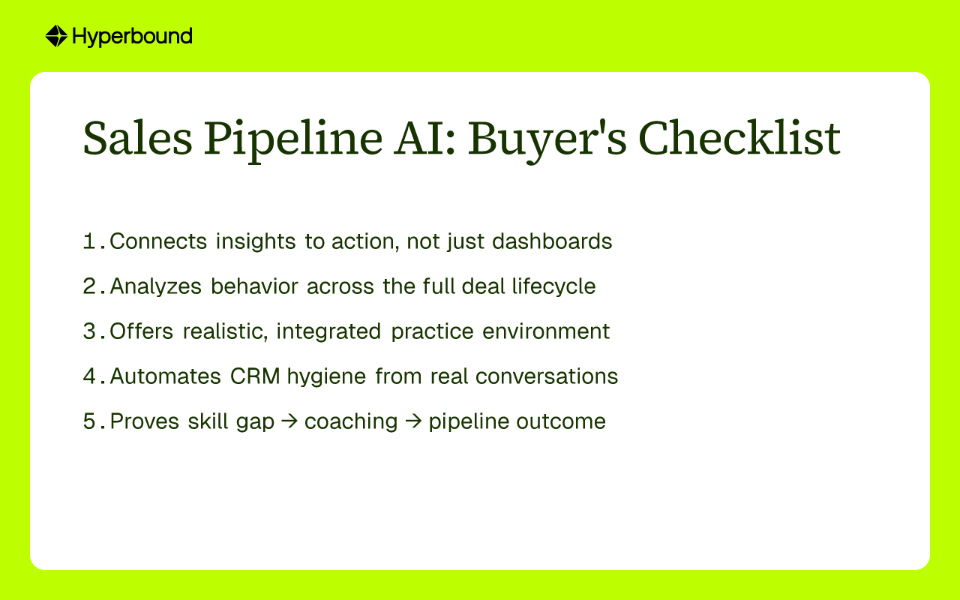
1. Does it connect insights to action — or just create another dashboard? If the output is a report that goes to a manager who then has to manually decide what to do with it, you haven't closed the loop. Look for tools that recommend specific actions, automatically assign coaching, or trigger practice based on real deal behavior.
2. Can it analyze behavior across the full deal lifecycle — not just individual calls? Deal momentum is built (and lost) across multiple touchpoints. A tool that only analyzes isolated calls misses stakeholder dynamics, objection patterns across calls, and the cumulative signals that indicate whether a deal is moving or stalling.
3. Does it offer a realistic, integrated practice environment? The best AI sales coaching tools don't separate "training mode" from "deal mode." If a rep is losing pricing conversations in live deals, can the system automatically create a targeted practice scenario to fix that specific gap? Generic roleplay has its limits — look for practice that's grounded in real B2B conversation data and connected to active pipeline.
4. How does it handle CRM hygiene? Manual data entry is a well-documented time drain — sales reps report spending more time typing notes than closing deals. AI-enhanced CRM tools automate this to free reps to focus on selling. Ask whether the tool auto-fills CRM fields from real conversations, and whether reps retain visibility before data is pushed.
5. Can it prove a direct line from skill gap → coaching intervention → pipeline outcome? This is the hardest question — and the most important one. If a vendor can't show you how their tool changes rep behavior in the field (not just completion rates on training modules), you're investing in activity metrics, not revenue outcomes.
The best sales pipeline AI assistant for your team isn't necessarily the one with the most features — it's the one that closes the gap between what your data tells you and what your reps actually do next. Most tools in this space are strong on the insight side. The rare ones are strong on the activation side. That distinction is worth asking about before you sign.
A sales pipeline AI assistant is a tool that analyzes conversations and activities across your entire sales pipeline to automate tasks, identify deal risks, and trigger coaching for sales reps. Unlike traditional CRMs that only store data or conversation intelligence tools that only record it, an AI assistant actively connects insights from deal behavior to actions that change sales outcomes.
They improve CRM data accuracy by automatically capturing and syncing key information from sales calls and emails directly into your CRM. This eliminates the need for manual data entry by reps, a process that is often inconsistent and time-consuming. Tools like Hyperbound's Auto-CRM Fill listen to conversations, extract details like budget, timeline, and next steps, and update the CRM record, ensuring data is timely and reflects the true state of the deal.
The primary difference is action versus analysis. Conversation intelligence (CI) tools like Gong are excellent for recording, transcribing, and analyzing calls to provide insights into what's happening. A sales AI assistant takes the next step by using those insights to do something—such as automatically updating the CRM, identifying a rep's skill gap, and assigning a targeted coaching exercise to fix it. CI tools create a library of data; AI assistants activate it.
Connecting deal analysis directly to coaching is crucial because it makes performance improvement scalable and timely. Sales managers have limited time for coaching. An AI assistant can analyze every deal simultaneously, spot a rep struggling with pricing objections, and instantly assign a relevant practice roleplay. This ensures coaching is based on real-world performance, not generic feedback, and happens the moment it's needed—not weeks later in a 1:1.
Multiple roles benefit in distinct ways. Sales reps save time with automated CRM entry and get targeted, personalized coaching to help them close more deals. Sales managers save hours on call reviews and coaching prep, allowing them to focus on high-impact strategic guidance. Revenue leaders get a more accurate view of pipeline health and can confidently forecast based on real deal momentum, not just rep-reported optimism.
To choose the right tool, focus on whether it closes the loop between insight and action. Don't just look for dashboards; look for features that trigger automated coaching, practice, and CRM updates based on live deal data. Use the Buyer's Checklist from this article: prioritize platforms that analyze the full deal lifecycle, offer integrated and realistic practice, automate CRM hygiene, and can prove a direct link between the coaching provided and improved pipeline outcomes.










Use Cases
Legal