
You've hired a promising sales rep. They arrive eager and ready to make an impact. Three months later, they're struggling to hit quota, frustrated by lack of progress, and eyeing the exit door.
Sound familiar?
Traditional sales onboarding is failing both companies and new hires. With the average cost of replacing a sales rep exceeding $115,000 and a concerning 35% annual turnover rate industry-wide, ineffective onboarding isn't just an HR issue—it's a business crisis.
"New hires usually show up pumped, full of energy… but when you hand them a 40-page onboarding doc or training videos, their enthusiasm is gone," notes one sales leader on Reddit.
The stakes are clear: Organizations with structured onboarding programs see 60% higher new hire productivity and 50% greater retention rates. Yet most companies continue making the same critical mistakes that drive away top talent and extend ramp times from the industry average of 6-9 months to nearly a year.
The solution? AI-powered sales onboarding that transforms how reps learn, practice, and perform. Let's examine the five most costly onboarding mistakes and how AI technology is revolutionizing the process.
Traditional onboarding is heavy on passive learning—endless slide decks, product documentation, and call shadowing. What's missing? Actual practice.
Most new reps get only one or two manager-led role-plays before being thrown into live customer calls. This creates anxiety, undermines confidence, and leads to poor initial performance that can permanently damage a rep's trajectory.
Hyperbound's AI Sales Roleplays provide new hires with a safe, simulated environment to practice critical conversations until they achieve mastery. Instead of learning theoretically how to handle objections, they can actually practice responding to them dozens of times before their first real call.
These aren't simplistic chatbots. The AI buyer personas are hyper-realistic, often built by analyzing thousands of a company's actual sales calls to mirror genuine customer interactions. Reps can practice:
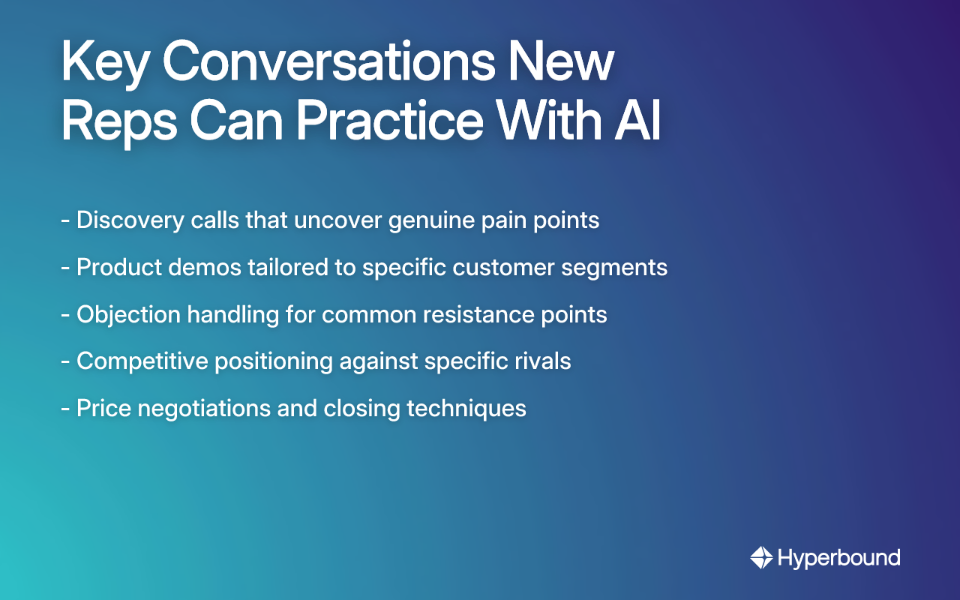
The platform's gamified learning approach and leaderboards keep motivation high while providing the repetition necessary for skill development. One company using this approach reduced their average ramp time from seven months to just under four by ensuring reps had mastered key conversations before engaging with real prospects.
In traditional onboarding, the quality of feedback a new hire receives depends entirely on their manager's availability, communication style, and subjective opinion. One manager might praise a discovery call while another critiques the exact same approach.
This inconsistency creates confusion about what "good" actually looks like. Worse, feedback often comes days after a call when details are no longer fresh, making it difficult for reps to connect feedback to specific moments in the conversation.
Hyperbound's AI Real Call Scoring eliminates subjectivity by analyzing and scoring every conversation—both practice and real customer calls—against predefined standards aligned with your sales methodology.
The platform provides data-driven insights on critical metrics like:
This ensures every rep receives consistent, high-quality feedback regardless of their manager's bandwidth. The system can integrate with existing call recording platforms or use its own recorder, automatically extracting key moments, objections, and buying signals through AI Deal Summary.
For new hires, this creates crystal clarity around expectations and performance standards, accelerating their path to competence.
Even the most dedicated sales managers face a fundamental limitation: time. With competing priorities and growing teams, managers simply can't provide the intensive, personalized coaching that new hires need during their crucial first months.
This challenge is especially acute for remote or distributed teams where managers can't simply walk the floor. The result? A growing gap between top and bottom performers, with struggling reps often falling through the cracks until it's too late.
Hyperbound's AI Coaching solves the scaling problem by providing every rep with immediate, personalized feedback after every call or practice session. The AI identifies:
This just-in-time coaching empowers reps to self-correct and improve continuously without waiting for manager availability. According to industry research, organizations implementing this kind of real-time coaching have seen revenue increases of up to 58%.
For managers, AI coaching doesn't replace their role—it elevates it. When managers do conduct coaching sessions, they can focus on strategic guidance rather than basic skill correction, making better use of their limited time.
Many companies use the same generic onboarding track for everyone from brand-new SDRs to experienced AEs. This approach fails to address individual skill gaps and learning styles. Equally problematic is the lack of clear milestones defining when a rep is truly "ready" to engage with customers.
"I wish my company had done better onboarding with clearer expectations," shared one sales rep on Reddit, expressing a common frustration.
AI enables structured, personalized learning journeys with clear, measurable certification criteria. Research shows that 93% of people believe personalized learning improves performance, making this a critical enhancement to traditional approaches.
With AI-powered onboarding, companies can create structured 30-60-90 day plans tailored to individual needs:
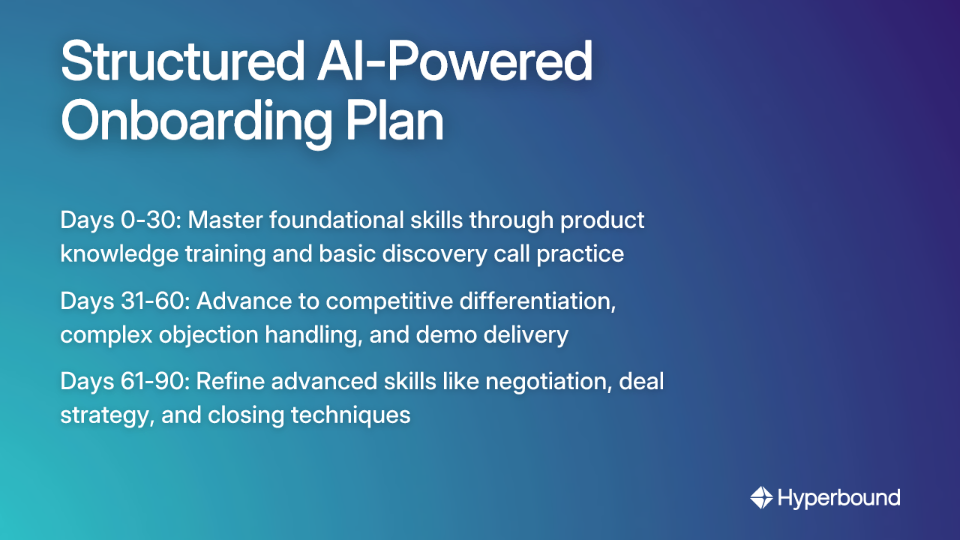
Certification becomes objective when based on AI scoring of both roleplays and live calls. Managers gain data-driven confidence in rep readiness, while reps get clear visibility into their progress and remaining skill gaps.
Perhaps the most fundamental mistake is viewing onboarding as a finite process that ends after 90 days. In reality, the market, products, and competitive landscape constantly evolve. When training isn't continuous, the team's skills quickly become outdated.
This problem affects both new and tenured reps. New messaging takes too long to implement, competitive responses lag behind market changes, and the initial investment in onboarding provides diminishing returns.
AI transforms sales enablement from a one-off event into an ongoing, agile process that adapts to changing conditions:
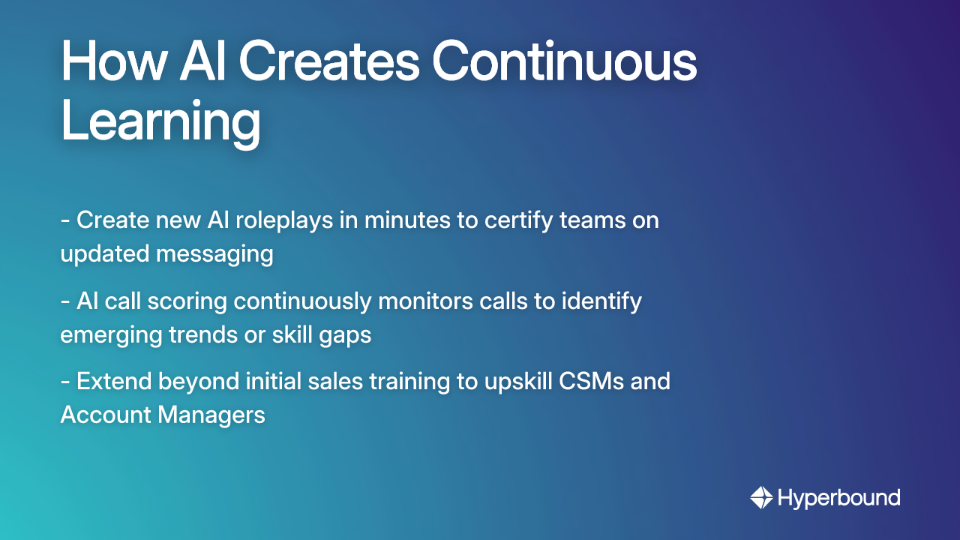
This continuous approach ensures that both new hires and veterans maintain peak performance regardless of market changes or role transitions.
These aren't just theoretical benefits. Leading companies are already seeing remarkable returns from AI-powered onboarding approaches.
Take Cognism, a B2B sales intelligence platform that implemented Hyperbound to transform their global onboarding program. The company faced challenges with inconsistent sales methodology adoption and lengthy ramp times for new reps.
By implementing AI roleplays for discovery calls, demo delivery, and objection handling, Cognism achieved:
"The ability to practice critical conversations until they become second nature has transformed how our new hires develop," noted their CRO. "Their first real customer conversations are now exponentially more effective."
The cost of poor onboarding extends far beyond the immediate impact of slow ramp times. It creates a ripple effect of missed quotas, damaged customer relationships, and ultimately, the loss of promising sales talent who might have thrived with the right support.
AI isn't just enhancing traditional onboarding—it's fundamentally transforming what's possible:
Organizations that embrace these AI-powered approaches aren't just reducing ramp time and improving retention—they're creating sustainable competitive advantages through consistently excellent sales execution.
AI-powered sales onboarding is a modern approach to training that uses artificial intelligence to create personalized, scalable, and data-driven learning experiences for sales representatives. It moves beyond traditional passive learning by incorporating tools like AI roleplay simulators for active practice, automated call scoring for objective feedback, and personalized coaching to accelerate skill development and reduce ramp time.
Traditional sales onboarding is often ineffective because it suffers from several key flaws: a lack of hands-on practice, inconsistent and subjective feedback from managers, unscalable coaching models, one-size-fits-all learning paths, and a failure to provide continuous training. These issues lead to longer ramp times, lower rep confidence, and higher employee turnover.
New sales reps can practice with AI using AI-powered roleplay simulators, such as those offered by Hyperbound. These tools provide a safe, risk-free environment where reps can engage in hyper-realistic conversations with AI buyer personas. They can practice discovery calls, objection handling, demo presentations, and negotiation skills as many times as needed to build confidence and mastery before interacting with real customers.
The key benefits of using AI in sales onboarding include significantly reduced ramp time, higher new hire retention rates, and more consistent sales performance across the team. By providing unlimited practice, objective feedback, and scalable coaching, AI helps reps reach quota faster. Companies like Cognism have seen up to a 40% reduction in time to quota attainment.
No, AI sales coaching is designed to augment, not replace, human sales managers. AI handles the task of providing immediate, consistent feedback on foundational skills after every call, freeing up managers from repetitive corrections. This allows managers to focus their limited time on higher-level strategic coaching, deal strategy, and career development.
AI is used for sales certification by providing objective, data-driven proof of a representative's readiness. Instead of relying on subjective manager opinions, AI platforms score a rep's performance in both practice roleplays and real customer calls against a consistent, predefined rubric. This creates clear, measurable milestones in their 30-60-90 day plan, ensuring they have mastered critical skills before advancing.
AI supports continuous learning by transforming sales training from a one-time event into an ongoing, agile process. When new products are launched or messaging is updated, leaders can create new AI roleplay scenarios in minutes to certify the entire team. Continuous AI call scoring also helps identify emerging skill gaps across the team, allowing for targeted training interventions long after the initial onboarding period is over.
Ready to stop losing top talent to outdated onboarding practices? See how Hyperbound transforms sales readiness and book a demo today.







Use Cases
Legal