
You've hired a great rep. They show up on day one energized, eager, and ready to crush quota. Then you hand them a 40-page onboarding doc and a folder of training videos — and you can almost watch the enthusiasm drain out of them in real time.
Sound familiar? You're not alone. As one sales enablement leader put it on Reddit: "New hires usually show up pumped, full of energy… but when you hand them a 40-page onboarding doc or training videos, their enthusiasm is gone."
The problem isn't motivation. It's the structure — or the lack of it.
The average sales ramp time sits at 5.7 months, costing companies up to 3x a rep's base salary in lost productivity and unrealized revenue. Without the right tools in place, it can take 12–18 months before a new hire generates a positive ROI. That's not a talent problem. That's a system problem.
This guide is built for sales enablement leaders who are serious about fixing it. We're not going to hand you a generic software roundup. Instead, we'll walk you through six functional categories of sales onboarding tools — what each one solves, what to look for, and which tools are worth your attention — and close with a practical look at how they fit together as an integrated stack. Because as any experienced RevOps leader knows, the big thing with enablement stacks is making sure tools actually talk to each other.
Let's get into it.
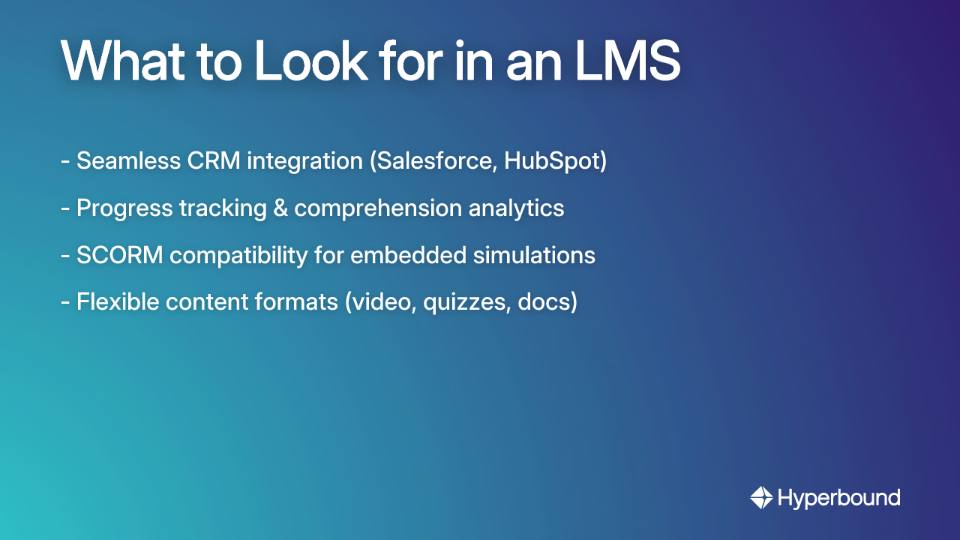
What it solves: Every rep deserves the same strong foundation. An LMS (Learning Management System) gives you a centralized, consistent source of truth for product knowledge, sales playbooks, processes, and company methodology. Without it, new hires waste their first weeks hunting down materials across Slack, Google Drive, and their manager's inbox — a fragmented experience that slows ramp and creates knowledge gaps you won't discover until a deal blows up.
What to look for:
Representative tools:
What it solves: Theory only gets reps so far. Call recording moves learning from the classroom to reality — capturing how your best reps actually handle disco calls, run demos, and navigate objections in the real world. It creates a living library of what "good" looks like, and gives enablement leaders raw material they can turn into targeted coaching playlists by role, deal size, or region.
Smart enablement teams create separate playlists for different deal sizes, regions, and call types so new hires can skip straight to what's relevant for their role — instead of wading through hours of calls that don't apply.
What to look for:
Representative tools:
What it solves: This is the category that actually moves the needle on ramp time, and it's the most underinvested layer in most onboarding stacks. Call libraries and LMS modules are passive. Reps watch, read, and nod — then freeze on their first live call because they've never actually practiced the conversation.
AI roleplay gives reps a safe environment to build muscle memory before touching live pipeline. They can practice cold calls, objection-handling, multi-stakeholder demo calls, and more — getting immediate feedback without burning a real prospect. It's the at-bats new reps desperately need, on demand, without pulling a manager into every session.
What to look for:
Recommended tool: Hyperbound Practice
Hyperbound Practice is the AI roleplay and practice simulation platform purpose-built to reduce sales ramp time. The critical differentiator: Hyperbound's AI buyer personas are trained on 2M+ hours of real B2B sales conversations — not generic scripts — which means the simulations feel like actual prospects, not customer service bots.
Key features for onboarding:
The outcomes speak for themselves:
Hyperbound integrates natively with Gong, Salesforce, HubSpot, Seismic, Highspot, Zoom, and MS Teams — making it a connective layer across your entire enablement stack rather than another isolated tool.
What it solves: The CRM is the central nervous system of your sales org. For onboarding specifically, CRM proficiency is a core competency — not just a nice-to-have. A rep who can't navigate your CRM confidently is a rep who's losing time to admin work, missing follow-ups, and giving you inaccurate pipeline data. Getting reps SFDC- or HubSpot-fluent early is one of the fastest ways to shorten the path to first won deal.
What to look for:
Representative tools:
What it solves: Call recording captures what was said. Conversation intelligence tells you what it means — at scale. It uses AI to analyze conversations across your entire team, surfacing which behaviors correlate with closed-won deals, where deals are quietly at risk, and what separates your top reps from the rest. For onboarding, it's how you identify exactly where a new rep is struggling without a manager sitting in on every call.
What to look for:
Representative tools:
What it solves: This is the "last mile" problem. You can have the best LMS, the most sophisticated call intelligence, and a best-in-class roleplay platform — and still see ramp times plateau if the coaching layer isn't working. Research shows managers only spend 5–8% of their time coaching, and that coaching is often inconsistent from manager to manager. Coaching orchestration tools synthesize signals from across your stack and proactively recommend what to coach, who to coach, and when — so managers stop guessing and start acting on real data.
What to look for:
Recommended tool: Kota Activate by Hyperbound
Kota is Hyperbound's AI Revenue Analyst — the orchestration layer that sits above both Hyperbound Practice and Hyperbound Perform. It synthesizes data from simulated call performance and real call scoring to recommend personalized coaching interventions at the right moment for the right rep. Instead of a manager spending hours digging through dashboards, Kota surfaces the answer: this rep is struggling with multi-threading — here's the Bitesized Roleplay to fix it, and here's the deal at risk because of it.
The most common objection we hear from RevOps leaders when evaluating new enablement tools is entirely valid: "We already have too many tools that don't talk to each other."
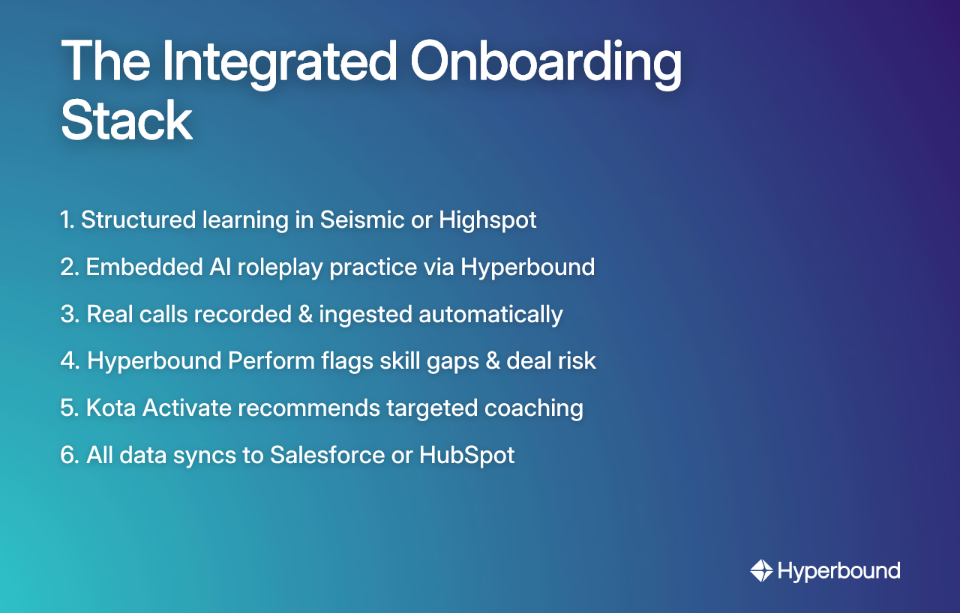
The good news is that the right stack isn't more tools — it's the right tools, tightly integrated. Here's what that looks like in practice:
The result is a continuous improvement loop — Score Real Calls → Identify Skill Gaps → Practice Roleplays → Score Real Calls again — that compounds over time and turns onboarding from a one-time event into an ongoing performance engine.
If you're serious about cutting ramp time, the tools exist to do it. The question is whether they're connected. Hyperbound integrates natively with Gong, Salesforce, HubSpot, Seismic, and Highspot — making it the connective tissue between the layers of your stack rather than yet another destination for reps to ignore.
Start with practice. Build from there.
The essential sales onboarding tools create an integrated system for learning, practice, and performance analysis. This typically includes a Learning Management System (LMS) for structured content, call recording and conversation intelligence platforms for real-world examples, a CRM as the central data hub, and an AI roleplay platform to build practical skills in a safe environment.
An integrated tool stack is crucial because it creates a continuous feedback loop that connects learning to real-world performance. When tools like your LMS, CRM, and AI practice platform "talk" to each other, you can identify a rep's skill gap on a real call and automatically assign targeted practice, tracking their improvement all in one system. This prevents knowledge silos and accelerates ramp time.
AI roleplay accelerates ramp time by giving new reps a safe, scalable way to practice real-world sales conversations before they engage with live prospects. This builds muscle memory for handling objections, pitching value, and navigating difficult calls. Instead of learning passively from videos, reps actively build confidence and competence, allowing them to become productive much faster.
Call recording simply captures sales conversations for later review. Conversation intelligence, on the other hand, uses AI to analyze those recordings at scale. It identifies key moments, tracks adherence to sales methodology, surfaces trends across the team, and provides data-driven insights into what behaviors lead to won deals, turning raw recordings into actionable coaching opportunities.
You can measure the effectiveness of your onboarding program by tracking key metrics like time-to-first-deal, time-to-quota-attainment, and conversion rates at each stage of the sales funnel for new hires. An integrated tool stack provides the data, allowing you to compare the performance of reps who have completed specific training and practice modules against those who haven't.
AI roleplay is designed to augment, not replace, manager-led coaching. It handles the repetitive, high-volume practice that managers often don't have time for, freeing them up to focus on higher-level strategy, deal reviews, and personalized mentorship. The AI provides the "at-bats," while the manager provides the "game plan."








Use Cases
Legal