
"We spent months on onboarding docs and playbooks in Notion. Literally no one looked at them after week one."
If that hits close to home, you're not alone. Sales leaders across the industry are running into the same wall: they invest heavily in building onboarding programs — knowledge bases, LMS courses, playbooks, shadowing schedules — and still watch new hires stumble on their first real calls, burn pipeline while learning, and take three months to hit quota when the business needs them productive in six weeks.
The problem isn't effort. It's architecture.
Most sales onboarding stacks are built around a single category of tool — usually an LMS or a content management platform — and expected to do the job of three. The result is a knowing-doing gap that no amount of documentation can close. Reps finish their LMS course, pass the quiz, and then freeze the moment a real buyer pushes back.
Here's the diagnosis: effective sales onboarding requires three distinct but interconnected layers working together.
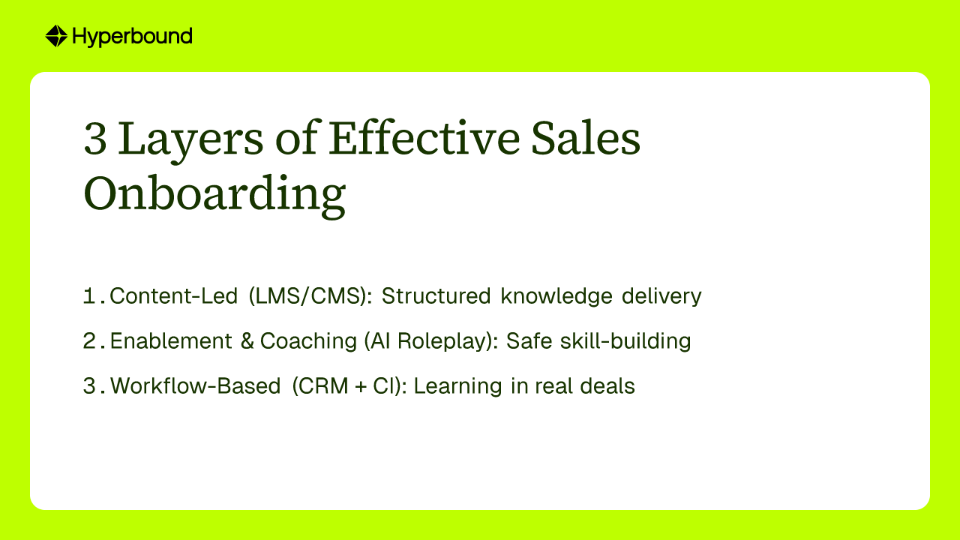
This article breaks down each category of sales onboarding tools — what it solves, where it breaks down, and what a real-world stack looks like. By the end, you'll have a decision framework for building an onboarding program that doesn't just inform reps, it activates them.
Content-led platforms are where most onboarding programs start — and for good reason. Tools like Seismic (Lessonly), Highspot, and Trainual give you a scalable, standardized way to deliver product knowledge, competitive positioning, compliance training, and sales methodology to every new hire in a consistent format.
For larger organizations with distributed teams, this layer is non-negotiable. Industry data shows that sales onboarding software reduces the time it takes to get new reps up to speed by centralizing training content and ensuring uniform knowledge delivery across the team. When a new SDR joins your team in London while most of your enablement team is in San Francisco, an LMS makes consistent onboarding possible.
The best platforms in this category — like Highspot — also combine content management with analytics, so you can see which modules are being completed and which are being skipped. Centralized playbooks, objection handling guides, and GTM content all find a home here.
Here's the uncomfortable truth: reps forget 80% of what they learn within 30 days if it isn't reinforced through active practice.
Research highlights the core limitation of content-led tools: "training occurs outside of live workflows." Reps complete modules in isolation, divorced from the actual conversations they'll need to navigate. They know the talk track. They can't yet use it.
This is the knowing-doing gap. It's why seasoned sales leaders say things like "less documenting, more reps." A new hire who has read every playbook but never practiced a cold call is still going to freeze when a prospect asks, "Why should I switch from your competitor?"
The verdict: LMS/CMS tools are essential as a knowledge foundation, but they're table stakes — not a complete onboarding strategy.
The practice layer is where knowledge becomes skill. Instead of passively consuming content, reps actively rehearse the conversations they'll have with real buyers — in a safe-to-fail environment where mistakes are learning opportunities, not lost pipeline.
This directly addresses one of the most-cited pieces of advice from practitioners: break onboarding into "small daily reps, short knowledge checks, objection handling prompts, quick product refreshers — delivered over a couple of weeks instead of all at once."
AI roleplay platforms make this scalable. Here's how the leading tools compare:
Hyperbound Practice — The most realistic AI roleplay platform on the market, and the entry point for every Hyperbound deployment. What sets it apart is that its AI buyer personas are trained on 2M+ hours of real B2B sales conversations, not generic scripts. That means reps aren't gaming a predictable bot — they're practicing against a dynamically responsive AI that sounds, objects, and deflects like an actual buyer.
Key capabilities include:
Mindtickle frames onboarding as a "readiness journey" with readiness scoring and simulated practice. It's a solid platform for structured programs, though some note it has "limited immersion in live calls."
Second Nature / PitchMonster — Both offer AI roleplay, but their simulations are based on generic scenarios rather than a company's real call data. This is a meaningful gap: reps quickly learn to "game the bots" when the AI isn't grounded in real buyer behavior. Hyperbound's training data specifically addresses this problem.
Practice without signal is inefficient. If you don't know where your reps are struggling on real calls, you can't assign targeted practice. You're guessing at skill gaps rather than diagnosing them from evidence.
The practice layer needs to be fed by real-world performance data to be truly effective — which is where the third category comes in.
The third layer embeds learning into the actual sales workflow. Rather than onboarding existing parallel to the job, it makes the job itself a learning environment.
This layer has two components:
The System of Record — CRM (Salesforce, HubSpot): Your CRM is where deal activity lives. CRM workflows can automate onboarding sequences, initiate tasks based on deal stage progression, and keep new hires focused on selling instead of getting lost in manual data entry. When a rep moves a deal to "Discovery Complete," the CRM can automatically surface the corresponding coaching prompt or next-step checklist. This is onboarding that scales with real activity.
The System of Intelligence — Conversation Intelligence: These tools analyze actual sales calls to surface coaching moments, identify objection patterns, and give managers visibility into what's happening in the field. For new hires, this means their early calls aren't just flying under the radar — they're being captured, analyzed, and used to accelerate learning.
Hyperbound Perform represents the next evolution of this layer. Unlike traditional conversation intelligence tools (like Gong or Chorus) that analyze calls in isolation, Perform connects behavior across the entire deal lifecycle — from first cold call to closing conversation. Its AI Deal Coaching looks across all touchpoints in an opportunity to surface what's helping or hurting the deal, and what to work on next.
Critically for onboarding, Perform automatically scores 100% of real calls against custom methodology scorecards and can recommend Bitesized Roleplays based on the specific skill gaps it identifies — closing the loop directly back to the practice layer.
Conversation intelligence tools are excellent at identifying problems. They're not built to fix them. A manager who sees that a new rep consistently struggles with economic buyer objections gets a clear diagnosis — but has no built-in mechanism to assign targeted practice, verify skill improvement, or confirm the rep is ready for the next deal.
This is the data-rich, action-poor trap. Without a practice layer connected to the performance data, the insight has nowhere to go.
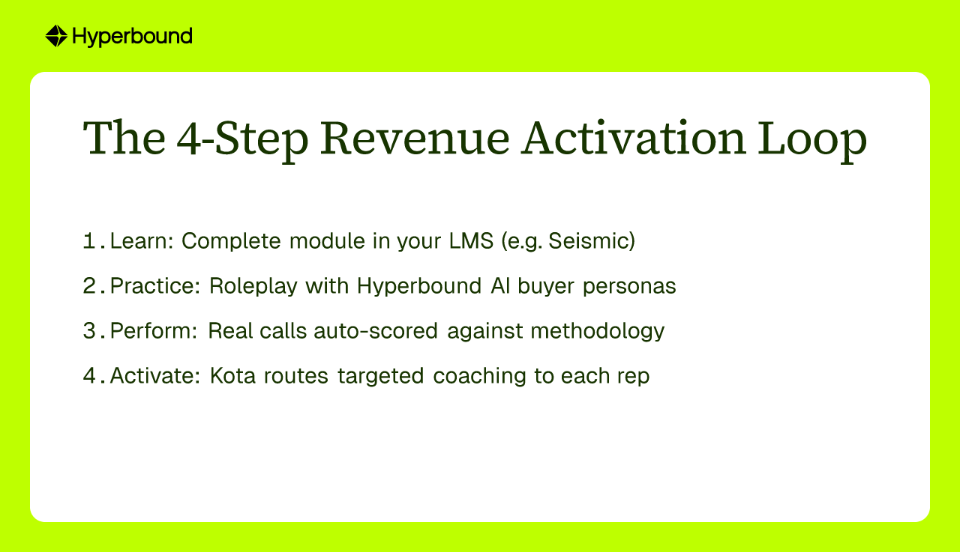
Here's what a fully integrated onboarding motion actually looks like:
This is what Hyperbound calls Revenue Activation — not just analyzing call data, but using it to change outcomes. The operational loop is continuous: Score Real Calls → Identify Skill Gaps → Practice Roleplays → Score Real Calls again. Kota Activate sits above Practice and Perform, orchestrating the interventions so the right coaching reaches the right rep at the right time.
No other platform natively connects the practice arena, real-call performance analysis, and AI-orchestrated coaching interventions in a single loop. Most teams are stitching this together manually — which means insights get lost, practice stays untargeted, and managers spend their coaching time on diagnosis rather than development.
The shift from "we have a lot of tools" to "our tools work together" is what separates a 90-day ramp from a 45-day ramp.
Nivoda, a global B2B diamond marketplace, used an integrated approach anchored by Hyperbound to transform how quickly new reps could generate pipeline. The results, as reported by Rob Rangel (Director of Sales Performance):
Reps weren't just completing training modules — they were practicing the specific conversations that drove demos, getting scored against real criteria, and entering live calls with confidence built from repetition, not theory.
For LinkedIn's sales organization, the challenge wasn't speed — it was scale. Deploying consistent onboarding quality across 3,000+ sellers across three business units (LinkedIn Talent Solutions, LinkedIn Sales Solutions, and Sales Dev) in both NAMER and EMEA is an infrastructure problem as much as a training one.
Alex Herrmann (Senior Program Manager at LinkedIn) used Hyperbound to standardize what "good" looks like across every team and region — ensuring that a new BDR in Dublin receives the same quality of practice and feedback as one in New York. That kind of consistency doesn't come from a playbook. It comes from a system.
The best sales onboarding tools aren't the ones with the most features — they're the ones that work together as a system.
When these three layers are connected through a platform like Hyperbound — where Practice feeds into Perform and Kota orchestrates the coaching loop — you stop fighting the knowing-doing gap and start closing it systematically.
Ramps get shorter. Win rates go up. And every rep carrying a quota has been activated, not just onboarded.
The "knowing-doing gap" refers to the common situation where new sales reps understand concepts intellectually but can't apply them effectively in live customer conversations. This happens when onboarding focuses too much on knowledge transfer (reading playbooks, watching videos) and not enough on practical application, causing reps to freeze or falter under pressure despite passing their training quizzes.
A traditional LMS or knowledge base is not enough because it only addresses the knowledge component of sales readiness, leading to the "knowing-doing gap." While essential for delivering foundational knowledge like product specs and sales methodologies, these platforms don't provide a safe environment for reps to practice conversations, handle objections, and build the real-world skills needed to perform in live deals. Reps often forget up to 80% of this information if it's not reinforced through active practice.
The three essential layers are Content-Led, Enablement & Coaching, and Workflow-Based.
AI roleplay helps new reps ramp faster by providing a scalable, safe-to-fail environment where they can practice real-world sales scenarios repeatedly. This allows them to build muscle memory for handling objections, navigating discovery calls, and articulating value propositions before they engage with actual prospects. Platforms like Hyperbound use AI buyers trained on real call data, ensuring the practice is realistic and directly prepares reps for the conversations that drive revenue.
The effectiveness of a sales onboarding program is measured by key business metrics, not just training completion rates. The most critical metrics include:
Conversation intelligence (CI) tools analyze sales calls to provide data and insights on what happened, such as identifying when a competitor was mentioned. AI coaching platforms, like Hyperbound, take this a step further by using those insights to activate change. An AI coaching system not only identifies a skill gap from a real call but also automatically recommends or assigns targeted practice (like an AI roleplay) to help the rep improve, thereby closing the loop between performance analysis and skill development.
Ready to build an onboarding program that actually drives revenue? Book a demo of Hyperbound and see how the full stack works together.









Use Cases
Legal