
Here's an uncomfortable truth most sales leaders already know but rarely say out loud: the average 30-60-90 day sales onboarding plan is a PowerPoint calendar, not a behavior-change program.
It tells new reps what to learn. It schedules product walkthroughs, compliance training, and CRM demos across tidy color-coded blocks. And then it does almost nothing to ensure those reps can actually do anything with what they've absorbed. There's no mechanism for deliberate practice. No objective measurement of skill transfer. No reinforcement loop. Just content consumption, fingers crossed, and a ramping quota that starts ticking anyway.
The results are predictable. New reps feel lost and overwhelmed without real guidance. They burn through their best leads while still learning. If your typical sales cycle is four to six months and onboarding only lasts four weeks, your new hire is disadvantaged from day one — set up not for success, but for a slow, demoralizing fail.
There's a better way.
Vanta, using Hyperbound as their sales onboarding platform of choice, cut their ramp time from 210 days to 72 — a 60% reduction — while scaling their BDR team 4x and generating 5x pipeline. That's not a marginal improvement. That's a fundamentally different approach to how you activate new talent.
This article is a practical playbook to help you build that system. Not a calendar. A three-phase coaching engine built around practice, measurement, and reinforcement — the three things most onboarding programs skip entirely.
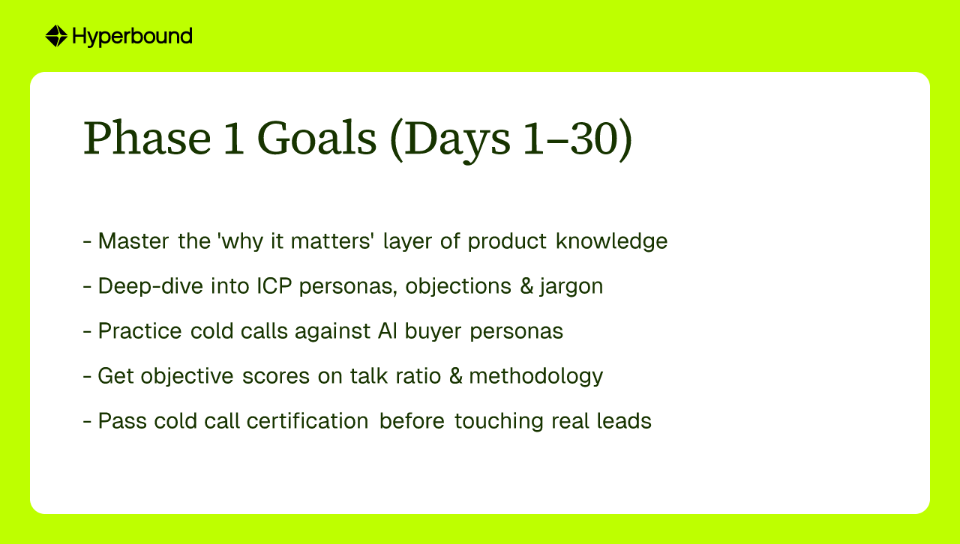
The goal of the first 30 days isn't for new reps to know more. It's for them to do something with what they know — and to prove it before they ever touch a real lead.
What this phase covers:
The operational mechanism: Hyperbound Practice
This is where most onboarding programs fall apart: they have no safe, scalable place for reps to practice. Shadowing helps, but it's limited by manager bandwidth. Generic roleplay scripts are gameable and don't mirror real buyer behavior.
Hyperbound's AI Roleplays are built from 2M+ hours of real B2B sales conversations — which means the AI buyer personas push back like actual prospects, not cooperative training dummies. Reps can run cold call simulations against their specific ICP personas, get scored on talk ratios, objection handling, and methodology adherence, and receive instant coaching feedback — without burning a single real lead.
After every session, AI Scorecards give reps clear, objective data on where they're improving and where they're not. This solves one of the most common complaints from new hires: ambiguity about how they're actually performing.
Phase 1 exit gate: Every rep must pass a cold call certification roleplay — scored against your methodology — before advancing to Phase 2. No exceptions. This turns onboarding from a time-based calendar into a competency-based system.

The second phase bridges the gap between simulated practice and live execution. Reps have passed certification — now they need to apply those skills with real prospects, under structured coaching, with objective measurement of what's actually happening on calls.
What this phase covers:
The operational mechanism: Hyperbound Perform
Once reps are on live calls, you need to measure what's actually happening — not based on gut feel or the one call a manager happened to sit in on. Hyperbound Perform automatically scores 100% of real customer conversations against the same methodology scorecards used in Phase 1 practice. That continuity matters: you can now see directly whether what was trained is being applied.
This solves a persistent problem for frontline managers, who spend only 5–8% of their time coaching and can't realistically evaluate rep performance outside of random ride-alongs. With AI Real Call Scoring, every manager has data-driven visibility into every rep — not just the ones they happened to shadow that week.
Perform also surfaces early deal risk signals by looking across all calls in an active opportunity — not just one conversation in isolation. If a new rep is consistently skipping budget discovery or losing momentum after the demo, that pattern shows up in the data before it costs you a deal.
Phase 2 exit gate: Reps should be consistently hitting activity targets (meetings booked, pipeline generated) and showing measurable week-over-week improvement in their real call scores. If scores are flat or declining, that's a coaching signal — not a wait-and-see situation.
By Phase 3, your reps have foundational skills certified and early real-world data in hand. Now the job shifts: build consistency, deepen advanced skills, and close the gap to quota. This is where onboarding stops being onboarding and starts becoming performance management — and the two need to connect seamlessly.
What this phase covers:
The operational mechanism: The full Hyperbound loop — Practice → Perform → Activate
Phase 3 is where the continuous improvement cycle fully activates. The loop runs like this: Score Real Calls → Identify Skill Gaps → Assign Targeted Practice → Score Real Calls Again. Each iteration tightens the gap between what a rep can do in simulation and what they execute in the field.
Kota Activate — Hyperbound's AI Revenue Analyst — sits above Practice and Perform, orchestrating this cycle. If Kota's analysis of a rep's real calls via Perform shows they're consistently losing ground on pricing conversations, it can recommend or assign a targeted AI roleplay focused specifically on budget objections. The rep doesn't get generic training — they get the exact practice they need, based on what their actual calls reveal.
This closes the loop that most sales onboarding platforms never even attempt to open: the connection between what reps practice, how they perform, and what that means for revenue outcomes. For VPs and CROs trying to pinpoint why win rates are stagnant, this is the system that surfaces the answer — and then does something about it.
Phase 3 exit gate: The rep has a healthy, progressing pipeline. Their real call scores reflect consistent application of your sales methodology. They're on a clear trajectory to quota — and if they're not, you have the data to show exactly why and what targeted intervention is needed.
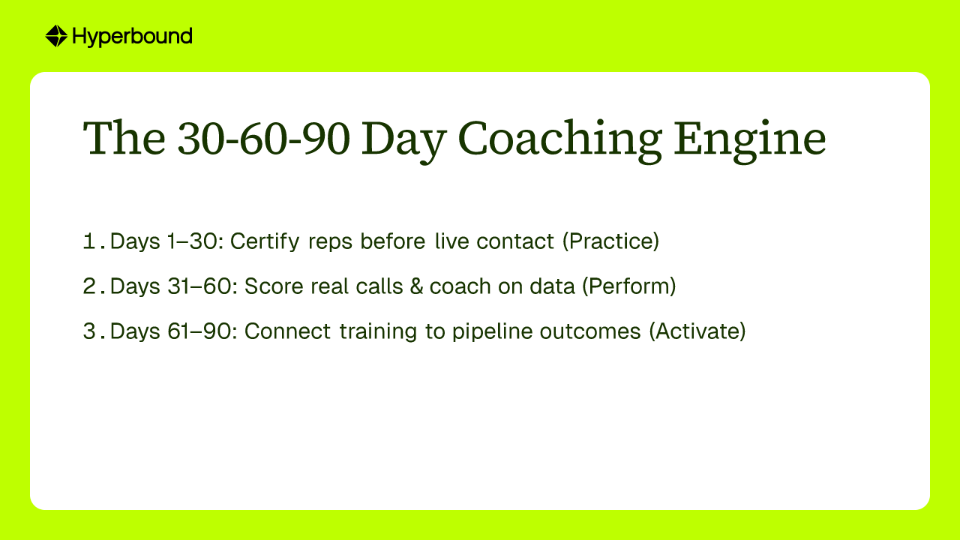
A high-performing 30-60-90 day sales onboarding program isn't a document. It's an operational loop:
The results this system produces are real. Vanta went from 210-day ramp to 72. Nivoda achieved a 50% ramp reduction, 2x revenue YoY, and a 150% increase in demo rates. Across Hyperbound customers, teams see 50% faster ramp times and 2x faster time to first won deal.
The difference isn't effort. It's architecture. Stop handing new reps a calendar and hoping the knowledge sticks. Build a system where every rep practices deliberately, performs measurably, and improves continuously — from day one through their first closed deal.
Ready to put this into practice? We've built a ready-to-use 30-60-90 day onboarding template with a week-by-week activity breakdown, key metrics for each phase, and built-in Hyperbound touchpoints mapped to Practice, Perform, and Activate.
No fluff. Just a working framework your team can implement next quarter.
A 30-60-90 day sales onboarding plan is a structured program designed to integrate new sales representatives into a company by setting clear goals and milestones for their first three months. Traditionally, these plans focus on knowledge transfer, scheduling activities like product training and CRM demos. However, the most effective modern plans are behavior-change programs that prioritize deliberate practice, skill certification, and performance measurement to ensure reps can apply what they've learned and ramp to full productivity faster.
Most 30-60-90 day plans fail because they are treated as simple content calendars rather than comprehensive coaching engines. They focus on what a rep should learn but lack mechanisms for deliberate practice, objective skill measurement, and continuous reinforcement. This leaves reps to practice on live leads, leading to inconsistent performance, longer ramp times, and a feeling of being overwhelmed without clear guidance on how they're truly performing.
A high-impact sales onboarding program is built on three key phases: foundational practice and certification (Days 1-30), coached real-world application (Days 31-60), and data-driven performance optimization (Days 61-90). The first phase focuses on certifying reps in core skills like cold calling in a safe, simulated environment. The second phase involves scoring 100% of their initial real customer calls to provide data-backed coaching. The final phase connects their conversational skills directly to pipeline and revenue outcomes, creating a continuous improvement loop.
You can measure the success of your sales onboarding program by tracking key metrics like time to ramp, time to first deal, and new hire quota attainment. Beyond lagging revenue indicators, you should also measure leading indicators of skill development. This includes tracking certification pass rates for core skills (like cold calling or demos) and monitoring the improvement of in-call performance scores on live calls. This gives you a real-time view of whether training is translating into on-the-job effectiveness.
AI plays a critical role in modern sales onboarding by providing a scalable way to practice skills, objectively measure performance, and deliver personalized coaching. AI-powered tools like Hyperbound offer safe, realistic roleplay scenarios against AI buyer personas, allowing reps to practice without risking live deals. AI can also analyze 100% of real customer conversations to score performance against a methodology, identify skill gaps, and automatically recommend targeted practice exercises, creating a data-driven coaching cycle that managers can't replicate manually.
You certify a new sales rep by having them consistently pass a structured roleplay simulation that is scored against your company's sales methodology. This process moves onboarding from a time-based schedule to a competency-based system. Instead of simply completing a training module, reps must demonstrate their ability to execute a successful cold call or discovery call in a simulated environment, ensuring a consistent standard of readiness before any real prospect is contacted.










Use Cases
Legal