
Here's something the sales training industry doesn't want to admit: most reps already know the objections they're going to hear. "It's too expensive." "We're happy with our current vendor." "I need to think about it." The problem isn't knowledge — it's instinct.
Research into how top-performing reps actually operate reveals a consistent pattern: they don't memorize a library of rebuttals. Instead, they've drilled a small set of high-leverage frameworks until those responses feel completely natural under pressure. Meanwhile, the rest of the sales floor is still fumbling through generic scripts that — as communities of experienced sales professionals have noted — feel "embarrassing" and "manipulative," damaging the trust they're supposed to be building.
The gap isn't knowing the techniques. It's the muscle memory to deploy them in the moment, authentically, without sounding like you're reading from a playbook. That muscle memory only comes from deliberate, repeated handling objections training — not from reading slides in a one-time onboarding session.
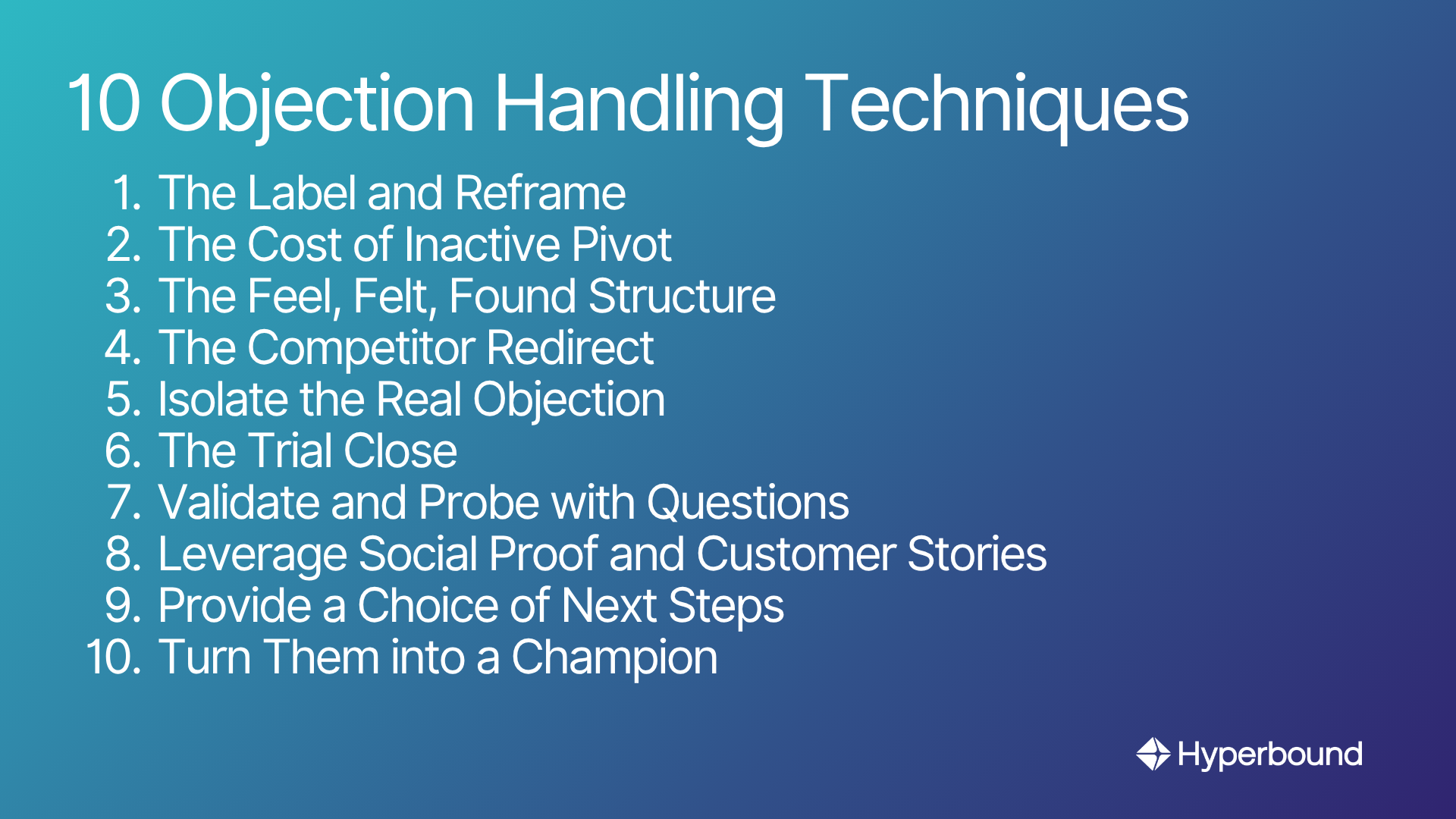
This article breaks down 10 proven techniques top reps use, with a real-call example for each. More importantly, it shows you exactly how to practice each one until it becomes second nature.
What it is: Acknowledge the prospect's concern by naming it (the label), which validates their feeling without agreeing with their conclusion. Then shift the conversation toward value by asking what success would actually look like.
Why it works: Sales conversations become adversarial when reps react defensively to objections. Labeling defuses that tension immediately.
Real-call example:
Prospect: "This seems really expensive compared to our current solution. "Rep: "Price is clearly a critical factor here, and I want to make sure we're looking at it the right way. What kind of ROI or efficiency gains would you need to see to make an investment like this feel like a home run for your team?"
💡 How to practice this: The 'Label and Reframe' has to be smooth and immediate — a half-second of hesitation makes it sound rehearsed. Use Hyperbound Practice's AI Roleplays to drill this against budget and pricing objections. The AI buyer personas are built from 2M+ hours of real B2B sales conversations, and AI Scorecards give you instant feedback on how well you validated before pivoting to value.
What it is: Shift focus from the cost of your solution to the tangible cost of not solving the problem — lost revenue, wasted hours, missed opportunities.
Why it works: "Not a priority right now" often means the pain hasn't been quantified. Making inaction expensive changes the frame entirely.
Real-call example:
Prospect: "I don't think this is a priority right now — our current process is fine. "Rep: "I get that. You mentioned your team spends about 15 hours a week manually chasing down data. By delaying a decision, that's over 700 hours of lost productivity in the next year alone. What could your team accomplish with that time back?"
💡 How to practice this: Run "urgency objection" scenarios in Hyperbound Practice where the AI is programmed to defend the status quo. The goal is to get comfortable with on-the-fly math and confident delivery — two things that only come from repetition.
What it is: A three-part empathy framework: validate their emotion ("I understand how you feel"), provide social proof ("Others felt the same way"), then share the resolution ("What they found was...").
Why it works: It builds rapport and de-risks the decision using third-party proof — without sounding pushy.
Real-call example:
Prospect: "I'm concerned this will be too disruptive for my team to adopt. "Rep: "I completely understand how you feel — change management is real. Many of our clients felt the same way initially. What they found was that our onboarding got their teams fully ramped in under two weeks, with a measurable productivity lift by the end of the first month."
💡 How to practice this: This framework sounds scripted if not delivered with the right tone and pacing. Use Hyperbound's AI Roleplays to practice until your delivery feels genuinely empathetic, not rehearsed. The platform's analytics track talk ratios so you know if you're turning a concise story into an accidental monologue.
What it is: When a prospect brings up a competitor, never attack. Acknowledge the competitor as a valid option, then pivot cleanly back to your unique differentiator.
Why it works: Attacking competitors signals insecurity and puts prospects on the defensive. Redirection shows confidence and keeps focus on your value.
Real-call example:
Prospect: "We're also looking at [Competitor], and their price point is lower. "Rep: "It makes complete sense you're evaluating them — they're a well-known player. A lot of customers who came to us had looked at them too, and what they told us was that post-sales support and dedicated success management were what actually determined their long-term results. How are you thinking about partnership in your evaluation?"
💡 How to practice this: Run competitive objection scenarios in Hyperbound Practice. You can simulate calls against AI personas programmed to favor specific competitors, forcing you to sharpen your redirect and articulate your differentiators cleanly under real pressure.
What it is: Before solving any objection, confirm it's the only thing standing in the way. Prospects often hide their true concerns behind surface-level smokescreens — especially around price.
Why it works: As experienced reps have noted, "You have to isolate the objection and get the prospect to agree that is truly the reason they are not moving forward." Otherwise you're solving the wrong problem.
Real-call example:
Prospect: "The price is just too high for us. "Rep: "I hear you on budget. Setting price aside for a moment — does our solution actually solve the problem you're trying to fix?" (pause for answer) "Okay. So if we could find a commercial structure that works for your budget, is this the platform you'd want to move forward with?"
💡 How to practice this: The dynamic nature of Hyperbound's AI Roleplays is built for this. Ask your isolating questions and see how the AI responds — it might agree and reveal a real blocker, or introduce a new objection, mimicking the complexity of a live call.
What it is: A low-stakes question, dropped throughout the call, that tests the prospect's buying temperature and builds micro-commitments. It confirms you're aligned before you ask for anything big.
Why it works: Waiting until the end of a call to gauge interest is a classic mistake. Trial closes give you real-time signal and keep the prospect engaged as a participant, not a passive audience.
Real-call example:
Rep: (After walking through a key feature) "Now that you've seen how this automates that entire process — how does that line up with what you were hoping to accomplish? "Prospect: "Yeah, that looks like exactly what we need. "Rep: "Good to hear. In your view, would this solve the efficiency problem you mentioned at the start of our call?"
💡 How to practice this: Use Hyperbound's Bitesized Roleplays to drill specific moments in a call where a trial close is appropriate. Try different phrasings to find what feels natural and test which questions get the most positive engagement from the AI persona.
What it is: Treat objections as requests for more information, not attacks to deflect. Validate the concern, then ask open-ended questions to uncover the real root cause.
Why it works: Active listening is one of the most cited gaps in objection handling. Reps who ask better questions turn potential arguments into collaborative discovery sessions — which is where trust is actually built.
Real-call example:
Prospect: "We don't have the bandwidth to implement a new tool right now. "Rep: "That's completely valid — implementation resources are always stretched. Could you walk me through what your team's top priorities are this quarter? I want to see if there's a way this actually accelerates one of those initiatives, rather than competing with them."
💡 How to practice this: Run scenarios in Hyperbound Practice where the AI gives vague or incomplete objections. Your goal: use probing questions to uncover specific underlying pain points. The AI Scorecard tracks how effectively you dig for new information versus accepting the surface-level answer.
What it is: When a prospect wants to "think about it," don't accept a dead end. Offer two positive, value-added options for what comes next. This shifts their thinking from a yes/no decision to a "which option" choice — and maintains deal momentum.
Why it works: "I'll think it over" is often code for "I don't know what happens next and I'm not ready to commit." Giving a clear choice removes ambiguity and keeps the door open.
Real-call example:
Prospect: "This is a lot to take in. I need some time to think it over. "Rep: "Of course — it's an important decision. To help with your review, what would be more valuable right now: a one-page summary focused on the specific ROI we discussed, or a brief 15-minute call with one of our product specialists to answer your team's technical questions?"
💡 How to practice this: Use Hyperbound's AI roleplays to drill closing moments and next-step conversations. Repetition here is especially important — this is the part of the call where reps most often lose their confidence and let the prospect off the hook.
What it is: When a prospect says "I'm not the decision-maker," don't just ask for an introduction. Equip them to sell on your behalf by finding out what their executive cares most about, then giving them the exact materials to make that internal case.
Why it works: Your champion will sell your solution without you in the room. The quality of that conversation determines whether your deal advances or stalls — and you can influence it.
Real-call example:
Prospect: "This all sounds great, but I'll need to get my VP's sign-off. "Rep: "That makes total sense. To help you prepare for that conversation — what do you think will be the single most important outcome for your VP? I can put together a one-pager focused specifically on that metric so your business case is as tight as possible."
💡 How to practice this: Use Hyperbound's Multiparty Roleplays to simulate complex buying scenarios. Practice speaking with an AI champion while anticipating the concerns of an AI economic buyer who isn't on the call — training you to equip your internal advocate with exactly what they need.
Knowing these 10 techniques is the easy part. The real challenge is deploying them fluently, in the right moment, on a live call with a real prospect — without pausing to think about which framework applies.
That only happens through consistent, deliberate practice. Not a quarterly workshop. Not a one-time onboarding session. A repeatable cadence that keeps these skills sharp and turns handling objections training from a one-time event into an ongoing habit.
Top reps treat objection practice the same way athletes treat drills: short, specific, and frequent. They isolate one technique, run it against realistic pressure, get immediate feedback, and repeat. Over time, the responses stop feeling like techniques and start feeling like instincts.
The platform purpose-built for this kind of practice is Hyperbound. Hyperbound's AI roleplays are trained on 2M+ hours of real B2B sales conversations — not generic scripts — so the AI buyer pushes back the way actual prospects do. After every session, AI Scorecards deliver instant, objective feedback on talk ratios, key selling moments, methodology adherence, and exactly where you lost the thread.
The results speak for themselves: Vanta cut ramp time by 60% — from 210 days down to 72 — while growing their BDR team 4x. Nivoda increased their demo conversion rate by 150% and doubled revenue year-over-year. These aren't outcomes from better scripts. They're outcomes from reps who practiced until the right response became automatic.
If your team is still practicing on live deals, it's time to change that. See how Hyperbound Practice works — and start turning these 10 techniques into muscle memory.

The most effective objection handling technique is not a single script, but a framework that validates the customer's concern before reframing the conversation. While methods like "Label and Reframe" or "Feel, Felt, Found" are powerful, the best approach depends on the context. The key is to first listen, understand the root of the objection, and respond with empathy rather than a defensive rebuttal. This builds trust and turns a confrontation into a collaboration.
You can practice objection handling without risking live deals by using AI-powered sales roleplay platforms. Tools like Hyperbound create realistic, risk-free environments where you can drill specific objections against an AI buyer. This allows you to build "muscle memory" and receive instant, data-driven feedback on your performance, something that is impossible to get from practicing on actual prospects.
Traditional objection handling scripts often fail because they sound rehearsed, inauthentic, and can feel manipulative to modern buyers. Prospects can easily detect a canned response, which damages trust. The goal is not to memorize a library of one-liners, but to internalize flexible frameworks that can be adapted to any conversation. This allows you to respond naturally and empathetically, keeping the focus on the customer's problem rather than on your script.
The best way to handle the "it's too expensive" objection is to first isolate it to confirm price is the true blocker, and then pivot the conversation from cost to value and ROI. Use a technique like "Isolate the Real Objection" by asking, "Setting price aside for a moment, does our solution solve the problem you're facing?" If yes, you can then reframe the discussion around the cost of inaction or the potential return on investment, making the price seem less like a cost and more like a strategic investment.
Mastery in handling sales objections is achieved through consistent practice over time, not a one-time training session. While you can learn the techniques in a day, building the instinct to use them effectively under pressure takes deliberate, repeated practice. Top performers often dedicate time each month to roleplaying and refining their skills. With AI practice tools, reps can accelerate this process significantly, with some teams seeing major improvements in performance and confidence in a matter of weeks.
When a prospect says they need to "think about it," you should maintain control of the sales process by providing a choice of clear, value-added next steps. This common stall often means the prospect is unsure what to do next. Instead of accepting the vague timeline, offer two concrete options. For example: "To help you think it over, would you prefer I send a one-page ROI summary, or would a brief call with a product specialist to answer technical questions be more helpful?" This shifts the decision from "yes/no" to "which option," keeping the deal momentum alive.










Use Cases
Legal