
You've seen the leaderboard. Maybe you've even built one. A screen in the corner of the office (or a Slack post every Monday morning) showing who's on top, who's in the middle, and who's quietly hoping nobody notices their name near the bottom.
And if you've ever been on a sales floor, you've probably heard the grumbling too. One Reddit user put it bluntly: "Personally I find this shit demeaning. It just screams 'dance monkey dance' to me." Another asked the question that should make every sales leader pause: "Is this really how you will add any significant value to your team? A leaderboard tool with gamification? Is this it?"
Here's the hard truth: for most teams, that's exactly it. The scoreboard is the whole strategy.
But it doesn't have to be.
There's a meaningful spectrum when it comes to sales leaderboard software — and most tools cluster at one end of it.
Scoreboard-Only tools track lagging indicators — calls made, deals closed, quota percentage — and rank reps accordingly. They tell you who is winning. They offer zero insight into why, and nothing to help the reps who are losing actually improve.
Scoreboard + Skill Development platforms do something fundamentally different. They tie rankings to behaviors, identify the specific skill gaps behind the numbers, and give reps a concrete path to improve. The competition becomes a vehicle for growth — not just a weekly reminder of where you stand.
The business case for the latter is clear. Only 25% of sales organizations actually measure the leading indicators — the behaviors and skills that actually predict revenue — which means most teams are flying blind on what's causing their numbers. Meanwhile, Accenture research shows companies can expect a $4.53 return for every $1 spent on effective sales training. The teams that connect performance visibility to skill development are the ones compressing ramp time, increasing quota attainment, and moving win rates.
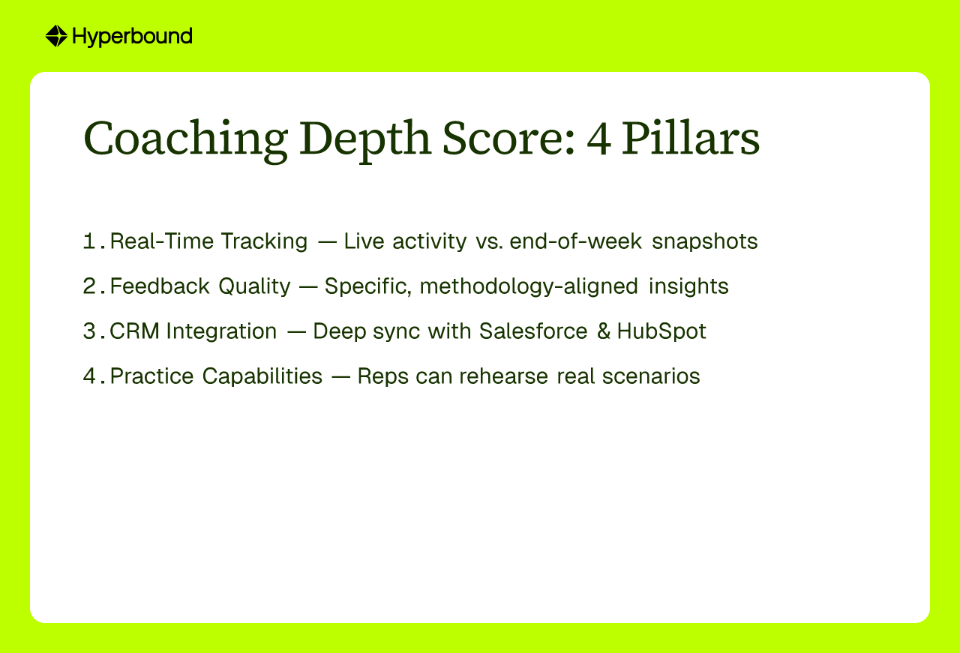
To move beyond surface-level feature comparisons, every tool in this list was evaluated on a Coaching Depth Score from 1 to 5, across four pillars:
With that framework in place, here are the 7 best sales leaderboard software tools — ranked by coaching depth.
Hyperbound is the only platform on this list built from the ground up around the idea that a leaderboard without a coaching loop is just noise. Where most tools stop at showing rankings, Hyperbound connects gamified leaderboards directly to the behaviors reps need to change — and then gives them the tools to actually change them.
The core model is a continuous loop: Practice → Perform → Activate. Reps practice conversations with AI buyers before deals happen. Real call performance gets scored and analyzed. Skill gaps surface automatically. And then targeted practice is assigned to close those specific gaps — not a generic training curriculum, but a 5-minute roleplay triggered by what went wrong on that call.
Real-Time Tracking (5/5): Hyperbound Perform analyzes live deal activity across all calls in a deal — not just individual conversations in isolation — surfacing behavioral patterns and deal-level risks while there's still time to act.
Feedback Quality (5/5): After every roleplay, Hyperbound Practice delivers AI Coaching that's methodology-aligned, flagging missed opportunities, weak objection responses, and off-track messaging. It's specific enough that reps actually know what to do differently. Managers get the same clarity on their team's real calls without listening to hours of recordings.
CRM Integration (5/5): Deep integrations with HubSpot and Salesforce, including Auto-CRM Fill that captures deal data from real calls automatically — with rep review before it's pushed, which matters for adoption.
Practice Capabilities (5/5): This is where Hyperbound separates from every other tool in this category. The AI buyer personas are trained on 2M+ hours of real B2B sales conversations — not generic scripts. That directly addresses the skepticism that AI roleplay "sounds like a robot." Bitesized Roleplays let tenured reps practice specific scenarios in under 10 minutes, making it something senior reps will actually use. Gamification leaderboards track roleplay scores and skill improvements, so the competition is about getting better, not just making more calls.
The ROI case for VPs and CFOs:
Gong is a widely-used conversation intelligence platform. It excels at analyzing real calls, surfacing deal risks, and giving managers a window into what's actually happening in the field. CRM integration is deep, feedback quality is strong, and the real-time tracking of deal activity is well-regarded.
The gap: Gong is, as one description puts it, "a giant library of data." It identifies problems with precision. But it doesn't close the loop between insight and action. There's no native practice environment where reps can work on the specific skills Gong flags. You need a separate tool — or a coaching calendar that never gets prioritized — to turn those insights into skill development.
Both platforms are powerful sales engagement tools that have expanded into conversation intelligence and basic coaching features. They track activity metrics well — dials, emails, meetings booked — making them functional leaderboard tools for top-of-funnel performance visibility. CRM integration is solid, and call recording with some analysis is available.
What's missing is the qualitative depth. The feedback skews quantitative rather than behavioral, and there's no deliberate practice capability. If a rep is struggling with discovery calls, there's no path inside either platform to actually improve that skill.
Ambition sits firmly in the "Scoreboard-Only" category — and it does that job well. It's built for sales performance management: highly customizable leaderboards, contests, and TVs broadcasting team rankings in real time. Integrates with CRM and call data sources, and excels at creating healthy competition around personal targets.
But the ceiling is low when it comes to coaching depth. Ambition shows you the score. It doesn't help you improve your swing. There's no feedback on why a rep is underperforming, and no practice environment to address it. It's a motivational tool, not a skill development platform — which means it can inadvertently create the exact dynamic that frustrates sales reps most: knowing they're behind with no path forward.
Hoopla's strength is visibility and celebration. Broadcast wins across the office (or to remote teams), display real-time rankings on TVs and dashboards, and create an energetic competitive environment. For teams that need morale and recognition baked into the culture, it does the job.
Like Ambition, the coaching depth essentially stops there. There's no call analysis, no behavioral feedback, and no practice layer. As a sales leaderboard software tool, it's excellent at the social and motivational dimension — but the question "what should I do differently?" gets no answer.
Built natively on Salesforce, LevelEleven is a clean solution for teams that live in that ecosystem. It's effective at turning CRM data into leaderboards, contests, and performance-against-target dashboards. For organizations that want gamification tied tightly to their existing Salesforce workflows, it's a low-friction option.
The coaching functionality is primarily managerial — dashboards and contest tracking rather than skill analysis or practice. It shows reps where they stand relative to their goals, but the path from "I'm behind" to "here's what I need to improve" isn't built in.
The baseline. Every sales team already has this: a report, a dashboard, a static view of who closed what. It's free, it's already there, and it tells you the score.
That's all it tells you. No activity-level tracking, no qualitative feedback, no integration with coaching workflows, and certainly no practice capabilities. This is the floor — the thing every other tool on this list is trying to improve upon. If your leaderboard strategy is still a HubSpot report pinned to a Slack channel, the good news is there's a lot of room to move.
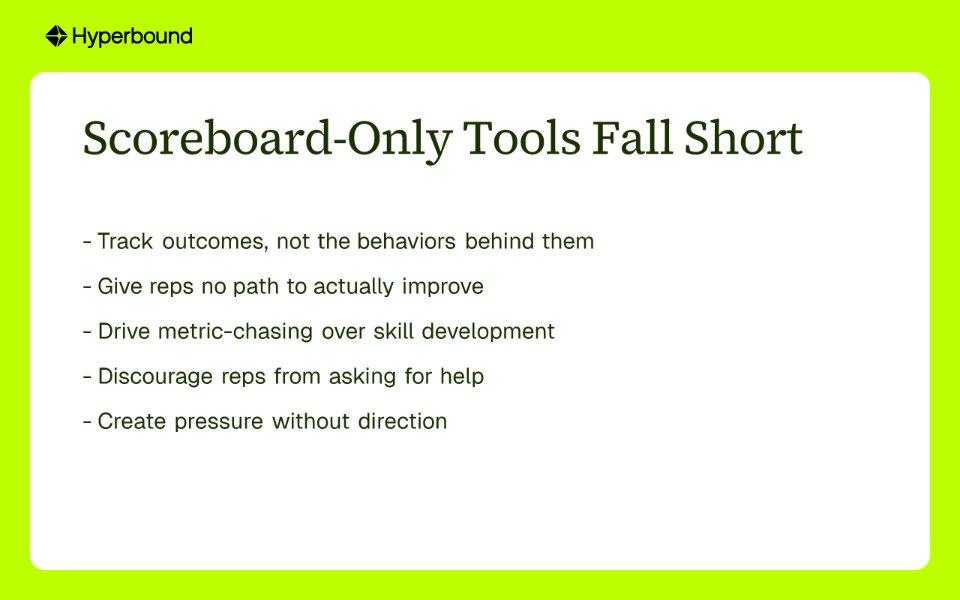
One observation from the sales community captures the core risk well: "If you focus too much on games and competition, people don't know how to prioritize time and projects and are less likely to ask for help and work together as a team."
Leaderboards that only track outcomes can drive exactly the wrong behavior — reps chasing the metric rather than developing the skill, and keeping their struggles private rather than seeking coaching. The fix isn't removing the leaderboard. It's making the leaderboard about improvement, not just rank.
The best sales leaderboard software tools tie the ranking to behaviors — and then create a feedback loop that helps reps move up by getting genuinely better. When the leaderboard tracks roleplay scores, skill certifications, and coaching completions alongside quota attainment, the competition stops being a source of pressure and starts being a source of direction.
The tools that drive real revenue outcomes — faster ramp, higher quota attainment, better win rates — aren't the ones that show the prettiest rankings. They're the ones that answer the question every rep at the bottom of the leaderboard is actually asking: "What do I need to do differently?"
If your current sales leaderboard software can't answer that question, it's time to raise the bar. Evaluate your stack through the lens of coaching depth — and look for tools that close the loop between insight and action. That's where revenue activation actually happens.
The biggest problem with most sales leaderboards is that they are "scoreboard-only," meaning they only track outcomes like deals closed but offer no insight into why reps are succeeding or failing. This approach can create pressure and demotivate reps who are struggling because it highlights their low rank without providing a clear path to improve their performance.
Sales leaders should focus on skill development because it addresses the root cause of performance issues, leading to more sustainable revenue growth. While tracking lagging indicators (metrics) tells you who is winning, focusing on leading indicators (skills and behaviors) tells you how they are winning. This allows you to replicate success across the entire team, reduce ramp time, and increase overall quota attainment.
The "Coaching Depth Score" is a metric used in this article to evaluate sales software based on its ability to facilitate actual skill improvement, not just display rankings. It matters because it shifts the focus from vanity metrics to tangible coaching value, assessing tools on real-time tracking, feedback quality, CRM integration, and practice capabilities. A higher score indicates a tool that helps reps get better, not just one that tells them where they stand.
AI improves sales coaching and practice by providing scalable, personalized, and objective feedback. For example, AI tools can analyze every sales call to identify specific skill gaps, and AI roleplay simulations allow reps to practice handling objections or navigating difficult conversations in a safe environment. This provides targeted, on-demand practice that closes the loop between identifying a weakness and actively improving it.
The main difference is that Hyperbound closes the loop between insight and action, whereas Gong primarily provides the insight. Gong is excellent at conversation intelligence—analyzing calls to identify what needs to improve. Hyperbound takes the next step by providing a built-in AI practice environment where reps can actively work on the specific skills and scenarios identified from those calls, turning analysis into tangible skill development.
To motivate your whole team, shift your leaderboard's focus from tracking only outcomes (like revenue) to rewarding improvement and the behaviors that drive results. This means creating a "skillboard" that celebrates progress, such as completing practice roleplays, earning skill certifications, or improving call scores. When reps see a direct path to move up the rankings by getting better, the leaderboard becomes a tool for growth and direction rather than a source of pressure.








Use Cases
Legal