
The persona guide is in Notion. The messaging deck is in Drive. The sales methodology lives in a PDF that enablement maintains. The battlecards are in a content platform that reps stopped opening six months ago. The competitive intelligence from last quarter sits in a Slack thread no one can find.
This is a governance problem in sales knowledge management, and that problem has been building for years.
Platforms like Showpad and Highspot primarily solve the distribution layer. As of this writing, they give reps a place to find current assets. What they do not solve is the layer beneath: who owns the core message, which version is authoritative, and how any system, human or AI, knows which piece of knowledge applies in a given situation. PitchKitchen identifies the same gap: most sales enablement platforms assume the message is already decided. They are distribution tools rather than governance layers.
The result is a knowledge base with no home and no single version of the truth.
Knowledge drift is the gap between what a knowledge base records and what is actually true. It accumulates incrementally, one stale document at a time.
According to Slite's research on knowledge drift, fewer than one in twenty documents in a paid knowledge base is updated in a given month. Silent decay is the norm. A methodology guide written eighteen months ago still ranks first in search. The persona framework a departed rep built still circulates in onboarding decks. Nobody flags it as wrong because nobody owns it.
Ownership is the structural failure underneath all of this. When a document has a clear owner, it is maintained. When that person leaves, the document becomes an orphan. Unclear ownership is a direct cause of stale content and lost rep trust. Once a knowledge base contains an error, a trust-collapse loop begins. Reps stop checking the official source, fall back to Slack DMs, and ask the senior closer instead of consulting the wiki. Institutional memory fragments further. Declining trust accelerates decay, and decay deepens the trust problem.
This is the state most sales teams are already in before AI enters the picture.
AI amplified knowledge drift into a structural condition.
The mechanism is straightforward. A rep building a new email sequence opens an AI tool and describes the requirement. To provide context, the rep copies a section of the messaging deck, paraphrases positioning points from the PDF, and pastes a competitor comparison from an older battlecard. The output is plausible and immediately useful, and it is saved to Drive.
A week later, a colleague follows the same process with a different section of the messaging deck, interprets a positioning point differently, and omits the competitor comparison because the battlecard cannot be located. The output is also plausible and saved.
Over a quarter, a workspace accumulates several interpretations of one methodology, each generated from a slightly different reading of the source material, with no trail back to any original document. AI raised write velocity without raising review velocity, and the delta between those two is the drift.
This produces two compounding failure modes. The first is knowledge drift: one wrong document gets inherited and re-served by every subsequent AI output. The second is context drift: AI agents reason over stale or conflicting definitions with no error signal. The agent does not know the messaging deck it is drawing from is three versions behind. It treats every document it can access as equally authoritative. The result is confident, fluent, and wrong.
After a quarter of AI-assisted content creation, five different answers to a basic positioning question are the predictable outcome.
The internal cost is substantial: reps search Drive for the right deck, enablement fields the same questions in Slack, and new hires onboard from documents that contradict each other. The external cost is becoming larger.
Gartner projects that by 2028, 90% of B2B buying will be intermediated by AI agents, with more than $15 trillion in B2B spend flowing through AI agent exchanges. Buyers will increasingly rely on AI systems to research vendors, compare options, and surface recommendations. Those agents will read whatever the organization's systems surface. If those systems surface four conflicting interpretations of the methodology and a persona guide that has not been updated in two years, that becomes the input those agents use.
Adobe Digital Insights data shows AI-referred visitors already convert 31% better than those arriving from paid search, email, or organic. The quality of what AI agents can access and reason over directly affects conversion.
Bolting a new AI tool onto the existing stack does not solve this. Every seam between a point solution and the underlying system is a governance gap. Adding agents on top of fragmented content multiplies errors at scale rather than containing them. The problem is an unowned layer of truth rather than a missing tool.
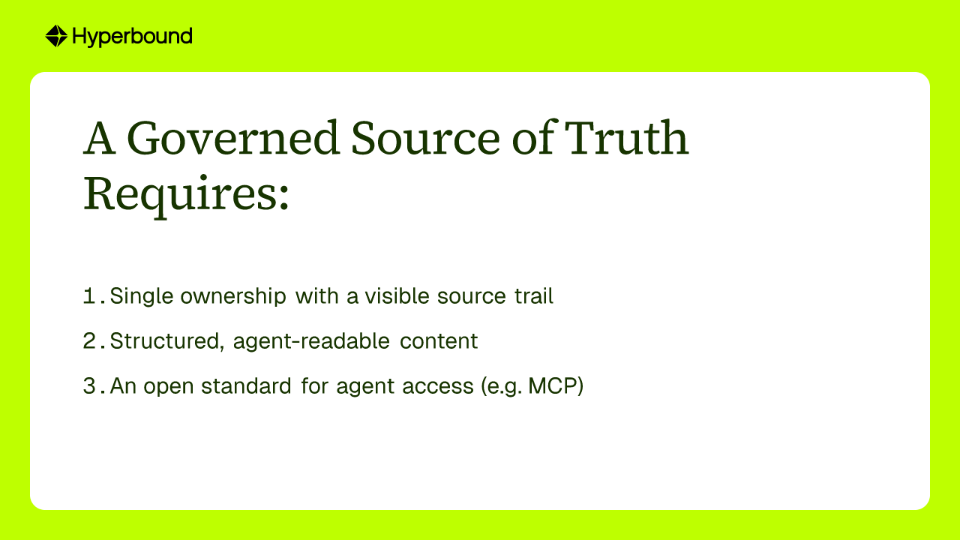
The solution is a single governed source that both humans and AI agents can read, query, and trust, rather than another asset library.
Three requirements follow from that:
These requirements describe a category: agentic content management. An agentic content management system is one where AI agents act on structured content, workflows, and connected systems to execute full operations under human governance, rather than only generating or suggesting content. The differentiator is action, not generation.
Kota CMS is Hyperbound's answer to this requirement. It is the knowledge layer behind Hyperbound, the Revenue Activation Platform: a governed source of truth built for both human teams and AI agents. It grounds the AI roleplays, deal-level coaching, and orchestrated interventions the platform runs, so the same verified knowledge feeds what reps practice and what they see mid-deal. It addresses the sales enablement content management gap that distribution platforms leave unresolved.
The consistency the Revenue Activation loop depends on starts here: structured content that agents can query reliably, under human oversight, from a single maintained source. That is what Kota CMS provides, and what lets Hyperbound's Practice and Perform layers turn governed knowledge into behavior change.
Kota CMS is available as a paid add-on in private preview. To request access, contact your Hyperbound account manager.
Private preview capabilities, scope, and availability are subject to change as we continue development and incorporate customer feedback.
Sales teams face a content governance shortage rather than a content shortage. The persona guide exists. The methodology exists. The battlecards exist. What does not exist is a single version of any of them with a named owner and a visible trail back to the source.
That gap was always a cost. It became a structural risk the moment AI started generating resources from those documents at scale.
The path forward is to treat sales knowledge as a governed asset rather than a collection of files. Assign ownership to every core knowledge document. Establish a single authoritative version of the narrative, the vocabulary, and the methodology. Then ensure that governance layer is structured and queryable, so that both reps and AI agents read from the same source when they build, respond, or decide. If your content is scattered across Notion, Drive, and SharePoint today, our guide to connecting those sources to your sales AI and the five-step content audit cover the first moves.
The question for enablement and revenue operations teams is direct: if an AI agent were to generate a battlecard for your top competitor today, which document would it draw, who owns that document, and when was it last verified?
If those three questions do not have clear answers, the drift has already started.
Knowledge drift is the gap between what a sales knowledge base records and what is actually true within the organization. It is caused primarily by stale, unowned documents and unclear version control, and it erodes rep trust until the official source is abandoned in favor of Slack DMs and tribal knowledge.
AI accelerates drift by increasing write velocity without increasing review velocity. Reps or AI tools create new content from different versions of messaging decks, personas, or battlecards, producing multiple plausible interpretations with no trail back to an authoritative source.
Sales enablement content governance is the system of ownership, version control, and distribution rules that determines which sales documents are authoritative and how both humans and AI agents should use them. It is the layer that prevents conflicting versions of the company narrative, persona definitions, methodology, and competitive intelligence.
Agentic content management is a category of content management system where AI agents act on structured content, workflows, and connected systems to execute operations under human governance, rather than only generating or suggesting content. The key differentiator is action, not generation.
The Model Context Protocol (MCP) is an open standard that allows AI agents to discover, query, and act on structured content. It is a universal connector between governed content sources and the AI agents that need to use that knowledge in sales, support, or buying contexts.
Sales teams can stop AI knowledge drift by assigning a named owner to every core knowledge asset, maintaining a single authoritative version with a visible source trail, structuring content so it is agent-readable, and exposing it through an open standard such as MCP rather than custom integrations.
Traditional sales enablement platforms primarily solve distribution, giving reps a place to find current assets. An agentic CMS solves the governance layer underneath: ownership, authoritative versions, structured content, and open agent access, so both humans and AI agents work from the same trusted source.
Kota CMS is the knowledge layer behind Hyperbound's Revenue Activation Platform. It is a governed source of truth for sales knowledge: structured, queryable content that AI agents can act on under human oversight. It lets teams reduce content drift and gives every agent the same verified knowledge to read and apply.








Use Cases
Legal