
Pick two or three behaviors, not twenty. Define each one as something a manager can identify on a call recording, not a trait such as "confidence" or "energy." Inspect for those behaviors every week for the next four weeks. Route practice only to the reps who are not yet demonstrating them. This sequence works because it matches how skills are built: through inspection, repetition, and targeted correction, not through a keynote.
The kickoff delivers alignment and morale. This article assumes the event is already planned; if you are still building the agenda, start with this sales kickoff planning guide and come back here for the part after the closing dinner. A typical sales kickoff (SKO) consumes about three of a rep's roughly 250 selling days a year, yet it is the single largest bet most revenue organizations place on changing how their team sells. In 2026, a fully loaded B2B SaaS SKO runs $1,500 to $3,500 per attendee, which puts a 100-rep organization at $150,000 to $350,000 for three days. That expenditure buys alignment and morale; neither moves a win rate. The four weeks after the closing dinner determine whether that spend changes CRM behavior or produces no measurable change.
Most SKO agendas are built around information transfer rather than skill-building. CEO keynote, product roadmap, partner panel, awards dinner: that lineup delivers alignment and morale, neither of which is behavior change. Reps return to their desks Monday with the intent to sell differently. By Friday, the CRM looks as it did the week before the event.
The reason is not lack of effort. skills, unlike knowledge, require practice, feedback, repetition, and psychological safety, none of which a stage and a slide deck can create. A rep can understand a new discovery framework fully and still default to the old habit on a live call, because the new pattern has not been practiced under real conditions yet. Without a structured coaching system, training fades and performance stalls. The cost of skipping reinforcement appears in performance metrics roughly 60 days after the closing dinner.
An event SKO is a schedule of keynotes, roadmap updates, and breakout panels. It produces alignment and morale and stops there. A behavior SKO assesses execution gaps before the event, runs coached practice during it, and sustains the change through structured 30/60/90-day reinforcement afterward.
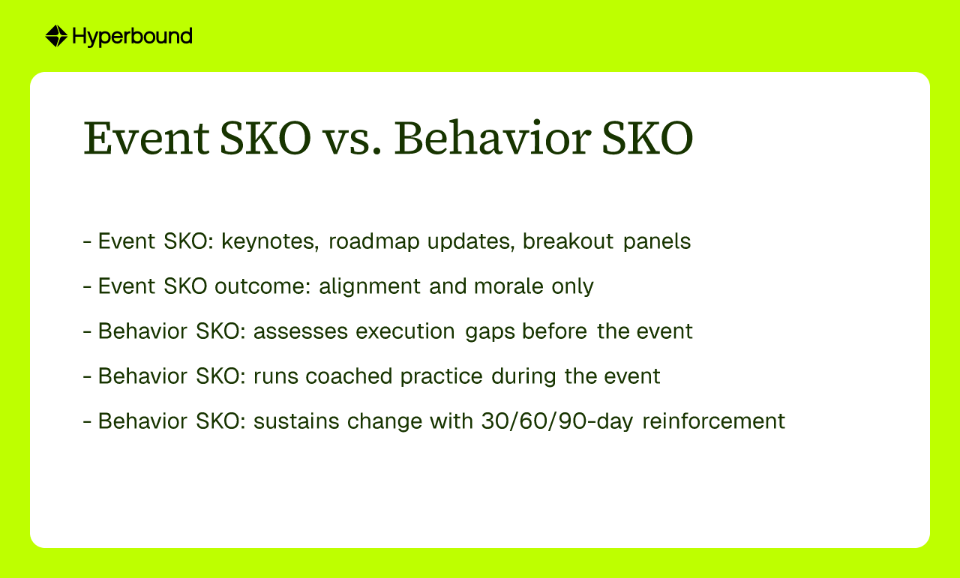
Most organizations already run the first version. The three days on site are rarely the gap. The twenty-eight days after receive no budget, no owner, and no plan. Building that plan is the work of this article, and it starts with translating the content covered on stage into something a manager can watch for on a call.
Every SKO covers too much: a new pitch, a competitive update, a methodology refresh, a pricing change. None of that changes selling behavior unless it is reduced to two or three observable, nameable moments a rep either does or does not do on a real call.
Scorecards should measure observable revenue-driving behaviors, not personality traits. Concrete examples that qualify: identifying business impact during discovery, confirming next steps before ending the call, identifying the decision-maker early, quantifying pain before presenting a solution. Each of these can be marked yes or no by a manager listening to a recording. "Built rapport" cannot.
The behaviors also need to be call-type-specific. A cold call is judged on opening clarity, objection handling, and meeting conversion. A demo is judged on value articulation and competitive positioning. Running one master scorecard across every call type creates noise and weakens the signal. Coaching becomes targeted only when the scorecard matches what the call was for.
The selection method matters as much as the criteria. Pull three to five transcripts of an organization's best-performing calls per call type, from whatever conversation intelligence platform already records them, and extract the behaviors the top performers consistently demonstrate. That grounds the two or three chosen behaviors in what correlates with winning, rather than in what sounded good from the stage. It also means the end-of-SKO commitment session, where each rep publicly names one specific behavior change, is doing more than a morale exercise. Attendir calls this the highest-leverage hour of the entire event and its most under-used moment; it gives the reinforcement plan something concrete to measure against from day one.
WeekFocusWhat happens1Lock the behaviorsFinalize the two or three observable moments chosen from the commitment session and top-call transcripts. Build or update the call-type-specific scorecard. Managers listen to a baseline sample of calls per rep before any coaching.2First inspection passManagers score real calls against the new scorecard. No group training. The output of week two is a list: which reps are already doing the behavior, and which are not.3Targeted practicePractice is assigned only to reps flagged in week two. Reps already demonstrating the behavior keep selling; they do not sit through a repeat of content they have already absorbed.4Re-inspect and reportManagers score a fresh batch of calls from the same reps who received targeted practice. Compare against the week-two baseline. This becomes the first data point for the 30-day checkpoint.
The point of this structure is that inspection happens continuously, every week, using call reviews, deal data, and CRM inputs as the evidence base, while training is routed only to the subset of the team that has not yet closed the gap. That is a materially different operating model from "coach everyone weekly," the standard default in post-kickoff plans. Coaching everyone consumes manager time on reps who already demonstrate the behavior, and it treats the whole roster as the problem when the problem usually sits with a fraction of it.
Each layer of the organization has a distinct, non-overlapping job in these four weeks.
Reps hold the one commitment made at the closing session and apply it on the next live call, not the next training module. The behavior only counts once it shows up in a real conversation with a real prospect. That is the difference between a certification that tests execution and one that only marks completion.
Managers run the weekly inspection cycle: listen to calls, score against the call-type-specific scorecard, and route practice to whoever the scorecard flags. That cadence is what makes coaching consistent from one rep to the next, instead of varying by whichever manager happens to be doing the review. Coaching is a structured process of identifying execution gaps and correcting specific behaviors through inspection, repetition, and guidance; it is not a motivational check-in, and it is not generic feedback.
Leadership and enablement own the reinforcement campaign itself: the cadence, the checkpoints, and the reporting that ties the four weeks back to pipeline metrics. Ownership commonly splits with marketing running the scheduled 30/60/90-day reinforcement touches while sales owns the 1:1 manager coaching. An owner must be assigned to the calendar. Without that ownership, the plan stops around week two, when the CRM starts to look unchanged again.
The mechanism that makes this plan work, and the part most post-SKO advice skips entirely, is routing. Watching a call and noting a gap is not enough on its own; the gap has to trigger practice for that specific rep on that specific behavior, and the rep who is already performing should not be pulled into the same exercise.
This is where a manager's time is scarce. Enablement leaders are typically outnumbered many times over by the managers and reps they support, and coaching is usually the first activity cut when the calendar gets tight. An inspect-then-route loop protects that time by narrowing practice to the reps who need it, rather than scheduling a blanket refresher for everyone.
For teams already recording calls, this loop can run on the same call data a manager would review anyway. Hyperbound's Agentic Enablement, its autonomous behavior change system, is built around exactly this idea: it runs on an organization's real call recordings, identifies which reps are and are not demonstrating a chosen behavior, and directs targeted practice only to the ones who need it, rather than to the roster as a whole. It is in concept form now, with a conversation available for teams that want to see how the inspect-and-route loop would apply to their own post-SKO plan, and it sits alongside Hyperbound Practice, which is where that targeted repetition happens once a gap is identified. None of this changes the underlying plan for a team running it manually: the loop is the same whether a manager builds it in a spreadsheet or a platform runs it against recorded calls.
The evidence points to a window of roughly four to eight weeks of active reinforcement, checked at 30, 60, and 90 days. Throughout that window, measure adoption on real calls, not a certification completion number. The 30/60/90-day structure gives the organization three formal checkpoints to confirm the behavior has stuck, and the fact that the cost of skipping reinforcement surfaces in performance metrics around day 60 means the first thirty days are not optional runway. They are the period in which the behavior either becomes routine or reverts.
The four-week plan above is the front half of that window, the part where the behavior is established and inspected weekly. The 60-day checkpoint asks whether the metrics are moving. The 90-day checkpoint asks whether the behavior has become the default without prompting. Skipping the four-week phase does not just delay the 60-day check; it usually means there is nothing measurable to check at all.
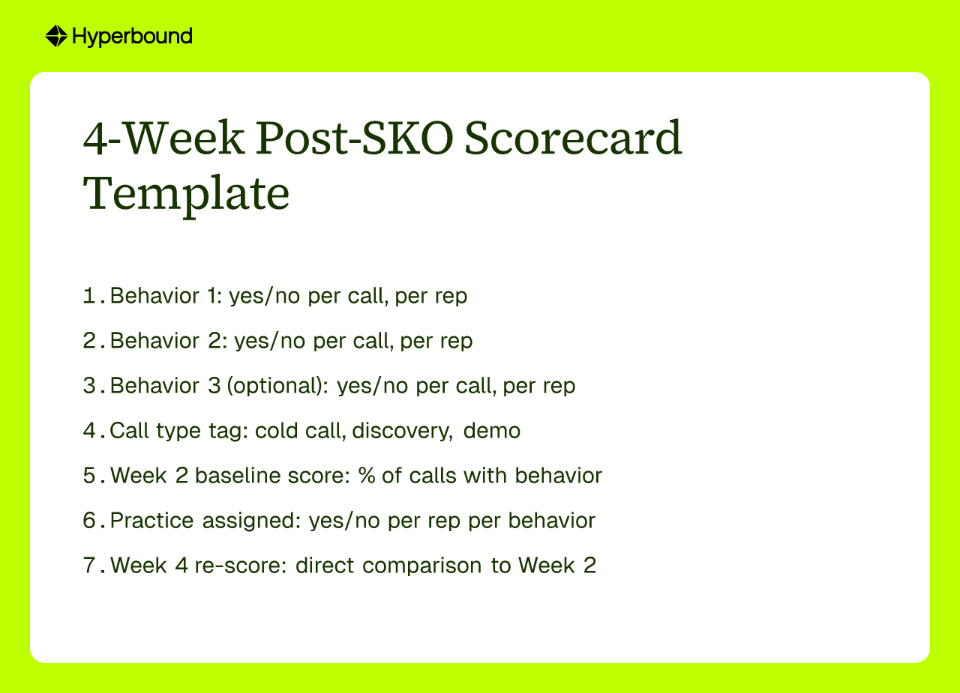
A manager can build this in a spreadsheet in under an hour:
Keep the sheet to these columns. Adding trait-based fields such as "energy" or "rapport" reintroduces the noise the whole exercise is designed to remove.
The behaviors chosen are too broad. If a manager cannot mark a behavior yes or no while listening to a single call, it is not observable enough. Go back to the transcript method and re-extract a narrower moment.
Everyone gets the same practice. This defeats the purpose of inspection. If a rep is already confirming next steps before ending calls, sending them through a generic refresher wastes a manager's limited coaching time and the rep's selling time.
Week one becomes another training session. The plan only works if week one is used to lock the scorecard and baseline the team, not to re-teach the SKO content. Re-teaching belongs at the kickoff; the four weeks after are for inspection and correction.
No one owns the calendar. Without an assigned owner for the weekly cadence, reinforcement stops around week two, when the CRM starts to flatten back to pre-kickoff patterns.
A 30/60/90 post-SKO reinforcement plan is a 90-day sequence of behavior inspection, targeted practice, and metric checkpoints that turns sales kickoff messages into durable selling habits. At 30 days, managers re-score the behaviors chosen after the SKO. At 60 days, the organization checks whether pipeline and conversion metrics have moved. At 90 days, leaders confirm the behavior is happening without scorecard prompting.
Sales training sticks when the SKO message is reduced to two or three observable call behaviors, inspected weekly, and practice is routed only to reps who are not yet demonstrating them. This inspect-then-route loop creates the repetition and feedback that turn a new framework into a default behavior.
An event SKO delivers alignment and morale through keynotes and breakouts, while a behavior SKO adds execution-gap assessment before the event, coached practice during it, and 30/60/90-day reinforcement after it. The first produces alignment and morale; the second produces measurable behavior change.
In the first four weeks, managers should lock two or three observable behaviors, score a baseline sample of real calls, inspect new calls weekly against a call-type-specific scorecard, and assign targeted practice only to reps who are not yet performing the behavior. They should not re-teach the SKO content or coach the whole team uniformly.
New sales behaviors typically need four to eight weeks of active reinforcement to become habitual, with formal checkpoints at 30, 60, and 90 days. The first 30 days are the critical window when a behavior either becomes routine or reverts.
No. Post-SKO coaching should be routed only to reps whose calls show they have not yet adopted the target behaviors. Reps already demonstrating the behavior should keep selling instead of sitting through refresher training, which protects manager time and keeps practice relevant.
A post-SKO scorecard should include two or three observable behaviors scored yes/no per call, a call type tag, a week-two baseline percentage, a practice-assigned flag, and a week-four re-score. It should exclude trait-based fields such as "energy" or "rapport," which create noise.
Frontline sales managers own the weekly inspection and targeted coaching, because they are closest to real call recordings. Enablement or marketing owns the broader 30/60/90-day campaign calendar, checkpoints, and reporting, so the cadence does not lapse.
No. A post-SKO reinforcement plan can run in a spreadsheet using existing call recordings. A platform such as Hyperbound's Agentic Enablement can automate the routing step, but the core inspect-then-route loop does not require new software.
The most common mistakes are choosing behaviors that are too broad, assigning the same practice to every rep, turning week one into another training session, and failing to assign an owner to the reinforcement calendar. Each of these weakens the inspect-and-route loop and lets the CRM revert to pre-kickoff patterns.









Use Cases
Legal