
Your pipeline is lying to you.
Deals that looked healthy at last week's forecast call are suddenly "pushing to next quarter." Reps are getting meetings but nothing is moving. And by the time you spot the pattern in your CRM, the moment to change the outcome is already gone.
This isn't a lead generation problem. It's an intervention gap problem.
Sales teams today have more call data, more CRM fields, and more pipeline dashboards than ever before. But data only tells you what already happened. There's a critical difference between visibility into past calls and intervention that changes what happens next. The former is passive. The latter is Revenue Activation — the discipline of identifying the moments where the right coaching action can still move a deal, and executing on them before it's too late.
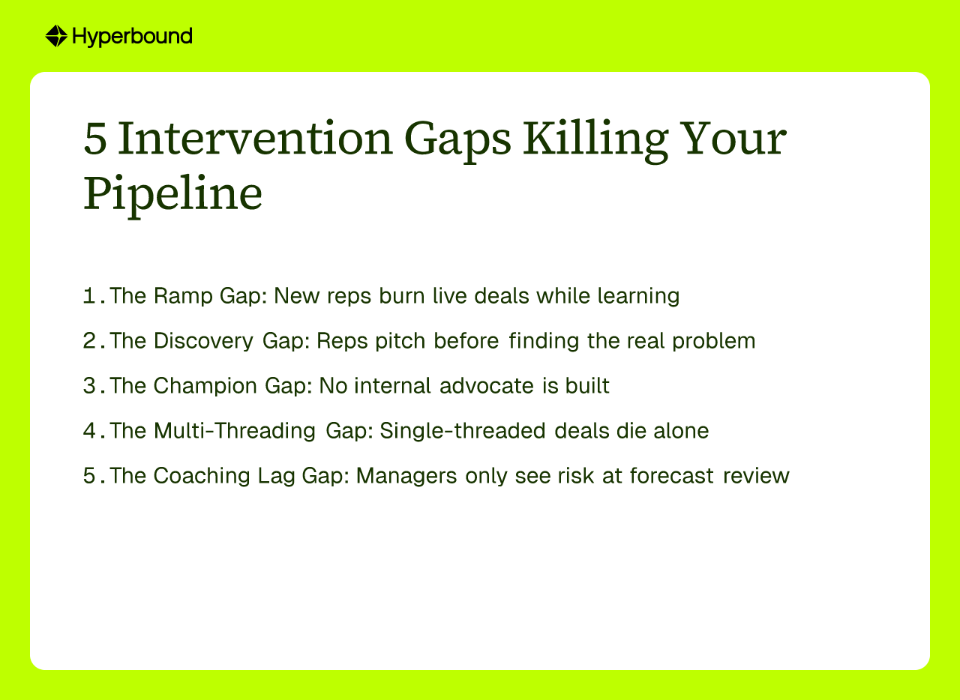
Below, we break down the five most common intervention gaps silently killing your pipeline, what's actually causing them, and a concrete fix for each one.
Symptom: New reps take six-plus months to become productive. In the meantime, the hot leads marketing worked hard to generate are wasted on reps who are still figuring out the pitch. You watch promising pipeline get torched by avoidable mistakes — wrong messaging, fumbled objections, no urgency established.
Root Cause: Onboarding still relies on reading playbooks, shadowing a few calls, and then hoping for the best on live accounts. Reps don't get enough at-bats to build confidence and competency before they're managing real opportunities. Managers can't fill the gap — research consistently shows frontline managers spend only 5–8% of their time on coaching, and that's usually the first thing cut when things get busy.
The Intervention: Before a rep ever speaks to a real prospect, they should have hundreds of simulated conversations under their belt. This means building a practice environment where certifications are skills-based (can they handle this objection?) not knowledge-based (can they pass a quiz?). Ramp needs to be measured in behaviors demonstrated, not days elapsed.
Hyperbound Practice is purpose-built to close this gap. Reps practice cold calls, discovery, objection handling, and demos against AI buyer personas trained on 2M+ hours of real B2B sales conversations — not generic, "too easy" scripts. AI Scorecards deliver instant, objective feedback on talk ratios, methodology adherence, and key selling moments. Managers can run Certifications to verify practical readiness before reps ever touch a live deal. The result: customers like Vanta saw a 60% ramp reduction — from 210 days down to 72 — and a 2x faster time to first won deal.
Symptom: Deals stall after the first meeting. Reps send a proposal, the prospect goes quiet, and suddenly the deal is in "nurture." When you dig into the call, you find the rep went straight into a product demo without establishing a compelling business problem. As one sales leader put it bluntly: "Rushing to introduce the product before the 'problem' and the scale of the problem has been diagnosed" is one of the most consistent pipeline killers.
Root Cause: Discovery is genuinely hard. Reps default to pitching because it feels productive. Without drilling effective questioning frameworks — like the Gap Selling approach of mapping current state, future state, and the cost of inaction — reps stay at the surface level and never uncover the real pain that justifies a purchase decision.
The Intervention: Reps need structured, repetitive practice on discovery — specifically on probing questions that force a prospect to articulate impact. Train for questions like "What happens if you don't solve this in the next six months?" and practice against skeptical buyer personas who don't give up information easily.
Hyperbound Practice lets reps build AI buyer personas directly from a LinkedIn profile, meaning every practice session mirrors the actual accounts in their pipeline. AI Coaching gives methodology-aligned feedback after every roleplay, flagging missed questions and weak follow-ups before those habits show up on a live deal. This directly drives outcomes: Nivoda reported a 150% increase in demo conversion rates after reps consistently practiced discovery conversations with Hyperbound.

Symptom: Your deal depends entirely on one person's goodwill. They go on vacation — deal stalls. They get pulled into another priority — deal goes dark. There's nobody inside the buying organization fighting for your solution when you're not in the room.
Root Cause: Reps confuse a friendly contact with a champion. A true champion has three things: organizational influence, access to the economic buyer, and a personal stake in the outcome. Most reps never test whether their contact has any of those. They mistake engagement (emails back, attends demos) for advocacy (lobbies internally, brings in other stakeholders, defends you when questioned).
The Intervention: Teach reps to actively test champion strength — not just assume it. Effective tests include: Can they get you a meeting with the economic buyer? Will they share internal objections? Have they proactively introduced you to someone else on the buying team? If none of those boxes are checked, you don't have a champion — you have a friendly contact.
Hyperbound Perform provides AI Deal Coaching that looks across the entire deal lifecycle, not just individual calls. By analyzing stakeholder interactions and email engagement across every touchpoint in the deal, Perform surfaces who is genuinely engaged versus who has gone quiet. It matches current deal signals against historical patterns from past closed-won deals to help reps and managers understand what a healthy champion relationship actually looks like — and where the current one is falling short — with guided actions to close that gap before it's too late.
Symptom: You're single-threaded. Your rep has one contact, that contact changes roles, and the deal evaporates overnight. Research into B2B pipeline health consistently identifies single-threaded deals as one of the highest-risk indicators in any pipeline — yet most reps default to working the relationship that's easiest, not the one that builds a defensible deal.
Root Cause: Reps take the path of least resistance. Once they have a comfortable contact who responds to emails and shows up to calls, there's little internal pressure to go broader. Multi-threading requires navigating organizational politics, asking for introductions, and running calls with multiple stakeholders who have competing priorities. Without deliberate coaching and accountability, it simply doesn't happen.
The Intervention: Make multi-threading a measurable deal exit criterion, not a "nice to have." By a defined stage, reps should have at least two to three engaged contacts from different functions (economic buyer, technical user, operational stakeholder). If that bar isn't met, the deal doesn't advance. Pair the standard with the practice to back it up.
Hyperbound Perform gives managers deal-level visibility into stakeholder engagement across the full buying committee, flagging single-threaded deals as an active risk factor rather than a discovery at forecast time. On the preparation side, Hyperbound Practice's Multiparty Roleplays let reps practice complex multi-stakeholder calls — running a live conversation with both a champion and a skeptical economic buyer at the same time, each with their own objections and agendas. Reps show up to those calls ready to build consensus, not just survive them.
Symptom: You find out a deal is at risk when the rep pushes the close date for the third consecutive week. By then, the stakeholder has gone cold, competing priorities have taken over, and the window to re-establish urgency has mostly closed. Classic pipeline warning signs — stalled stages, missed next steps, competitor mentions — went undetected because nobody was watching for them in real time.
Root Cause: Managers simply can't monitor what they can't see. The average frontline manager listens to less than 1% of their team's recorded calls. They rely on lagging CRM fields and optimistic rep updates in 1:1s. There's no early warning system — just a rearview mirror.
The Intervention: Shift deal inspection from a weekly ritual into a continuous, always-on signal. Managers need proactive alerts when deal health indicators change — not a summary waiting for them at pipeline review. And those alerts need to come with a specific recommended action, not just a data point.
Kota Activate is Hyperbound's AI assistant that sits above both Practice and Perform, orchestrating coaching interventions across your entire pipeline. Kota analyzes all deals simultaneously, references patterns from past closed-won and closed-lost deals, and sends proactive coaching alerts directly into Slack or Microsoft Teams. Instead of a manager discovering a problem at forecast, Kota can surface it the moment signals change — and recommend a specific action, like assigning a targeted "Setting a Mutual Action Plan" roleplay from Hyperbound Practice to a rep who's been closing calls without clear next steps. The end result: 3.5 workweeks of coaching time saved, with interventions happening while outcomes are still yours to change.

.png)
Hyperbound Practice | Hyperbound Practice | Hyperbound Perform | Hyperbound Perform | Kota Activate
These five intervention gaps don't announce themselves. They quietly compound — a discovery call that never went deep enough, a champion who was never tested, a manager who found out too late — until your pipeline is full of deals that look alive but are already lost.
The era of passive analysis is over. Conversation Intelligence made execution visible for the first time. That was real progress. But visibility was never the same as improvement. By the time a call summary lands in a dashboard, the moment to change that call is already gone.
Revenue Activation is different. It's the continuous loop of scoring real calls with Hyperbound Perform, surfacing skill gaps, closing them in a risk-free environment with Hyperbound Practice, and letting Kota Activate orchestrate coaching interventions the moment a deal shows signs of risk — not three weeks later at forecast review.
Your pipeline doesn't have to be a guessing game. Close the intervention gaps, and the deals will follow.
An intervention gap is the critical delay between when a problem occurs in a sales deal and when a manager can take action to fix it. While traditional tools provide visibility into past events, the opportunity to influence the outcome has often passed by the time a negative pattern is spotted. The gap is the period where timely coaching could have made a difference but didn't happen.
Revenue Activation is a proactive, data-driven system for coaching, whereas standard sales coaching is often reactive and based on lagging indicators found in a CRM. Instead of waiting for a weekly forecast review, Revenue Activation uses AI to continuously monitor deals, identify skill gaps in real-time, and prompt specific coaching interventions before a deal goes off track.
Even experienced reps can fall into the habit of pitching features instead of deeply diagnosing a prospect's business problem. This "discovery gap" occurs because pitching feels productive and is often easier than asking the tough, probing questions needed to uncover true pain and urgency. Without consistent, structured practice, reps stay at a surface level, leading to deals that stall after the first meeting.
The best way to test for a champion is to ask them to take a specific action that requires them to use their internal influence on your behalf. A friendly contact will take your calls, but a true champion will actively work to get your deal done. Test them by asking for an introduction to the economic buyer or for help navigating an internal objection. If they can't or won't do these things, they are not a champion.
AI can help in two key ways: practice and analysis. First, AI-powered multiparty roleplays allow reps to practice navigating complex conversations with multiple stakeholders (e.g., a champion and a skeptical CFO) at the same time. Second, AI deal coaching tools can analyze engagement across the entire buying committee, automatically flagging single-threaded deals as a risk and prompting reps to engage additional contacts.
Hyperbound is a Revenue Activation platform, which is the next step beyond Conversation Intelligence. While CI tools record and analyze past calls to tell you what happened, Hyperbound uses that intelligence to actively intervene and change what happens next. It connects real-time deal analysis with a safe AI practice environment, creating a continuous loop of performance improvement that CI tools alone cannot provide.
Ready to activate your revenue? Request a demo of Hyperbound →










Use Cases
Legal