
You're sitting at your desk, staring at the same CRM screen you've been looking at for hours. Another day of cold calls, another round of rejection, another set of metrics to hit. The commission is good—money isn't the issue—but finding the motivation to keep going feels increasingly difficult. Even with the promise of a paycheck, the monotony is real, and maintaining focus requires more energy than it should.
Sound familiar?
If you're nodding your head, you're not alone. Sales professionals everywhere struggle with this motivation gap, especially in today's remote work environment where "work gets boring" and "tasks feel monotonous and unengaging," as many salespeople confess in online forums. Even high performers admit that "it drives me insane not having specific numbers to hit on a daily basis."
Sales gamification is the process of turning pipeline tasks (like calling prospects, setting meetings, and closing deals) into a game, where completing tasks comes with rewards that motivate salespeople to repeat successful behaviors. Think of it as adding game elements—points, badges, leaderboards, and challenges—to non-game sales contexts.
But why does this approach work when traditional incentives sometimes fall flat?
It all comes back to psychology. Gamification is rooted in the principle of operant conditioning, pioneered by B.F. Skinner. The concept is simple: behaviors that receive positive reinforcement are more likely to be repeated. Just like a dog gets a treat for sitting, a salesperson gets points or recognition for hitting a call quota, reinforcing that positive behavior.
The numbers speak for themselves:
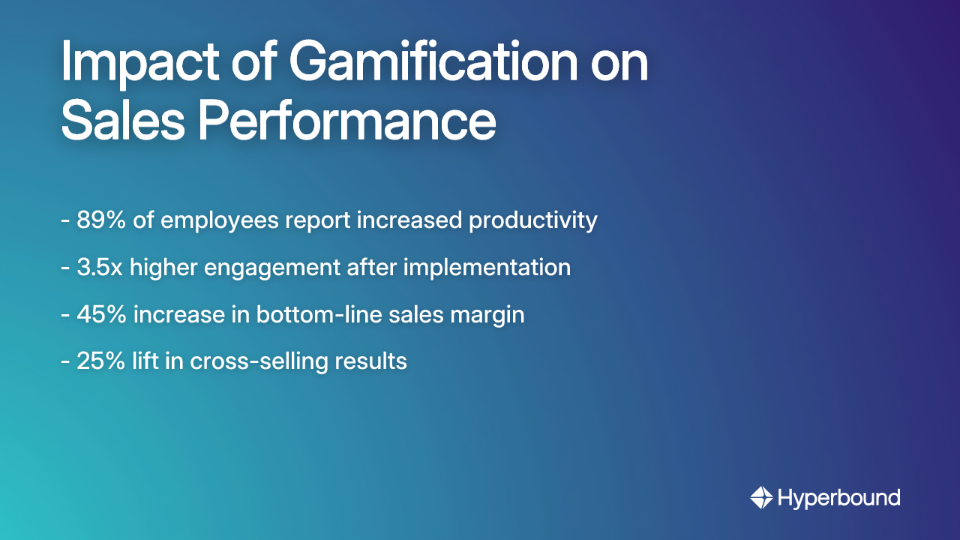
These aren't just vanity metrics—they're proof that the right gamification strategy can transform your sales culture from one of monotony to one of engagement, achievement, and healthy competition.
The foundation of effective sales gamification is a clear, simple points system tied to specific activities. As one sales professional on Reddit explains: "Build reports in CRM to track specific activities. Treat it as a score. Assign activities points. Cold call 2 points, successful cold call resulting in a meeting 20 points, Sale 50 points."
This approach provides immediate feedback and creates a tangible way to measure progress throughout the day—not just when deals close. The key is ensuring every point-earning activity aligns with behaviors that actually drive results.
Leaderboards transform abstract numbers into visual competition, making achievement visible and recognition public. But the effectiveness of leaderboards hinges on one crucial factor: they must be dynamic and updated in real-time.
As highlighted in user research: "The faster the sales teams know how they are doing, the faster they can do better." When reps can see their ranking change with each successful action, it creates immediate positive reinforcement and drives continued engagement.
Pro tip: Rotate your leaderboard metrics weekly or monthly to prevent the same top performers from always dominating, giving everyone a chance to excel in different areas.
Badges are powerful symbols of accomplishment that tap into our innate desire for collection and status. Create badges for specific achievements like "Rising Star" for top new hires, "Deal Closer" for consistent performers, or "Pipeline Pro" for those who excel at building opportunities.
The most important insight from sales professionals: "Badges should not be easy to win." If everyone gets a badge for minimal effort, they lose their value. Make them challenging enough to foster genuine pride when earned.
Break down large, intimidating annual targets into engaging short-term challenges. These might include:
Team-based challenges are particularly effective at building community while driving results. Simon-Kucher & Partners found that gamified approaches to cross-selling created a 25% lift in results, even while implementing price increases.
Effective gamification balances both intrinsic motivators (personal satisfaction, mastery) and extrinsic motivators (tangible rewards). The most successful programs offer a mix:
The key insight: understand what motivates your specific team. Use surveys to identify how they prefer to be rewarded and held accountable. Not everyone is motivated by the same things, and personalizing your approach dramatically increases its effectiveness.
Learning doesn't have to be boring. Instead of just quizzes, you can gamify the entire skill-development process. This is where AI-powered coaching tools shine, turning practice into an engaging, game-like experience.
For example, platforms like Hyperbound allow sales reps to practice critical conversations in hyper-realistic AI roleplays. Reps can "level up" their skills by tackling different buyer personas and objections, receiving instant, objective scores on their performance. This approach is particularly powerful for remote teams, as it provides a safe, repeatable way to master new playbooks and build confidence before ever speaking to a real customer.

The proof is in the results. Consider these impressive case studies:
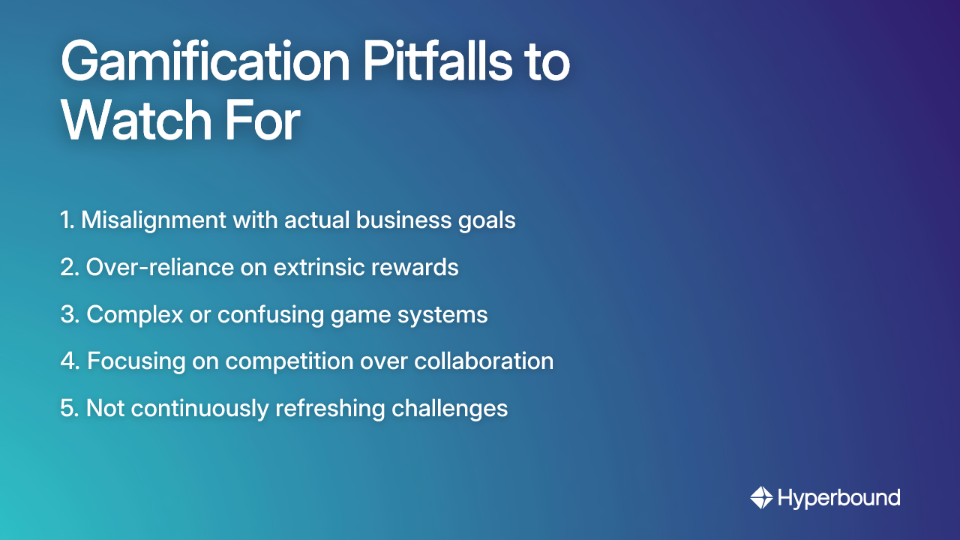
While gamification can transform sales performance, there are several common mistakes to avoid:
The modern sales environment demands more than traditional incentives to keep teams motivated and engaged. By implementing gamification strategies that tap into fundamental psychological principles, you can transform mundane tasks into engaging challenges that drive real results.
The best part? You don't need a complex system to get started. Begin by identifying one key behavior you want to improve, design a simple challenge around it, and leverage tools like Hyperbound for AI-powered training and practice, or platforms like Spinify, Gamifier, and Compass to bring the competition to life.
Remember, effective gamification unifies teams, celebrates both individual and collective success, and rewards the behaviors that lead to results—not just the final number.
It's time to stop playing games with your sales strategy and start using games to transform it.
Sales gamification is the application of game-design elements like points, badges, and leaderboards to non-game sales activities to motivate employees and drive specific behaviors. It transforms routine tasks such as making calls, setting meetings, or updating the CRM into an engaging competition, leveraging psychological principles of reward and recognition to make work more enjoyable and productive.
Gamification provides immediate, frequent feedback and recognition for daily activities, whereas traditional bonuses are typically long-term rewards tied only to final outcomes. This constant reinforcement loop keeps reps engaged day-to-day. While bonuses motivate based on a large, distant target, gamification uses smaller, intrinsic motivators (like public recognition) and micro-rewards (like badges) to encourage the consistent behaviors that lead to bigger wins.
To start, identify one specific, measurable sales behavior you want to improve, then create a simple points system to track and reward it. For example, if your goal is to increase prospecting, assign points for activities like "cold calls made" or "new meetings booked." Launch a simple leaderboard to visualize progress and ensure the rules are clearly communicated to the team.
You can keep gamification fair by rotating metrics and challenges to give everyone a chance to win based on their unique strengths. Instead of always focusing on "total revenue," create weekly challenges for "most calls," "best meeting-to-close ratio," or "most improved pipeline." Team-based quests also encourage collaboration and prevent the same top reps from dominating every competition.
Absolutely. Gamification is highly effective for improving activities across the entire sales funnel, including training, onboarding, and pipeline management. You can create challenges around completing training modules, achieving high scores in practice roleplays, or maintaining accurate CRM data. By rewarding foundational behaviors, you build a stronger, more skilled team.
AI enhances sales gamification by providing personalized, scalable, and objective ways to practice skills and measure performance. AI-powered coaching tools can create realistic roleplay scenarios where reps practice pitches against different buyer personas. The AI provides instant, unbiased feedback and scoring, allowing reps to "level up" their skills in a safe, engaging environment.
To prevent unhealthy competition, balance individual leaderboards with team-based goals and emphasize collaboration. Frame the competition as a way to push personal and team boundaries, not as a zero-sum game. Celebrate team milestones and create collaborative quests where everyone contributes to foster a supportive environment.









Use Cases
Legal