You've set up countless meetings, perfected your pitch, and put in the hours—yet success feels frustratingly random. One quarter you're crushing it; the next, you're struggling to meet half your quota. "Every role is a gamble," as one sales veteran puts it. "I just wanted to show up, do what's asked and get paid, but that doesn't always correlate to success."
Sound familiar? The truth is, sales success often feels like a casino game where the house always wins. But what if you could be the house?
While you can't control every factor affecting your sales performance, you can strategically choose which game to play and master the skills needed to tilt the odds dramatically in your favor. This isn't about luck—it's about understanding that sales success is determined by two critical factors:
By making smarter choices about where you work and what you sell, while mastering the aspects of sales within your control, you can transform an unpredictable gamble into a calculated risk with predictable returns.
Just as a professional poker player carefully selects which games to join, top sales performers understand that choosing the right company and market dramatically improves their odds of success. This section focuses on making strategic career decisions that set you up to win before you even start selling.
When interest rates were at historic lows during the ZIRP (Zero Interest Rate Policy) era, almost any product could find buyers. "When interest rates are low, money flows like wine," notes one sales professional. "But when rates rise, the economy slows down and consumer spending dries up."
Today's economic reality demands more discernment. Before joining a company, ask yourself a simple but powerful question borrowed from startup advisor Brett J. Fox: "Whose lunch are you stealing?" If you can't clearly identify which competitors your company can outperform—or why customers would switch—you're likely entering a market where success will be unnecessarily difficult.
Consider the plight of sales reps in challenging markets: "The market itself is rough because it's food service, zero margin anywhere, making it hard to win over prospects." No amount of sales skill can overcome fundamentally broken market economics.
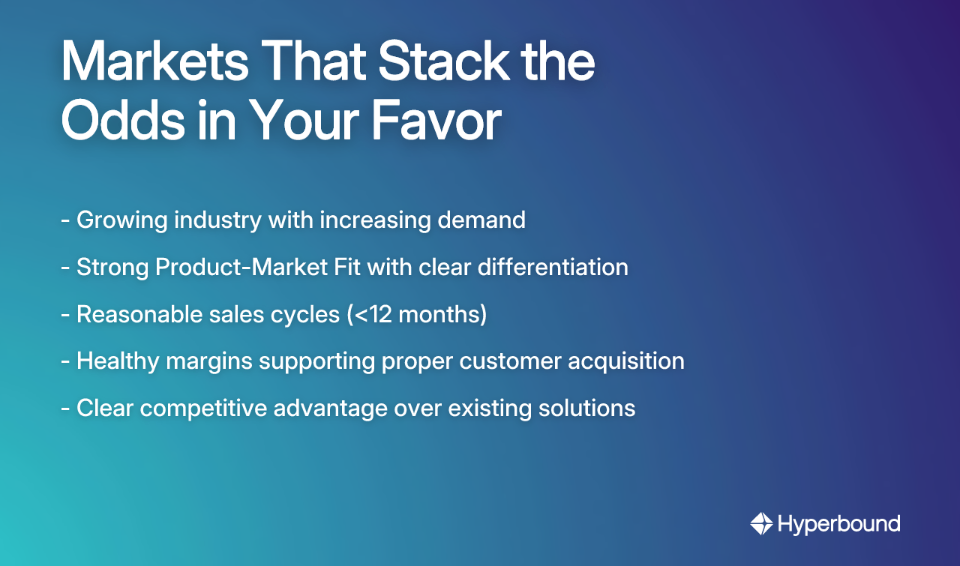
Markets with these characteristics typically offer better odds:
"A big thing people new to sales don't recognize is that your interview is also an interview from you," explains one seasoned rep. This insight is particularly crucial when considering startup opportunities, where the risks and rewards are amplified.
According to Bibi Careau's research on startup evaluation, you should expect startup salaries to be 10-30% lower than at established companies. This salary sacrifice is essentially a bet on accelerated professional growth and potential equity upside.
Before accepting any sales role, thoroughly vet the company with these crucial questions:
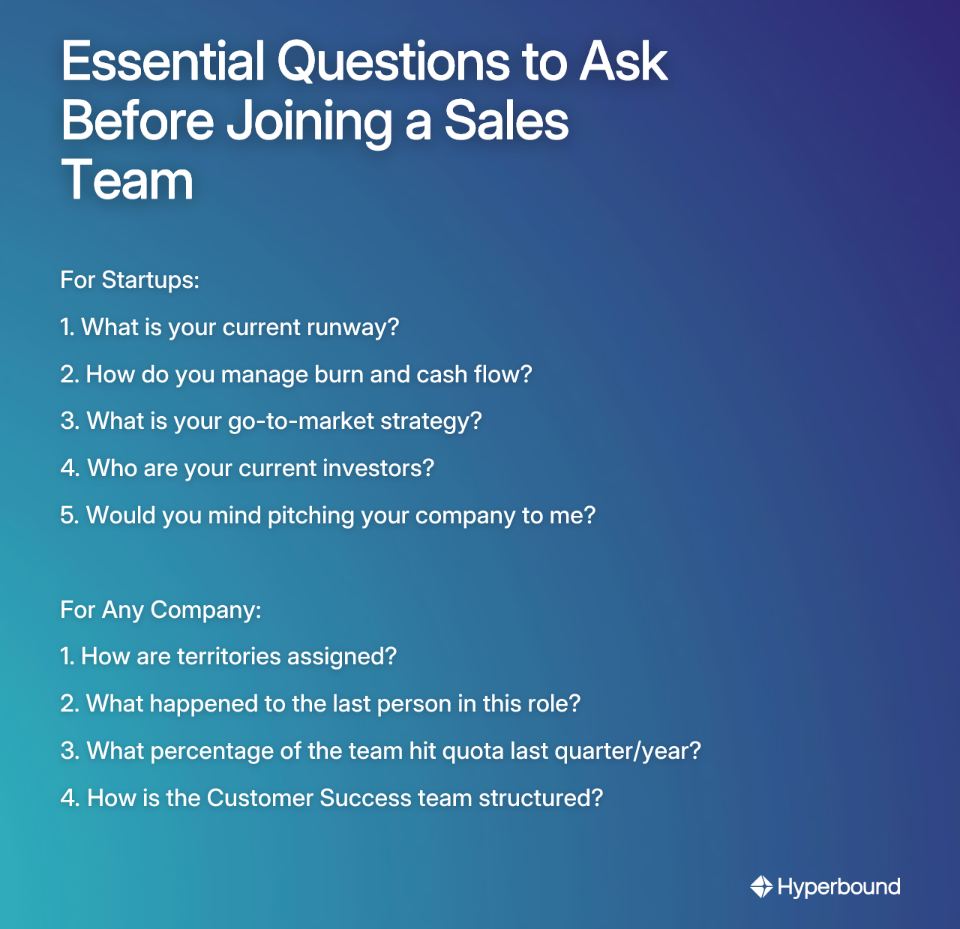
For Startups:
For Any Company:
Ask yourself these tough questions too: "Am I okay if I lose this job in a year? Can I handle uncertainty in my day-to-day responsibilities? Can I financially manage a lower salary and uncertain equity outcomes?"
The cards you're dealt matter enormously. "Did you get Manhattan or London or did you get Birmingham?" asks one rep, highlighting how Territory Assignment can make or break your numbers regardless of skill.
Beware of companies where "some managers and directors feel like their job is to anoint themselves the arbiter of who should be successful." Internal Politics can undermine even the most talented salespeople if the system is rigged against them.
Key factors to evaluate:
Once you've chosen your table wisely, it's time to focus on playing your hand with skill and precision. This is where your daily habits, processes, and skills development come into play.
Top performers are perpetual students of the game. As Anthony Iannarino describes in his journey from basic cold caller to strategic sales leader, the path to excellence requires moving beyond rigid sales scripts to develop adaptable skills.
Modern selling, particularly in complex B2B environments, requires a flexible, nonlinear approach. You must be able to navigate the dynamic nature of sales conversations, especially when selling SaaS (Software as a Service) solutions with longer sales cycles.
Invest in your skills development. AI-powered coaching platforms like Hyperbound are built for this, allowing you to practice and get feedback in realistic scenarios. The best salespeople view skill development as a career-long commitment, not a one-time training exercise.
Your job is to make the buyer feel confident in their "bet." According to Jeff Shore's research on gambling theory in sales, your buyer is subconsciously asking two questions:
Remember that buyers fear losses more than they value gains—often at a 2:1 ratio. Your role is to mitigate this focus on potential losses by highlighting the strong probabilities of successful outcomes.

In practice, this means shifting the conversation from price (the cost to play) to ROI (Return on Investment) and COI (Cost of Inaction). Make the purchase feel like a statistically sound decision, not a risky gamble.
Effective techniques include:
A consistent process is your defense against chaos and uncertainty. "Keep in mind that consistency of process is a hedge against the 80%" of factors outside your control, advises one successful rep.
Create a personal, non-negotiable routine for:
"The reality is that most people don't outbound enough," notes one manager. High activity levels, when guided by intelligent processes, remain the best predictor of sales success. This disciplined approach is what you lean on when the market is tough or morale is low.
For Closing Sales consistently, your process must be repeatable and refined through continuous improvement. Document what works, analyze what doesn't, and make incremental improvements to your approach with each opportunity. This is where AI-powered tools like Hyperbound's Real Call Scoring can provide a significant edge, automatically analyzing your conversations to give you objective data on what's working.
Sales is indeed a gamble, but you're not a helpless player at the mercy of chance. By strategically choosing your table and skillfully playing your hand, you can dramatically improve your odds of success.
Remember the two levers of control:
The most successful salespeople acknowledge external challenges without becoming victims to circumstance. As one veteran puts it, "You can acknowledge they exist without becoming a victim to circumstance."
By stacking the deck strategically and playing your hand with skill, you can transform sales from an unpredictable gamble into a game where you consistently come out ahead. The house doesn't always have to win—sometimes, that house can be you.

The two most important factors for sales success are the "table" you choose to play at (your company, market, and product) and how skillfully you "play your hand" (your process, skills, and adaptability). This means your success isn't just about individual effort. It begins with making a strategic choice to work for a company with a strong product in a healthy market. Once you've made a good choice, your success is then determined by your personal commitment to mastering your craft, following a consistent process, understanding buyer psychology, and building strong internal relationships.
Choosing the right market and company is critical because it stacks the odds of success in your favor before you even make a single call. A strong company with a great product-market fit in a growing industry provides the foundation for success. No amount of sales skill can consistently overcome poor market economics, a weak product, or a company with internal issues. Vetting your employer is as important as them vetting you.
To effectively evaluate a company, you must interview them as much as they are interviewing you by asking strategic questions about their financial health, go-to-market strategy, and team performance. For startups, ask about their financial runway, burn rate, and investors. For any company, inquire about how territories are assigned, why the last person left the role, and what percentage of the team hits quota. Their answers (or hesitation) will reveal the stability and fairness of the sales environment.
A modern salesperson should focus on developing adaptable skills that go beyond rigid scripts, including understanding buyer psychology, mastering a non-linear sales process, and effectively handling objections. Top performers are perpetual students. They invest in their own development through practice, coaching, and continuous learning. Using tools like AI-powered coaching platforms can help you practice realistic scenarios and get objective feedback, accelerating your path from a basic seller to a strategic advisor.
Understanding that buyers fear loss more than they value gain helps you frame your solution in a way that minimizes perceived risk and builds confidence. Your role is to shift the buyer's focus from the price (the "cost to play") to the strong probability of a positive outcome. You can do this by highlighting the Return on Investment (ROI) and the Cost of Inaction (COI), providing social proof with customer stories, and offering guarantees to make the purchase feel like a safe, logical decision.
A consistent sales process is your hedge against the many factors outside your control, providing structure and predictability in an otherwise uncertain role. By creating a non-negotiable routine for prospecting, CRM updates, follow-ups, and pipeline management, you build discipline. This process-driven approach, combined with high activity levels, is one of the best predictors of success. It's what you rely on to keep moving forward when the market is tough or a deal falls through.










Use Cases
Legal