
You can have the most advanced ML model in the world and it still won't matter if the basics aren't right. That observation comes from a RevOps leader in a Reddit thread on forecast accuracy, and it cuts straight to the core problem. Sales forecast accuracy without CRM data that actually reflects reality is a contradiction in terms. Most teams are building forecasts on a foundation of stale inputs, rep-filtered notes, and Friday afternoon updates.
The numbers back this up. According to research cited by Challenger Inc, only 20% of organizations achieve sales forecasts within 5% of actual results. Forrester puts fewer than 25% of sales organizations at 75% or higher forecast accuracy. The average B2B sales forecast, according to Landbase, is off by 25 to 40%.
The instinct is to fix the model. Add a weighted probability layer. Buy a forecasting tool. Run more pipeline reviews. But the model is rarely the problem. The problem is what goes into it.
This post is a framework for improving forecast accuracy by fixing the quality of deal data at its source. Not by replacing your forecasting methodology.
Here is what actually happens. A discovery call reveals that the buyer's internal champion just lost sponsorship. That is a material change to deal health. The rep knows it. But that insight won't hit Salesforce until the rep finds time to update it, which might be Thursday, or might be the day before your forecast call.
As one RevOps professional put it in a Salesforce community discussion: "If reps aren't updating deal stages or probabilities honestly, the system will just project bad numbers faster."
This is the CRM data gap. It is not a technology failure. It is a human one, and it is structural.
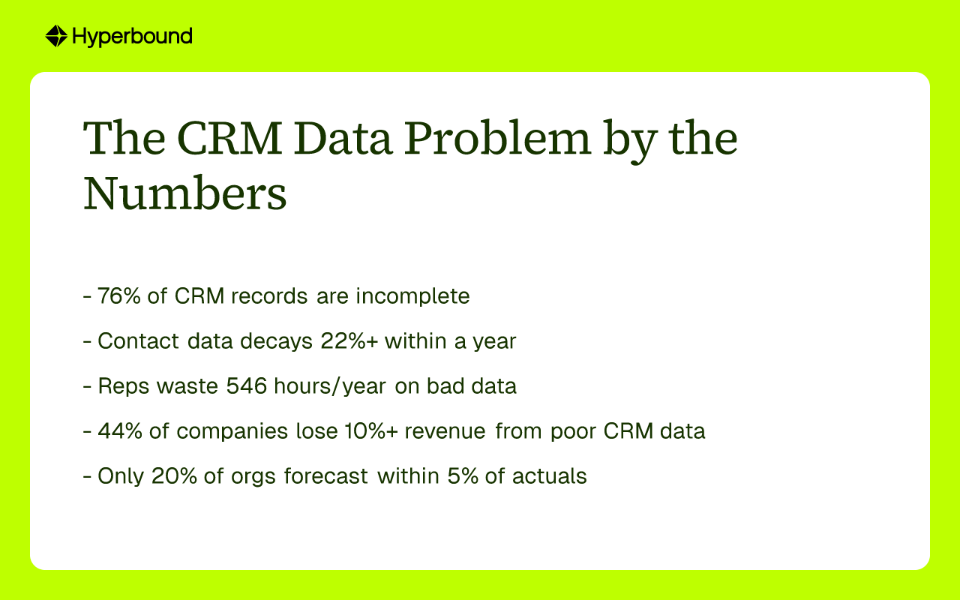
The scale of this problem is clear:
And because reps know the CRM is unreliable, many stop treating it as a single source of truth. They build shadow systems. Spreadsheets. Personal trackers. The CRM becomes a compliance exercise rather than an operational tool.
No model trained on that data will produce accurate forecasts. The problem is upstream.
Fixing forecast accuracy starts with fixing inputs. There are three specific levers that work. None of them involve adding more fields to Salesforce.
The goal here is to move from subjective data to objective data. Rep notes are filtered through optimism, selective memory, and time pressure. Call recordings, email threads, and meeting transcripts are not.
When deal data is grounded in what the buyer actually said, rather than what the rep chose to log, your pipeline reflects reality. And reality is what you need to forecast against.
Gartner research has found that improving CRM data hygiene can boost forecast accuracy by up to 30%. Organizations with accurate forecasts are also 10% more likely to grow revenue year-over-year, according to Databar.ai.
The question is not whether better data helps. It is whether you can capture it without adding more manual work to your reps. The answer to that is automation, which we will cover in a moment.
Most pipeline risk surfaces at the worst possible time. The rep flags a deal as at risk two weeks before close, when there is almost no runway to course correct.
The signals were there earlier. The economic buyer stopped joining calls. Competitor mentions started increasing. Budget conversations kept getting pushed. These patterns are visible in the behavioral data from buyer interactions. They are rarely in the CRM because nobody logged them.
Landbase research on buying signals shows deals with verified positive buying signals close 2 to 3 times faster than those without. The inverse is equally true. Negative or absent signals are powerful early warning indicators, if you have a way to surface them automatically.
This means moving from reactive pipeline management to proactive. The difference between catching a slipping deal in week four versus week ten of a sales cycle is often the difference between saving it and losing it.
Pipeline reviews should be strategic. Most are not. They become narrative sessions where reps defend their pipeline calls and managers try to read between the lines of what is actually happening.
The shift happens when you can replace "how is this deal feeling?" with a specific observation grounded in data. "The economic buyer hasn't been on a call in three weeks. What is the plan to re-engage them?" That is a coaching conversation. It is also a question you can only ask if you have objective behavioral data, not rep sentiment.
This lever is about shortening the gap between deal drift and manager awareness. The earlier you see a deal diverging from your win pattern, the more time you have to do something about it.

Before looking at implementation, it is worth naming the things that feel productive but do not move the needle.
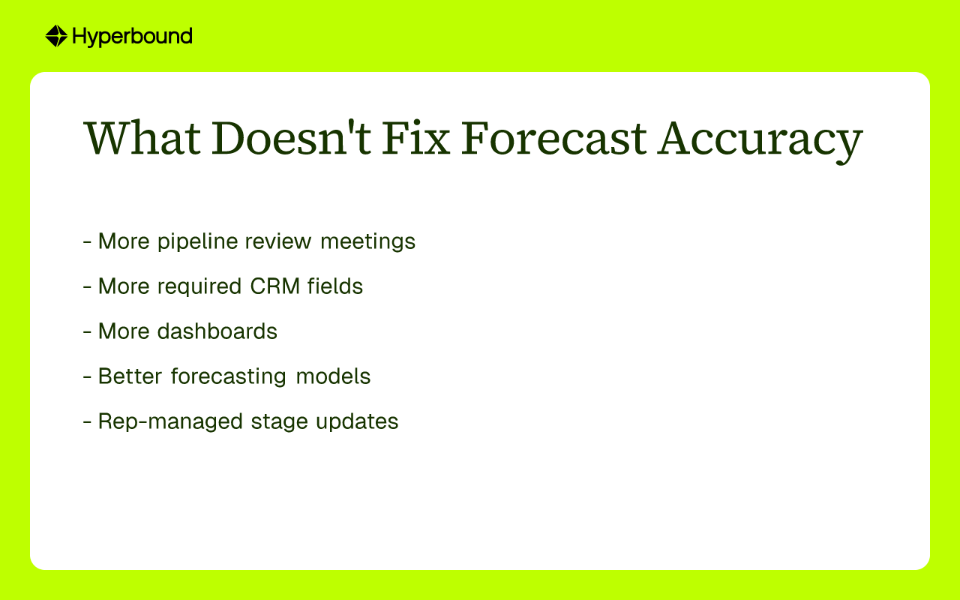
More pipeline review meetings. Without better data, these become status theater. Reps defend their assumptions. Managers push for commit. Nobody learns anything new. The Reddit community on RevOps called this out directly: "It feels less like a forecasting tool and more like something leadership pulls out at the end of the quarter to point fingers."
More required CRM fields. Adding required fields increases administrative burden. Reps fill them in with placeholder data to satisfy the requirement. Now you have more data that is even less trustworthy.
More dashboards. A dashboard built on bad data is a more polished version of fiction. It gives false confidence. You make resourcing decisions, hiring decisions, and compensation decisions based on numbers that do not reflect what is actually happening in your pipeline. As one operator put it, the result is "distrust and poor decision-making based on inflated expectations."
The common thread is that all three of these interventions treat the symptom. None of them fix the source.
The three levers above are not abstract. A Revenue Activation Platform like Hyperbound operationalizes each one. The key distinction is this: these tools do not replace your forecast. They improve what goes into it.
Automating data capture (Lever 1): Hyperbound Perform's Auto-CRM Fill eliminates the manual entry gap by capturing and syncing deal data directly from calls and interactions without waiting for rep input. This directly addresses the 76% incomplete record problem and frees up the rep time currently lost to data admin. The data that reaches your forecasting model reflects what actually happened, not what the rep remembered to log.
Atul Raghunathan, Hyperbound's co-founder, saw this firsthand. The company closed its "strongest quarter ever" using Perform internally. The issue was never rep intent. It was structural. Reps were not avoiding CRM updates out of laziness. They were doing it because managing deal information across calls, emails, and a Salesforce form was an impossible ask on top of an already full day. Removing that burden changed the quality of data flowing into the forecast.
Surfacing behavioral signals (Lever 2): Hyperbound Perform analyzes buyer interactions across the full deal arc and surfaces objective behavioral signals, both positive and negative. It does not rely on rep interpretation. It reads what is happening in the conversation itself. A manager reviewing a deal does not have to wonder whether a rep is being optimistic. The behavioral data shows what the buyer is actually doing.
This is not a forecasting layer. It is an input quality layer. Hyperbound Perform improves the signal your forecast is working with, not the model processing it.
Grounding pipeline queries in call reality (Lever 3): Kota Activate, Hyperbound's AI Revenue Analyst, lets revenue leaders ask pipeline questions grounded in what was actually discussed on calls, not what was entered into Salesforce fields. A question like "show me all deals in commit where the prospect has not mentioned budget in the last two conversations" becomes answerable. That is a coaching prompt with real data behind it.
Again, Kota Activate is not a forecasting tool. It is a way to interrogate your pipeline based on what buyers said, which is a fundamentally more reliable input than rep-managed stages.
Accurate forecasts mean people are making business decisions based on facts, not fantasy. That quote comes from a RevOps practitioner reflecting on what actually builds trust in a forecasting process. It is simple. It is also the standard most organizations are not meeting.
The path forward is not a better model. It is not more meetings or more required fields. It is fixing what the model is fed.
Sales forecast accuracy without CRM data quality is impossible. And CRM data quality is impossible when you rely on reps to manually capture it under time pressure, with imperfect memory, after every call.
Remove that dependency. Automate the capture of objective behavioral data. Surface risk signals before reps self-report. Ground your pipeline reviews in what buyers actually said. When you do those three things, your forecasting model, whatever it is, will start producing numbers you can actually plan against.
The forecast was never the problem. The inputs were.
The primary reason for inaccurate sales forecasts is poor quality data from the CRM, not the forecasting model itself. Most forecasts are built on incomplete, stale, and subjective information manually entered by sales reps, which fails to reflect the reality of the deals in the pipeline.
Poor CRM data directly leads to inaccurate forecasts by providing a flawed foundation for any predictive model. When deal stages, probabilities, and notes are not updated in real-time or don't reflect buyer conversations, the forecast becomes a projection of bad data, leading to missed targets and poor business decisions.
A better forecasting tool cannot fix the fundamental problem of "garbage in, garbage out." If the underlying CRM data is inaccurate, even the most advanced model will produce unreliable forecasts. The focus must first be on improving the quality and timeliness of the data inputs.
The three most effective ways to improve forecast accuracy are: 1) improving the quality of input data by capturing objective information from calls and emails, 2) detecting deal risk signals earlier through behavioral analysis of buyer interactions, and 3) enabling faster, data-driven coaching responses from managers.
You can improve CRM data quality without adding more work for reps by using automation. Tools that automatically capture and sync data from calls, meetings, and emails directly to the CRM eliminate manual data entry, ensuring records are complete and up-to-date while freeing up valuable rep selling time.
Early risk signals are objective behavioral indicators that a deal may be stalling, often before a sales rep manually flags it. Examples include the economic buyer no longer joining calls, an increase in competitor mentions, or repeated delays in budget discussions. These signals are typically found in conversation data, not CRM notes.
Subjective deal data is based on a sales representative's interpretation, memory, and sentiment, such as manually logged notes or a "gut feeling" about a deal. Objective deal data is based on verifiable facts and behaviors, such as direct quotes from call transcripts, email exchanges, and meeting attendance records. Forecasts built on objective data are far more reliable.










Use Cases
Legal