
You've set up your perfect outreach sequence, practiced your pitch until it's flawless, and you're ready to crush your quota. Then reality hits: the economy tanks as interest rates rise after years of ZIRP (Zero Interest Rate Policy), your territory turns out to be the equivalent of Birmingham instead of Manhattan, and your product's PMF (Product Market Fit) isn't quite aligned with what the market wants right now.
Sound familiar? If you're nodding your head, you're not alone.
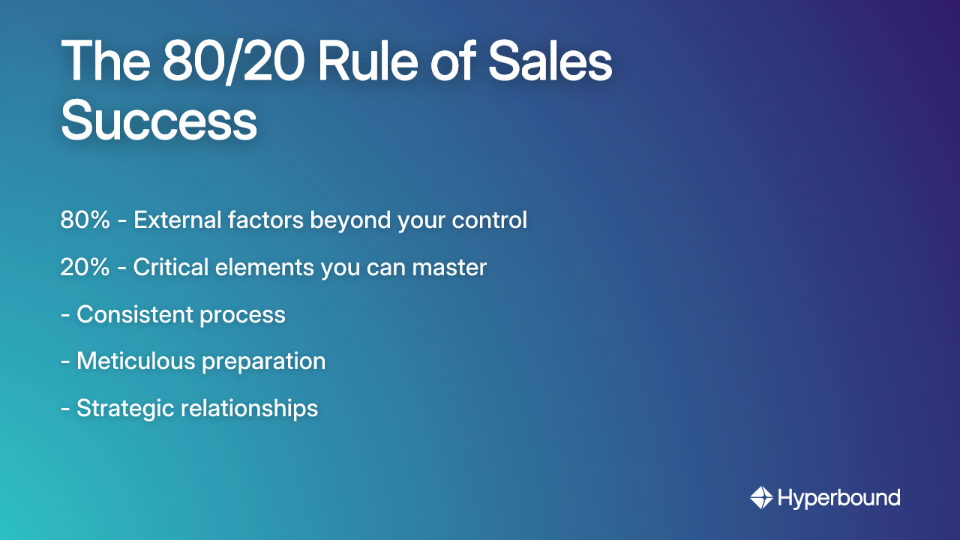
The harsh truth that most sales training glosses over is this: roughly 80% of your sales performance is impacted by factors completely beyond your control. The economy, market conditions, territory assignments, product-market fit, and even internal politics can make or break your numbers before you've made a single call.
"Every role is a gamble," as one veteran sales professional puts it. "I just wanted to show up, do what's asked and get paid, but that doesn't always correlate to success."
But here's the good news: top performers don't succeed because they have perfect conditions. They thrive because they master the 20% they can control with relentless focus and discipline.
This article will show you exactly how to maximize that critical 20% through consistent process, impeccable preparation, and strategic relationship building—so you can succeed even when the odds seem stacked against you.
Before diving into solutions, let's acknowledge the very real challenges you're facing. These aren't excuses—they're realities of the profession that every sales rep must navigate.
When interest rates are low, as one sales rep noted, "money flows like wine." But when rates rise, "the economy slows down and consumer spending dries up." This economic cycle directly impacts B2B sales as companies tighten budgets and scrutinize every purchase more carefully.
Market dynamics also play a crucial role. Perhaps you're selling in a space that's "rough because it's food service, zero margin anywhere, making it hard to win over prospects." Or maybe a dominant competitor has locked up your market, leaving scraps for everyone else. Customer expectations evolve rapidly, and what was a compelling Value Proposition last quarter might fall flat today.
One of the most frustrating aspects of sales is territory inequality. As one sales professional bluntly put it: "Did you get Manhattan or London or did you get Birmingham?" These territory assignments "can support or crush your numbers" before you've even begun.
Internal company dynamics can be equally challenging. "Companies can be slow to change," and as markets shift, they "are no longer positioned strongly." If your organization doesn't invest adequately in Customer Success, how can you expect renewal and upsell opportunities to materialize? Without proper support, your carefully nurtured relationships can wither after the initial sale.
Management decisions often feel arbitrary. Some managers "feel like their job is to anoint themselves the arbiter of who should be successful." When a manager's directive "can cost you commission and your job," the pressure becomes immense, especially if you disagree with their approach.
The sales game isn't always fair. But understanding this reality is your first step toward taking control of what you can actually influence.

Despite these challenges, elite salespeople find ways to thrive in any environment. Here are three powerful pillars to help you master the controllable 20% of your sales success:
A consistent process is your "hedge against the 80%." It creates predictability in an unpredictable world and gives you a framework for success regardless of external conditions.
According to an Aberdeen Group report, 52% of sales executives are concerned about lengthening sales cycles. Yet companies with a defined, formal sales process see an 18% higher revenue growth than those without one. In turbulent times, process becomes even more critical.
While you can't create opportunities from thin air, you can maximize every single one that comes your way through meticulous preparation and flawless execution.
In B2B sales, particularly with complex products, proper preparation can be the difference between closing a deal and watching it slip away. It's also entirely within your control.
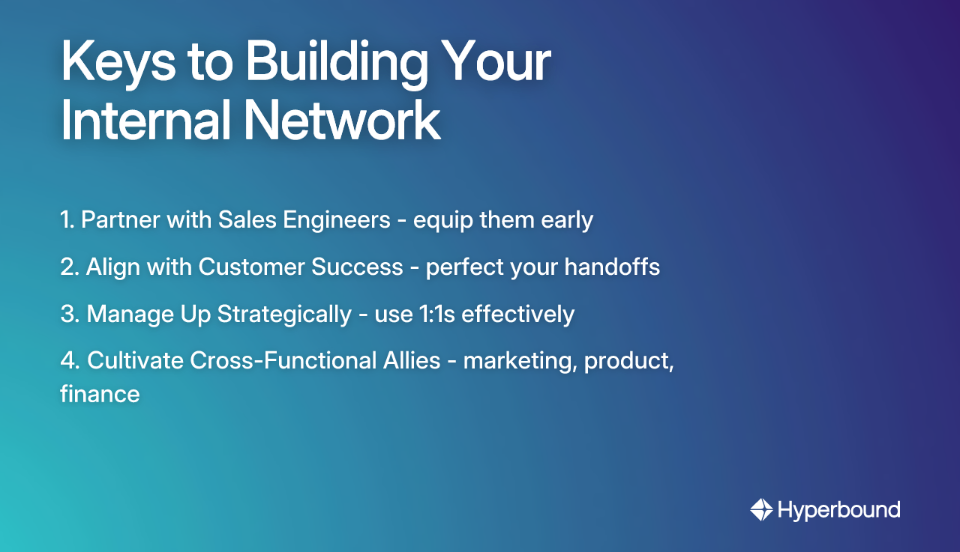
Your success doesn't depend solely on customer relationships; it's heavily influenced by your internal network as well. Strategic collaboration can expedite deals, resolve issues, and create unexpected opportunities.
In complex B2B and SaaS sales environments, no one closes deals entirely alone. You need support from product teams, sales engineers, customer success, and leadership at critical junctures in the sales cycle.
Let's be realistic: The sales environment will always be turbulent. The economy will fluctuate, markets will shift, and internal politics will exist. Some territories will outperform others, and some products will achieve better PMF than others.
But by focusing intensely on the 20% you control—your process, your preparation, and your relationships—you can build a successful sales career regardless of the headwinds.
Think of it as creating your own microclimate of excellence. While others are complaining about their territory or blaming the economy, you're methodically working your process, preparing for every interaction, and building the internal relationships that will help you succeed.
As one sales veteran wisely advised: "You can acknowledge these external factors exist without becoming a victim to circumstance."
The top performers in any sales organization aren't necessarily those with the best territories or the most favorable market conditions. They're the ones who consistently execute on the fundamentals, day in and day out.
They're the ones who recognize that while 80% may be beyond their control, mastering the critical 20% can make all the difference.
So yes, sales is partly a gamble. But by controlling what you can control, you stack the odds in your favor. That's how you thrive in sales, regardless of what's happening around you.
Because ultimately, your success isn't determined by your circumstances. It's determined by how you respond to them.

The 80/20 rule of sales success posits that approximately 80% of your performance is influenced by external factors you can't control, while the remaining 20% is determined by elements you can master. The uncontrollable 80% includes the broader economy, market conditions, your assigned territory, and product-market fit. The controllable 20% covers your personal sales process, your preparation and execution for each interaction, and the strategic internal relationships you build within your company.
Focusing on the 20% you can control is crucial because it provides a consistent framework for success and empowers you to thrive regardless of challenging external conditions. While you can't change the economy or your territory overnight, mastering your process, preparation, and relationships creates a personal "microclimate of excellence." Top performers succeed not because they have perfect conditions, but because they relentlessly execute on these fundamentals.
You can create a consistent sales process by documenting each step of your sales cycle, from prospecting to closing, and following it diligently for every opportunity. Start by defining clear stages like Qualification, Discovery, Proposal, and Presentation. Leverage your CRM to track progress through these stages, identify bottlenecks, and maintain momentum. Having a standardized approach creates predictability and helps you refine what works, even if your company doesn't enforce a formal methodology.
The most effective ways to prepare for a sales call include thoroughly researching the prospect's business, preparing targeted questions, and being ready to articulate both the Return on Investment (ROI) and the Cost of Inaction (COI). Meticulous preparation is entirely within your control. Before each interaction, study your prospect's industry trends and specific challenges. Additionally, practice your delivery and objection handling to ensure you maximize every opportunity.
Building strong internal relationships helps close deals by ensuring you have the necessary support from other departments like sales engineering, customer success, and leadership at critical moments. A good relationship with a Sales Engineer ensures they prioritize your demo. Aligning with Customer Success sets the stage for future upsells. These internal allies can expedite processes and even discreetly send referral opportunities your way.
If you have a bad sales territory, you should focus intensely on mastering the 20% of your job you can control—your process, preparation, and relationships—to outperform the territory's potential. While a poor territory is a significant headwind, consistent execution of fundamentals can make a difference. By becoming a reliable performer within your constraints and building a strong internal network, you also position yourself as a prime candidate for a better territory when one becomes available.
What will you focus on today?










Use Cases
Legal