Does your heart threaten to jump out of your chest before a cold call, even if you're great face-to-face? Do you feel like it's "bullshit that you gotta sell by yelling or by being super charismatic"? Do you struggle to "sell while happy and believe in your product," especially when you "don't believe in your implementation teams"?
If you're nodding along, you're not alone. The silent killer of sales isn't a weak pitch or even a tough market – it's your energy. That subtle, barely perceptible vibe you transmit through the phone is either building trust or destroying it before you even get to your value proposition.
Here's the truth: Your prospects can hear your mood. They can sense your belief (or lack thereof). They can feel your energy through the phone. And it's affecting your bottom line more than you realize.
The good news? Your mood is a controllable skill. In this article, I'll share three practical "mood fixes" that will transform your sales energy and, as a result, your closing rates.
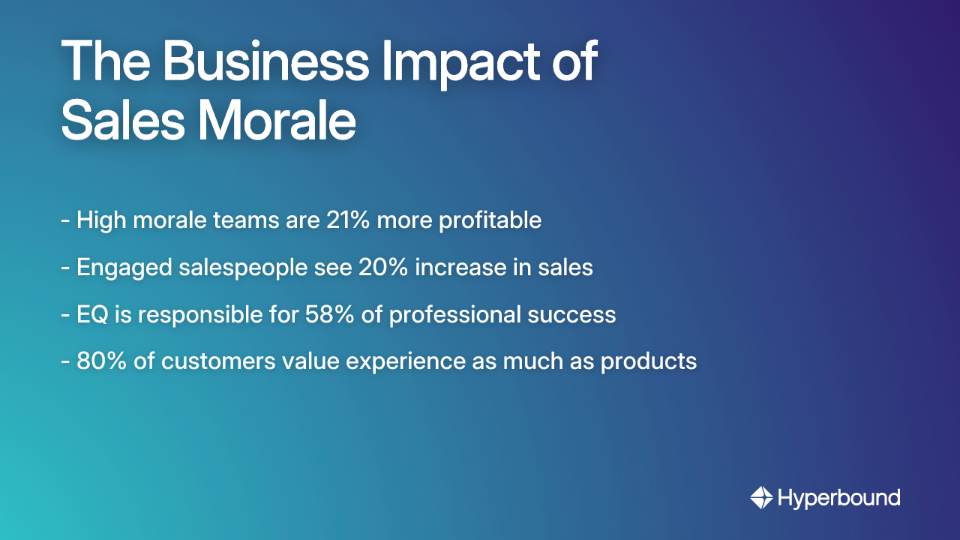
If you think mood management is just fluffy self-help advice, think again. It's a business metric with direct impact on your commission check:
This isn't just about you feeling better – it's about your customers perceiving more value. Salesforce reports that 80% of customers say the experience a company provides is as important as its products and services. Your mood directly shapes that experience.
What's killing your mood? The constant rejection, the pressure to perform, and burnout – with 67% of salespeople reporting they feel close to burnout, according to HubSpot. The question is: how do you fix it?
Ever notice how some salespeople sound like they just won the lottery? That's not an accident – it's strategy.
When you're on the phone, a staggering 84% of your message is communicated through your tone of voice alone, according to sales experts cited by Justin Calvert on LinkedIn. Without visual cues, your voice becomes your primary tool for building trust and rapport.
This isn't just theory. Research from the University of Portsmouth by Dr. Amy Drahota proved that listeners can accurately tell if a speaker is smiling just from the sound of their voice. A smiling voice is perceived as more trustworthy and engaging, as reported by ScienceDaily.
Think about it: When was the last time you bought something from someone who sounded bored, uncertain, or distracted? Would you trust your business needs to someone who couldn't even muster enthusiasm for their own product?
C-level executives particularly prefer salespeople who display charisma and energy. As noted by C-Level Partners, a smiling, energetic tone breaks the monotony of their day and makes you more human and relatable.
You cannot authentically project confidence in a product you don't believe in. As one sales pro put it, "If you don't truly believe in what you are selling, nobody will buy it."
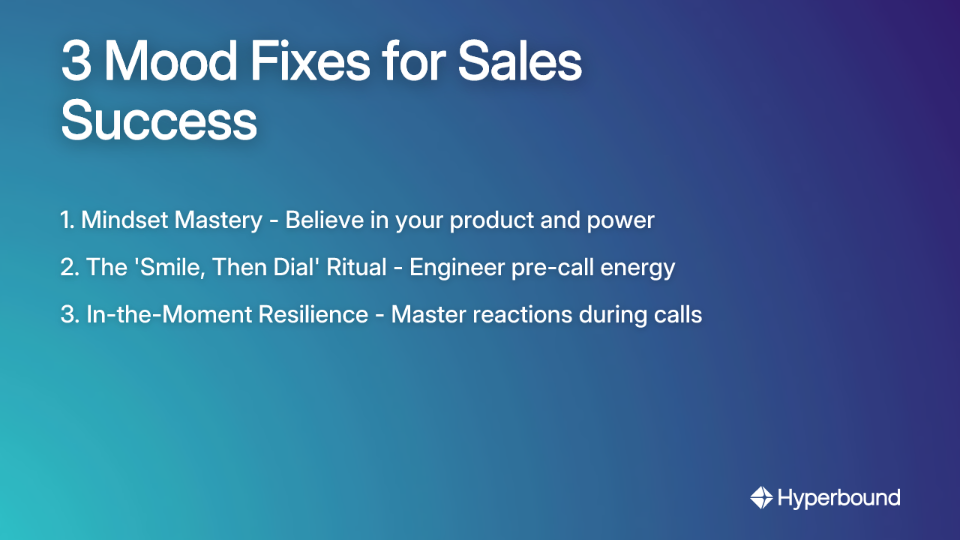
Here's how to master your mindset:
Your mood is a choice. You can architect your environment and routine to consciously elevate your energy before engaging with a prospect.
Rejection and slow days are inevitable. The key is to develop resilience and have tools to manage your energy during the workday and within a conversation.
Your mood isn't fluff; it's a foundational element of your sales toolkit. Your energy is contagious, and prospects are either catching positivity or apathy from you.
Remember the three fixes:

The next time you pick up the phone, ask yourself: "Do I sound like I just won a million dollars?" If not, implement these fixes before you make another call. Your pipeline—and your commission check—will thank you.
Believe in your product. Believe in your power. And most importantly, let that belief shine through in every word you speak.
Sales energy is crucial because it's transmitted through your tone of voice, which accounts for 84% of your message over the phone and directly impacts how prospects perceive your trustworthiness and enthusiasm. Without visual cues, a positive and energetic tone builds rapport and makes you more relatable, while a negative or low-energy vibe can destroy trust before you even state your value proposition. Data shows high-morale sales teams are significantly more profitable and productive.
You can sound more confident by adopting a "CEO mindset" to feel like a peer offering value, and by physically smiling before and during the call to improve your vocal tonality. Simple pre-call rituals are very effective. Create a "hype" playlist to boost your energy, practice good posture, and visualize a successful call. Practicing your script with AI roleplay tools can also provide feedback on your tone and help you build muscle memory for confident delivery.
Actively seek out reasons to believe in your product by focusing on the core problem it solves and gathering success stories from satisfied customers. Even if aspects like implementation aren't perfect, find the genuine value your product offers. Create a "self-promotion folder" with client praise and personal wins to remind yourself of your capabilities and the positive impact you can have. This builds authentic confidence that prospects can hear.
Two of the most effective pre-call rituals are to physically smile for a moment before dialing and to listen to a "hype" song that energizes you. These simple actions can quickly shift your emotional state. You can also place a sticky note on your monitor that says "SMILE" as a visual reminder, and take 60 seconds to visualize the call going perfectly. The goal is to consciously engineer your energy before engaging a prospect.
Handle rejection by reframing the call as a data-gathering opportunity instead of a personal failure, and by using the mute button to pause and collect your thoughts during tough conversations. After a difficult call, step away from your desk for a short break or walk to reset your mood. Analyze what happened: what objections were raised? Where did the conversation stall? Use this information to improve your next attempt. This turns a negative emotional event into a productive learning experience.
Yes, modern AI tools can significantly help by providing a safe space to practice and offering objective feedback on your performance. Platforms like Hyperbound offer AI Sales Roleplays where you can practice against different buyer personas and get instant feedback on your tone, pacing, and word choice. AI Real Call Scoring can also analyze your actual conversations to pinpoint where you can improve your objection handling and overall energy, turning every call into a coaching moment.










Use Cases
Legal